Flint and Tinder Waxed Trucker Jacket Review: Is It Worth It?
As an Amazon Associate I earn from qualifying purchases. This post contains affiliate links, which means I may earn a commission if you buy through them, at no extra cost to you.
The quick version: The Flint and Tinder Flannel-Lined Waxed Trucker Jacket is worth it if you want a weather-resistant jacket whose shell is 100 percent cotton, weatherproofed with wax instead of a synthetic membrane or a fluorinated water-repellent finish, and built to be re-waxed and worn for years instead of replaced. It is not plastic-free, and we will not pretend otherwise: the striped blanket lining is polyester, per the Gear Patrol review of this jacket. Read that trade-off below before you decide. It was the highest-ticket pick in our lower-plastic clothing swaps guide, which is exactly why it gets its own deep dive.
One rating note, because this site would rather be straight with you: we could not capture a clean star figure from this jacket’s Amazon listing, so we do not quote one. What we can tell you is that Men’s Journal reported in November 2025 that the jacket had earned well over 3,000 five-star ratings at Huckberry, and Dappered calls it the most popular thing Huckberry carries.
Why Does the Flint and Tinder Waxed Trucker Jacket Deserve a Deep Dive?
Most weather-resistant jackets get their water repellency from chemistry you cannot see: a synthetic shell fabric, often a membrane, and a durable water repellent (DWR) finish on the outside. Alpkit’s PFAS-free outdoor gear explainer (checked October 2026) puts the traditional version plainly: DWR treatments on waterproof clothing historically used fluorinated chemicals from the PFAS family, and the non-fluorinated alternatives include silicone, wax, and plant-based chemistry. Wax is the oldest option on that list, and it is the one this jacket is built around.
The Flint and Tinder waxed trucker jacket is interesting because it swaps the whole modern stack for a pre-synthetic one: cotton canvas, wax worked into the fibers, and a jacket you maintain instead of replace. It is also a genuinely expensive piece of clothing, and expensive clothing deserves a closer look before anyone clicks buy. This review walks through what the jacket is actually made of, including the part that is still plastic, how the wax works, how it fits, what the care routine really asks of you, and who should buy it versus who should start with the smaller swaps further down.
What Is the Flint and Tinder Waxed Trucker Jacket Made Of?
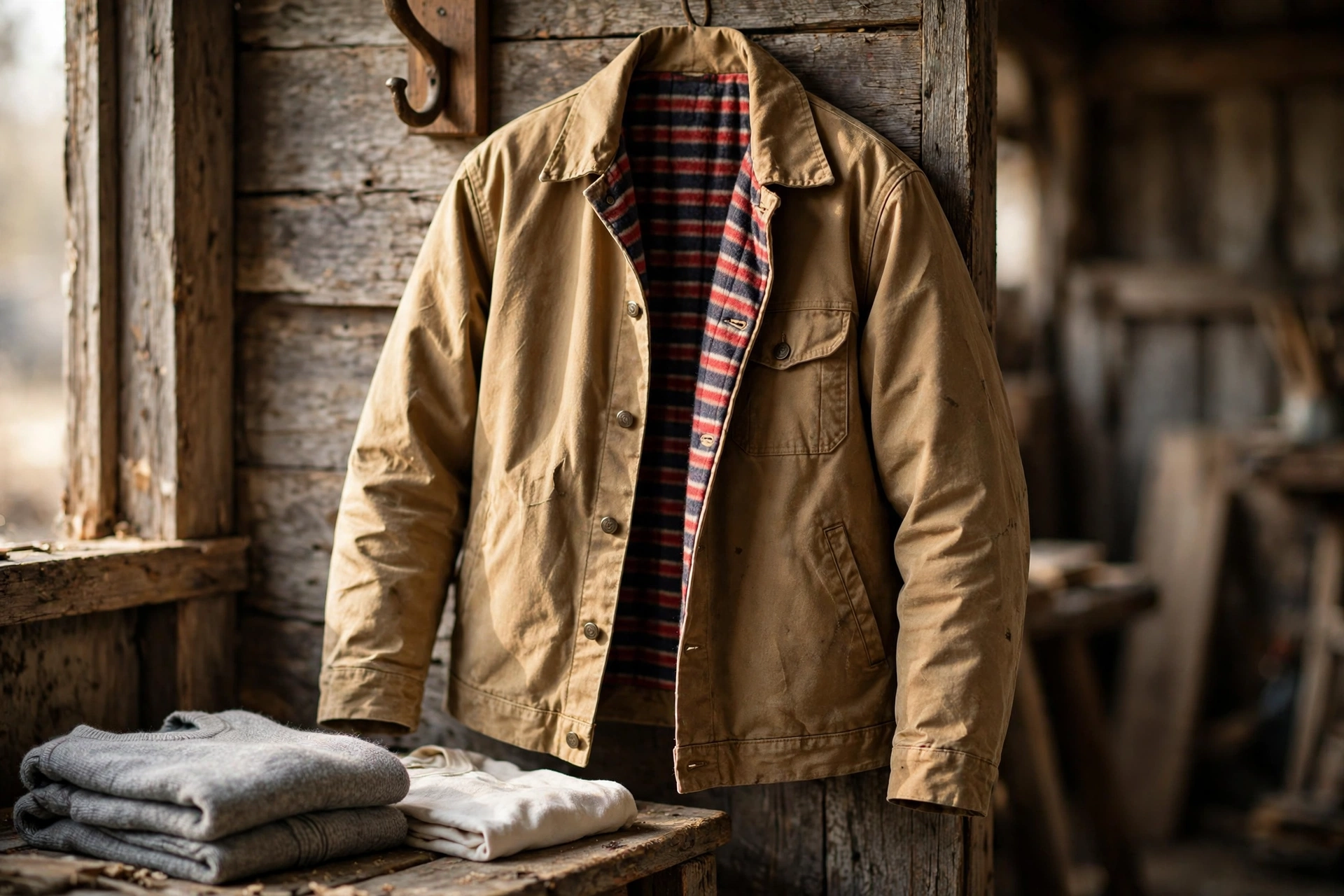
The shell is 100 percent cotton: a 7 ounce Martexin waxed sailcloth, woven in New Jersey, with wax applied to both sides of the fabric. That is the direct answer, and it is the whole reason this jacket belongs on this site.
Per the Amazon listing (checked October 2026), the fabric type is listed as “100% cotton from New Jersey,” the jacket is cut, sewn, and finished in Los Angeles, California, and the origin is Made in the USA. The sailcloth comes from Fairfield Textile in Bridgeton, New Jersey, a mill Stridewise’s comparison of Huckberry’s waxed jackets notes has made the fabric behind this jacket, and the wax is Martexin Original Wax, the long-running American waxed-cotton finish. Because the weatherproofing is wax impregnated into cotton rather than a coating sprayed onto a synthetic, the surface can be renewed: the listing calls the exterior re-waxable for a lifetime of water resistance.
Now the part a lot of reviews skip. The body and sleeves are fully lined with a soft, striped blanket flannel, and both Gear Patrol’s review and Stridewise’s comparison describe that lining as polyester. So the honest summary is this: the weather-facing half of the jacket, the half that replaces a synthetic shell and a fluorinated finish, is cotton and wax. The comfort layer against your body is a synthetic blanket lining. If your goal is a jacket with zero plastic anywhere in it, this is not that jacket. If your goal is to get out of a fully synthetic rain shell and into something repairable that will age for a decade, the trade may be worth it.
How Does Waxed Cotton Handle Weather, Honestly?
It sheds light to moderate rain and blocks wind well, and it is water-resistant rather than waterproof. That distinction matters, and it is the one most likely to disappoint a buyer who expects rain-jacket performance.
Gear Patrol’s review found the 7 ounce weight hits a useful middle: light enough to wear from early fall, warm enough with the lining in cool, wet weather roughly in the 36 to 60 degree Fahrenheit range they describe, and not the jacket for the dead of winter without another layer under it. Stridewise notes the dual-side wax application gives the fabric its rain and wind protection, and that high-wear areas lighten as wax rubs away. That lightening is the famous patina: like leather or raw denim, the jacket records where it has been folded, carried, and rained on.
The patina is also a maintenance gauge. When an area goes pale and dry, that is where the wax has worn, and that is where a re-wax goes. No membrane delaminates and no coating quietly fails across the whole garment at once. The failure mode is visible and fixable at home, which is a big part of why waxed cotton fans keep the same jacket for years.
How Does the Flint and Tinder Waxed Trucker Jacket Fit?
It has a traditional trucker fit that hits right at the hip, and the brand’s own guidance on the Amazon listing is to size up if you normally wear an XL or XXL: their 3XL fits more like a traditional XXL.
Sizes run XS to 3XL, with a Tall fit also offered, and Stridewise lists eight colors: Black, Coal, Navy, Field Tan, Forest, Havana, Light Gray, and Moss. Gear Patrol’s fit notes describe high armholes and a trim cut that molds to the wearer over time. Two details worth knowing before you order: there is no stretch anywhere in this jacket, because waxed cotton does not work that way, and the sleeves can feel long at first and effectively shorten as the fabric creases at the elbow with wear, an effect InsideHook’s reviewer also describes after years of owning one.
What Are the Honest Trade-Offs?
Price is the first one. This is the priciest clothing pick we have covered, a flagship product that Dappered notes is hardly ever on sale. You are paying for American-made fabric, Los Angeles sewing, and a jacket designed to be maintained rather than replaced, which are real costs. They are still costs.
Care is the second, and it is the trade most buyers underestimate. The Amazon listing is blunt: spot clean only, hand wash only, do not dry clean or machine wash, and re-wax sparingly. A waxed jacket never goes in the laundry pile with everything else. For most owners that is a feature, because the jacket rarely needs washing at all, but if your life involves toddlers, dogs, and mud on a daily basis, know what you are signing up for.
The third is the lining, covered above: polyester blanket flannel, chosen because it makes the jacket soft and wearable from day one instead of clammy against the skin. It is a sensible design choice and a real compromise for a lower-plastic wardrobe at the same time. The fourth is weather ceiling: this is a three-season, water-resistant jacket, not a downpour shell and not a deep-winter coat, per Gear Patrol’s testing notes. Readers in genuinely cold climates will layer it or reach past it in January, and our merino base layers guide is the layering companion if you go that route.
How Does It Compare With the Other Picks in Our Clothing Guide?
The jacket was the anchor of our clothing swaps roundup, and the picks around it are the natural supporting cast: natural-fiber basics to wear under it, and the wax bar that keeps it working. Here is the honest side-by-side.
| Product | Material | Best for | Honest trade-off |
|---|---|---|---|
| Flint and Tinder Flannel-Lined Waxed Trucker Jacket | 100% cotton waxed sailcloth shell, polyester blanket lining | A repairable, re-waxable outer layer instead of a synthetic shell | Premium price, spot clean only, lining is synthetic |
| Fair Indigo Organic Pima Cotton Tee | 100% organic Pima cotton | The natural-fiber layer under the jacket, made in Peru in a Fair Trade factory | A basic tee at a not-basic price |
| Darn Tough Hiker Micro Crew Socks | 61% merino wool, 36% nylon, 3% Lycra spandex | Wool-majority socks with an unconditional lifetime guarantee, made in Vermont | The nylon is the durability trade-off, stated plainly |
| Otter Wax Fabric Wax Bar | All-natural fabric wax, no petroleum or silicone per the brand | Re-proofing the jacket at home when pale, dry patches appear | A hands-on chore, with a 48 to 72 hour cure before wearing |
If the table makes the decision for you, good. The jacket is the system; the three picks below are how you wear it and keep it working.
What Should You Buy Alongside It, or Instead?
Start with the layer under the jacket and the tool that maintains it. These are the three supporting picks from our clothing guide and care research that readers ask about most next to this jacket.
Fair Indigo Organic Pima Cotton Tee
The Fair Indigo organic Pima cotton tee is the simplest swap on this page: 100 percent organic Pima cotton, made in Peru, from a brand built around Fair Trade factory sewing and OEKO-TEX tested dyes. Pima is a long-staple cotton, so the tee is softer and holds up better in the wash than a standard cotton tee, and it is the layer that actually sits against your skin under the jacket’s synthetic lining. Our organic cotton underwear guide covers the same fiber logic for the rest of the drawer.
Darn Tough Hiker Micro Crew Socks
The Darn Tough Hiker Micro Crew socks are the buy-it-for-life pick at sock scale: 61 percent merino wool, knitted in Vermont, and covered by the brand’s unconditional lifetime guarantee, which CNN Underscored’s review of the line describes as a replace-them-no-questions-asked promise. Be clear on the blend, because we were in our clothing guide too: 36 percent nylon and 3 percent Lycra spandex is what makes a wool sock this durable, so this is a wool-majority pick, not a plastic-free one. Readers who want the fiber story in full should also see our fleece alternatives guide, which covers where wool earns its place and where it does not.
Otter Wax Fabric Wax Bar
The Otter Wax Fabric Wax Bar is the maintenance half of owning a waxed jacket. Per the Amazon listing, the routine is simple: start with a clean, dry surface, rub the bar back and forth to spread the wax, smooth it into the canvas, then let the jacket cure in a warm, low-humidity spot for about 48 to 72 hours before wearing. Otter Wax is a small family business in Portland, Oregon, and its fabric waxes are made without petroleum distillates, chemicals, or preservatives, per the brand’s listing copy.
Frequently Asked Questions
Is the Flint and Tinder waxed trucker jacket waterproof?
No. It is water-resistant, not waterproof, per the Amazon listing and Gear Patrol’s review. The waxed cotton shell sheds light to moderate rain and blocks wind; a sustained downpour will eventually get through, as it does with any waxed cotton jacket.
Is the Flint and Tinder waxed trucker jacket plastic-free?
No. The shell is 100 percent cotton waxed sailcloth, but the striped blanket lining is polyester, per Gear Patrol and Stridewise. The jacket is a lower-plastic choice than a synthetic shell with a fluorinated finish, and this review does not claim more than that.
Does waxed cotton use PFAS?
The weatherproofing here is wax worked into cotton, not a fluorinated DWR finish. Alpkit’s PFAS-free outdoor gear explainer (checked October 2026) lists wax among the non-fluorinated alternatives to traditional PFAS-based DWR treatments. That is a statement about the finish type; only the brand can certify a specific garment’s full supply chain.
How do you re-wax a waxed trucker jacket?
Clean and dry the jacket, rub a fabric wax bar like the Otter Wax bar above over the pale, worn areas, smooth the wax into the canvas, and let it cure for about 48 to 72 hours, per the Otter Wax listing instructions. The Flint and Tinder listing advises re-waxing sparingly, only where the finish has worn.
Does the Flint and Tinder waxed trucker jacket run small?
The brand’s guidance on the Amazon listing is to size up if you normally wear an XL or XXL, and that its 3XL fits like a traditional XXL. The cut is a trim, traditional trucker fit that hits at the hip, in sizes XS to 3XL plus a Tall fit.
Where is the Flint and Tinder waxed trucker jacket made?
In the USA, per the Amazon listing: the Martexin waxed sailcloth is woven by Fairfield Textile in Bridgeton, New Jersey, and the jacket is cut, sewn, and finished in Los Angeles, California.
The Bottom Line on the Flint and Tinder Waxed Trucker Jacket
If you want one outer layer that trades the synthetic shell and fluorinated finish for waxed cotton you can maintain at home for a decade, and you have read the lining trade-off above with your eyes open, the Flint and Tinder Flannel-Lined Waxed Trucker Jacket is the strongest version of that idea we have found, and the reason it anchored our clothing guide. If the price, the spot-clean-only care, or the polyester lining gives you pause, that pause is information: start with the Fair Indigo tee and the Darn Tough socks, build the natural-fiber base first, and come back for the jacket when a buy-once outer layer is actually what you need. External reading: Gear Patrol’s Flint and Tinder waxed trucker jacket review is the most detailed independent take on fit and warmth we found.
Get the Weekly Swaps
One short email a week: the newest microplastics studies in plain English, plus the swaps that are actually worth your money. Join free and we will send you our room-by-room microplastic checklist to get you started.
Get Our Free Room-by-Room Microplastic ChecklistJoin the newsletter and get the checklist free →
Browse Our Full Amazon StorefrontAll our lower-plastic clothing picks in one place →
Join Our Free Facebook GroupNon-Toxic Family Living: parents sharing swaps that work →
Add Us as a Preferred Source on GoogleOne tap, and our guides show up first in your Google results →