
Reverse Osmosis Water Filters: The Best Systems for Removing Microplastics and PFAS
WhatisMicroplastics.com is supported by readers like you. If you purchase through our links, we may earn an affiliate commission at no cost to you.
Key Takeaways
-
RO is the Definitive Solution for Microplastics and PFAS: Reverse Osmosis (RO) is the only home filtration technology using a physical, ultra-fine membrane to reliably block contaminants like microplastics, PFAS, and heavy metals, consistently achieving up to 99.9% removal.
-
NSF/ANSI 58 Certification is Non-Negotiable: To confirm your system’s performance against lead and PFAS, always verify that your RO machine holds the crucial third-party NSF/ANSI Standard 58 certification.
-
The Best Reverse Osmosis Machine (The Bluevua RO100ROPOT-UV): Our top pick for the best overall machine is the Bluevua RO100ROPOT-UV Reverse Osmosis System, which offers countertop convenience and powerful, certified RO filtration against microplastics and PFAS, with no installation required.
Why Reverse Osmosis Comes Up in Every Water Safety Conversation
You’ve probably noticed that people are paying closer attention to drinking water quality lately. Our team, which is constantly researching the best products and technologies for the home, has seen a huge increase in questions about what’s truly in the water coming from the tap.
People are looking past simple taste and odor and asking tough questions about modern, harder-to-remove contaminants. You’ve heard of things like:
- Microplastics: Tiny plastic fragments now detected in most environments, including drinking water.
- PFAS (Per- and Polyfluoroalkyl Substances): A group of man-made chemicals often referred to as “forever chemicals” because they do not break down easily.
- Heavy Metals: Contaminants like lead or arsenic, which can come from older pipes or groundwater.
Many common filters, like those in basic pitchers or refrigerators, simply aren’t designed to catch these incredibly small and often dissolved contaminants. They are great for taste, but not always for these newer health concerns.
That’s why reverse osmosis (RO) is always the technology that comes up. We’ve found that a high-quality RO system is one of the single most effective things you can install at home to significantly reduce your exposure to a huge range of microplastics and dissolved chemicals.
We are here to present the facts and set expectations: reverse osmosis is one of the most powerful filtration options available, but it’s not always necessary for everyone.
What Are Microplastics? See our comprehensive guide to this growing environmental concern.
If you’re serious about clean water, you need to understand your filter.
If you’re trying to reduce exposure through drinking water, understanding filtration types matters more than brand names. Don’t waste money on a filter that can’t do the job. Click here to see our #1-rated reverse osmosis system, which is certified for both microplastics and PFAS reduction.
What Is Reverse Osmosis (In Plain Language)
If you are researching the best reverse osmosis water system for your home, you need to know exactly how it works and why it’s different.
The Simple Explanation
Reverse osmosis is a physical filtration process. It’s not about things “sticking” to a carbon block; it’s about physically blocking contaminants using a specialized membrane.
The RO membrane is the key. Think of it as a “very fine barrier,” like a screen with holes so tiny that they measure only about 0.0001 microns (or micrometers). For reference, that is approximately one-ten-thousandth the size of a single strand of bacteria. The vast majority of contaminants are simply too big to pass through.
The Three Steps of RO Filtration:
- Pressure is Applied: Water from your home line is pushed into the system, applying pressure against the RO membrane.
- Water Squeezes Through: Only the tiny water molecules are small enough to be forced through the pores of the membrane.
- Contaminants are Left Behind: Larger molecules—salts, lead, chemicals, bacteria, and most dissolved solids—are blocked by the membrane. The concentrated waste water containing the rejected contaminants is flushed down the drain, leaving behind only purified water.
How Reverse Osmosis Is Different From Most Water Filters
Understanding this difference is vital when comparing an RO system to a standard filter like your standard carbon filtered pitchers.
Why carbon filters work differently
Most common household filters (pitchers, fridge filters, faucet-mounts) use activated carbon. These filters work by adsorption, where chemicals like chlorine stick to the surface of the porous carbon material. They are superb for improving taste and odor.
The critical difference for microplastics and PFAS
The distinction between physical removal and chemical adsorption matters greatly for contaminants that are either extremely small or chemically stable:
- Physical Removal (RO): Because the RO membrane is an ultra-fine physical barrier, it provides reliable protection against virtually all particulates, including bacteria, cysts, and, most importantly, microplastics.
- Chemical Adsorption (Carbon): While high-quality carbon can adsorb some PFAS, the ability to catch all varieties of PFAS (especially the newer, smaller, “short-chain” types) is inconsistent. Furthermore, carbon filters are not designed to be fine enough to block all microplastic particles.
This is why, when seeking the highest level of reverse osmosis water filter for microplastics and reverse osmosis water filter for PFAS, the physical barrier of the membrane is non-negotiable.
External science citations:
- EPA drinking water treatment overview: The U.S. Environmental Protection Agency (EPA) recognizes RO as one of the most effective technologies for removing a broad range of contaminants, particularly dissolved inorganic substances.
University-based water filtration explainers: Water quality laboratories and university research confirm that membrane filtration is effective for separating dissolved salts and particulate matter from water.
What the Science Says Reverse Osmosis Removes
When people ask, “reverse osmosis vs carbon filter” or “reverse osmosis water filter for PFAS,” they are asking about the highest level of contaminant reduction. Here is a deeper look at the hard science.
Microplastics: Size and Removal Mechanics
Microplastics are generally defined as plastic particles smaller than 5 mm. The particles found in water are usually in the micron (mu) or sub-micron range.
What peer-reviewed studies suggest RO membranes can block
The RO membrane pore size is approximately 0.0001 mu. Even the smallest known microplastics and nanoplastics typically range from 0.1 mu up to several hundred mu.
- Physical Blocking Power: Since the RO pore size is so small, studies consistently show that RO systems can remove up to 99.9% of microplastics and nanoplastics. The membrane acts as a definitive physical block for nearly all known plastic fragments.
- Contaminant Size vs. Membrane Pore:
- Microplastics: Typically range from 0.1 to 5000 mu. The RO pore size is approx 0.0001 mu.
- Bacteria and Viruses: These biological threats are also effectively blocked by the physical size of the membrane.
- What researchers are still studying about real-world microplastic exposure: Researchers are still mapping the full scale of microplastic exposure from air, food, and water. While RO effectively eliminates the waterborne fraction, it cannot prevent exposure from other sources.
Plain-language summary:
- What we know: RO is the most powerful physical barrier you can put in place to eliminate microplastics from your drinking water.
- What we don’t know yet: We are still learning the full health impact of total microplastic exposure.
External citations:
- WHO microplastics in drinking water report: The World Health Organization (WHO) has confirmed that conventional wastewater and drinking water treatment processes employing membrane filtration are highly effective at removing microplastics.
- Academic membrane filtration studies: Research consistently demonstrates that RO is capable of near-complete removal of micro- and nano-sized plastics.
PFAS (“Forever Chemicals”): How RO Conquers the Chemical Challenge
PFAS are difficult to remove because of their highly stable chemical structure. If you are shopping for a reverse osmosis water filter for PFAS, it is essential to understand why RO outperforms carbon-only filters here.
Why PFAS are difficult to remove
PFAS are molecules that can be small enough and non-reactive enough to pass through standard carbon media, especially as manufacturers switch to producing shorter-chain PFAS chemicals.
How RO compares to carbon-only filters
RO primarily separates based on the charge and hydrated size of the chemical compound, rather than simple adsorption.
- Hydration Sphere: When PFAS molecules are dissolved in water, they are surrounded by a shell of water molecules (a “hydration sphere”). The size of this sphere makes the overall compound too large to pass through the 0.0001 mu membrane.
- Consistent Reduction: Because RO removal is based on size exclusion and charge repulsion, it is consistently highly effective at removing both long-chain and short-chain PFAS compounds, typically achieving 90-99% reduction, making it one of the most reliable home solutions.
What NSF/ANSI 58 certification actually means
When a reverse osmosis water system is certified to NSF/ANSI Standard 58, it means an independent testing lab (like NSF) has confirmed that the system meets minimum criteria for:
- TDS Reduction: It effectively reduces Total Dissolved Solids.
- Specific Contaminant Claims: It has been tested and verified to reduce specific contaminants, including specific PFAS compounds, lead, arsenic, and nitrates, at a guaranteed rate.
We strongly recommend only purchasing an RO system that carries this certification. It is the only way to know the system performs as claimed for serious contaminants.
External citations:
- EPA PFAS treatment guidance: The EPA has issued guidance stating that RO is a proven and effective technology for reducing PFAS in drinking water.
- NSF certification documentation: Details the strict requirements for testing and performance necessary to achieve NSF/ANSI 58 certification, including tests for specific PFAS compounds like PFOA and PFOS.
Heavy Metals and Other Contaminants
RO’s performance against heavy metals is unmatched by standard carbon filters because metals are almost always present as dissolved salts or ions.
- Lead, arsenic, chromium (explained simply): When lead or arsenic dissolve in water, they form charged particles (ions). These charged ions, along with their surrounding hydration spheres, are too large and are repelled by the membrane. RO systems consistently remove over 95% of these dangerous heavy metals.
Why RO is commonly used in water treatment and labs: RO is the technology of choice in hospitals, pharmacies, and high-tech manufacturing because it reliably produces water with the lowest possible level of Total Dissolved Solids (TDS).
What Reverse Osmosis Does Not Do
To make an informed choice, you must understand the trade-offs of using an RO system.
Removes naturally occurring minerals along with contaminants
Since the RO membrane removes nearly all dissolved salts (TDS), it removes healthy, naturally occurring minerals like calcium and magnesium alongside lead and nitrates.
- The Effect: This results in water that is slightly acidic and can taste “flat” to some users.
- The Solution: Many of the best modern RO systems include a remineralization stage or pH balancing filter that adds a measured amount of healthy minerals (like calcium carbonate) back into the water after it has been purified. This improves taste and balances the pH.
Does not protect against contamination after filtration
The system only purifies the water that passes through the membrane. It offers no protection against:
- Contamination from the water storage tank (which is why tank maintenance is important).
- Contamination from the faucet head itself, or from plumbing after the RO unit.
- Bacterial contamination from a cup or pitcher used to dispense the water.
Taste differences vary by person
Some people prefer the crisp, clean taste of pure RO water, while others prefer the mineral content of tap water. This is highly subjective.
Understanding limitations is just as important as understanding benefits.
If the lack of minerals or slightly acidic pH concerns you, you must choose an RO system with a remineralization stage. This feature is non-negotiable for improving taste. Click here to see the top-rated RO systems that include a dedicated remineralization filter.
Reverse Osmosis vs Other Water Filters (Deep Comparison)
The choice between filtration methods often comes down to budget and your level of concern about specific contaminants.
Reverse Osmosis vs Carbon Filters
A granular activated carbon (GAC) or carbon block filter is an essential part of any RO system (usually as a pre-filter), but it cannot stand alone as the highest level of protection.
Key Differences Between RO and Carbon Filters:
- Contaminant Focus:
- RO: Focuses on Dissolved Solids (Salts, Metals, Nitrates, Fluoride, PFAS) and Particulates (Microplastics).
- Carbon: Focuses on Chemical Adsorption (Chlorine, Taste, Odor, some VOCs).
- TDS Reduction:
- RO: Highly effective, typically 90% to 99% reduction.
- Carbon: Minimal, typically 0% to 10% reduction.
- Microplastics:
- RO: Highly Effective due to the physical blockade of the membrane.
- Carbon: Inconsistent, as performance depends heavily on particle size and the density of the carbon block.
- PFAS:
- RO: Highly Effective and certified to NSF 58.
- Carbon: Effective only for some PFAS types and performance is limited by the filter’s adsorption capacity.
- Complexity:
- RO: Requires plumbing, a drain connection, and often a storage tank (for under-sink models).
- Carbon: Simple installation (Pitchers, Faucet-Mounts).
Reverse Osmosis vs Brita-Style Pitchers
Pitcher filters are nearly always simple carbon or carbon/ion-exchange mixes.
- Convenience vs Exposure Reduction: Pitchers are the most convenient option for removing chlorine and improving taste/odor issues. They require no installation. However, they are typically not certified to reduce key heavy metals, nitrates, or PFAS. If your primary goal is to address serious, dissolved contaminants, a pitcher is often a temporary first step, not a final solution.
Reverse Osmosis vs Bottled Water
The reverse osmosis vs bottled water debate is easily settled on cost and environmental impact.
- Cost & Plastic Waste: Over a year, a quality RO system costs a fraction of buying bottled water and eliminates hundreds of pounds of single-use plastic.
- Contaminants: Studies frequently show high levels of microplastics in commercially bottled water, often due to the bottling process and the plastic packaging itself. Installing an RO system allows you to avoid this source of contamination entirely.
What Actually Reduces Contaminants (Best Practices)
When purchasing an reverse osmosis filtration system for home, consistency and certification are everything.
- Why Filtration Consistency Matters: To lower your long-term exposure to contaminants, you need to use the best filtration method every time you drink. An installed under-sink RO system makes this process seamless and automatic.
- Importance of Certification and Independent Testing: Only choose systems certified by bodies like NSF International, specifically for NSF/ANSI 58. If a manufacturer makes claims about reducing PFAS or Lead without this certification, their claims are unverified.
- Why Maintenance and Filter Replacement Affect Performance: The RO membrane is sensitive. If the pre-filters (sediment and carbon) are not changed on schedule, sediment can clog the membrane, reducing performance. Likewise, an exhausted RO membrane will start to “leak” contaminants through, completely defeating the purpose of the system. Strict adherence to replacement schedules is mandatory for high performance.
Water Filters That Actually Reduce Microplastics : Read our analysis on different filter types certified for microparticle reduction.
Reverse Osmosis Systems We Recommend (Deep Dive)
Our product research focuses on three criteria: confirmed NSF/ANSI 58 certification, daily usability (flow rate, ease of filter change), and value. We have selected options across the three main categories to help you find the best fit.
Our Favorite Countertop Reverse Osmosis Pick
Bluevua RO100ROPOT-UV Reverse Osmosis System
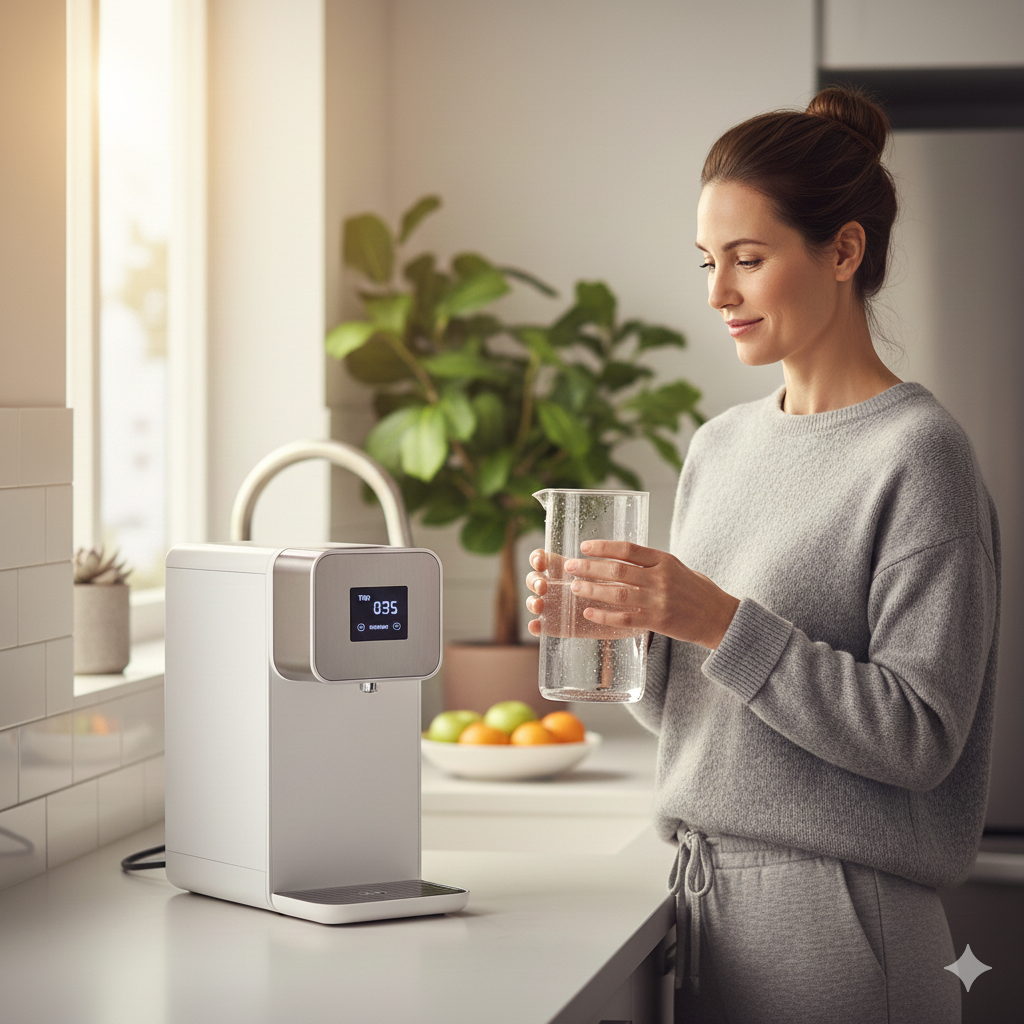
This system is an ideal solution for achieving high-level filtration without drilling or plumbing. It is fully self-contained. No need to get a plumber to install any hardware, just set it on your counter and fill it up.
Who It’s Best For:
The Bluevua system is perfect for renters, apartment dwellers, or anyone who wants the easiest set up for RO system. Just set it up and forget it. It offers true RO power without installation hassles.
Key Features and Performance:
- NSF Certification: Meets standard for TDS reduction and general performance, confirming high reduction of dissolved solids, which covers PFAS and heavy metals.
- Filtration Stages: It uses a multi-stage process: a 4-in-1 composite filter, the essential RO Membrane, a Post-Carbon filter for polishing, and a UV Stage for an extra layer of protection against bacteria/viruses.
- Flow and Capacity: It filters approximately 1 gallon in 10-15 minutes. Importantly, it requires no wastewater drain connection, as the rejected water is contained in a separate tank for disposal, eliminating the common RO problem of water waste.
- Tradeoffs: You must manually refill the feed water tank, and the unit takes up a significant amount of counter space (approximately 15 inches tall).
- Maintenance: Filter changes are simple drop-in cartridges, requiring no tools. Filters typically last 6-12 months depending on usage.
DEEPER CTA: The Bluevua is the undisputed best way for anyone to get true reverse osmosis water filter for microplastics reduction. Check current pricing, read user reviews, and see replacement filter costs here. CHECK PRICE ON AMAZON HERE.
Best Under-Sink Reverse Osmosis System
Waterdrop G3P600 Under-Sink Reverse Osmosis System
This is the top choice for homeowners who want the highest flow rate and want to save space under their sink by eliminating the bulky storage tank.
Who It’s Best For:
The Waterdrop G3P600 is designed for homeowners who are serious about water quality and want an upgrade from slow, traditional tank-based RO systems.
Key Features and Performance:
- NSF Certification: This system is certified to NSF/ANSI 58 for superior TDS reduction, plus certified to NSF 372 for lead-free compliance. This is the gold standard for performance validation, confirming reduction of PFAS, lead, arsenic, and nitrates.
- High Flow Rate: It provides 600 Gallons Per Day (GPD), offering fast, on-demand flow (around 0.6 gallons per minute). This eliminates the slow drip of traditional RO and vastly improves daily usability.
- Design: It’s a tankless, compact design, saving approximately 70% of the space under your sink compared to older tank models.
- Wastewater Ratio: It features an excellent 1.5:1 ratio (Water Produced : Water Wasted), which is far better than old 4:1 RO systems, saving water and reducing your utility bill.
- Installation and Maintenance: Installation requires connecting to the cold water line and drain. The system includes an integrated filter replacement reminder, and the main RO membrane can last up to 24 months.
DEEPER CTA: If you own your home, the Waterdrop G3P600 is the best system to deliver consistent, fast, NSF-certified water purity. See the installation guide and check the current price for this high-performance reverse osmosis filtration system for home. BUY ON AMAZON HERE.
⇒ READ OUR DETAILED REVIEW HERE
High-End Integrated Reverse Osmosis Option
Delta Reverse Osmosis Water Filtration System
This choice focuses on seamless integration, design, and high-quality components for long-term homeowners and those remodeling their kitchen.
Who It’s Best For:
This system is designed for homeowners undergoing a remodel or those who want an appliance-grade RO system where the faucet design is prioritized to match high-end kitchen aesthetics.
Key Features and Performance:
- NSF Certification: It is certified to NSF/ANSI 58 and 42/53, verifying broad reduction of dissolved solids and specific contaminants. Verified performance against the toughest contaminants, including PFAS and lead.
- Design & Components: It is often sold with a high-end, aesthetically matched faucet and uses higher-grade internal components for increased durability.
- Performance: It typically uses a traditional pressurized tank system, ensuring reliable flow even if your incoming water pressure is low.
- Value Proposition: The higher initial cost reflects superior component quality, fit, and finish, aimed at a permanent, lifetime installation. You pay a premium for seamless design and robust, long-term durability, not necessarily better contaminant reduction than certified mid-range options.
- When It Makes Sense: If the RO system is a permanent fixture in a custom or “forever home,” this quality level reduces the chance of component failure over decades.
DEEPER CTA: For homeowners demanding aesthetic perfection and long-term durability, the Delta system is worth the investment. Compare integrated systems with standard under-sink RO options and see if this premium choice fits your remodel plans. BUY ON AMAZON HERE
Why Carbon Pitchers Aren’t the Same (A Detailed Comparison)
We often get questions about the LifeStraw Home Glass Pitcher because it’s a popular, design-forward option. It serves as a great point of comparison to highlight the RO difference.
LifeStraw Home Glass Pitcher
- Core Technology: This pitcher uses advanced Activated Carbon and Ion Exchange technology—it does not use a physical RO membrane.
- What it does well: The advanced carbon filtration is excellent at removing chlorine, improving taste, and reducing some lead and chemicals (often meeting NSF 53 standards).
- What it doesn’t do: It does not significantly remove Total Dissolved Solids (TDS), meaning contaminants like nitrates and fluoride will remain, and its performance for PFAS and microplastics relies on adsorption, which has a finite and potentially less consistent capacity than a physical RO membrane.
- The Exposure Gap: An RO system’s physical membrane offers a permanent, structural barrier against particles, and its performance against dissolved solids is confirmed by the specific, rigorous NSF 58 standard that pitchers do not meet.
- When a pitcher can still be a reasonable first step: If your budget does not yet allow for an RO system, a high-quality pitcher that is NSF 53 certified for lead is an excellent, immediate upgrade to reduce some major health risks while you save for a full reverse osmosis system.
DEEPER CTA: Don’t confuse an excellent carbon filter with the power of RO. If your budget only allows for a pitcher now, buy the best one certified for lead. Click here to learn which filters actually reduce microplastics and see how the LifeStraw stacks up in full detail.
Is a Reverse Osmosis Water Filter Worth It for You? (The Final Decision)
Determining if a reverse osmosis system worth it for your home involves weighing your needs against the costs and trade-offs.
Key Decision Factors
- Water Source: If you have Private Well Water (which is unregulated) or if you have City Water with known Lead Concerns (e.g., older pipes), an RO system is strongly recommended. If your city water is consistently excellent, a carbon filter might be enough.
- Contaminant Concern: If you are actively worried about PFAS, Nitrates, or Lead detected in water testing, an RO system is the most reliable way to address these risks.
- Household Size: For large families who drink a lot of water, an RO system saves hundreds of dollars annually compared to bottled water.
- Budget vs. Risk: A high-quality RO system requires a $400- $1,000 initial investment. If your budget is strictly limited, start with the best certified carbon filter and save for an RO unit.
- Reverse Osmosis vs Carbon Filter for Risk: If your personal risk tolerance is low regarding microplastics and PFAS, RO is the definitive solution. If your risk tolerance is higher and you only want better taste, a carbon pitcher is sufficient.
Budget considerations without pressure
A high-quality RO system costs between $0.05 and $0.10 per gallon over the system’s life (including filter changes). Compare this to bottled water, which costs between $0.50 and $1.50 per gallon. The RO system pays for itself, often within the first two years, making it a sustainable and cost-effective long-term choice.
Bottom Line: What We Know, What We’re Still Studying
Clear Summary of Confirmed Science
- A certified reverse osmosis water system is the most effective point-of-use technology for removing a broad spectrum of contaminants, confirmed by its NSF/ANSI 58 status.
- The system’s physical membrane provides a nearly foolproof barrier against particulates like microplastics and biological threats.
- Its size-exclusion and charge-repulsion mechanics reliably reduce dissolved contaminants like PFAS and heavy metals.
Honest Discussion of Uncertainties
- Researchers are still working to understand the total, long-term health impact of all environmental exposures to contaminants like PFAS and microplastics.
- While RO handles the drinking water component, it cannot address exposure from food, air, or other water usage (e.g., showering).
Ultimately, installing an RO system is a powerful, proactive step to take control of the purity of the water your family consumes every day.
You’ve done the research—now make the move.
You are armed with the facts, the science, and the top product recommendations. Your next step is easy. Explore our full, comprehensive guide to reducing microplastics exposure at home and see which RO system is right for your budget today.
Pingback: Waterdrop G3P600 Review: Best Tankless RO for Families
Pingback: Is the Delta Clarifi Reverse Osmosis System Worth The Money -