Aquasana Rhino EQ-1000 Review: Is the Million-Gallon Whole House System Worth It?
As an Amazon Associate I earn from qualifying purchases. This post contains affiliate links, which means I may earn a commission if you buy through them, at no extra cost to you.
The quick version: The Aquasana Rhino EQ-1000 is the install-once tank system from our whole-house guide: a big carbon and KDF tank rated for 1,000,000 gallons or about 10 years, built to cut chlorine and improve taste at every tap, shower and appliance in the house. It is not a softener, it is not reverse osmosis, and it does not promise membrane-level removal for drinking water. If you understand that trade and you are tired of changing cartridges, it is the most hands-off whole-house option from a flagship name. If you want lower upfront cost or well-water iron help, the cartridge picks further down will fit better.
It was the highest-ticket pick in our whole-house water filters guide.
Why the Aquasana Rhino EQ-1000 Deserves a Deep Dive
Most whole-house filters ask you to remember them. Cartridges load up, pressure drops, and somewhere around month eight the shower reminds you that you forgot. The Rhino flips that routine. You install a large tank on the main line once, change only small pre and post filters a few times a year, and the main media is rated to keep working for a decade in a typical home.
That promise is exactly why it needs a closer look. A system built to last 10 years is a long commitment, it is the priciest pick in our whole-house roundup, and its salt-free scale stage is easy to misunderstand as softening. This review walks through what the Aquasana Rhino EQ-1000 actually does, what it honestly does not do, and who should spend on it versus who should start with a cartridge system.
What the Aquasana Rhino EQ-1000 Actually Filters
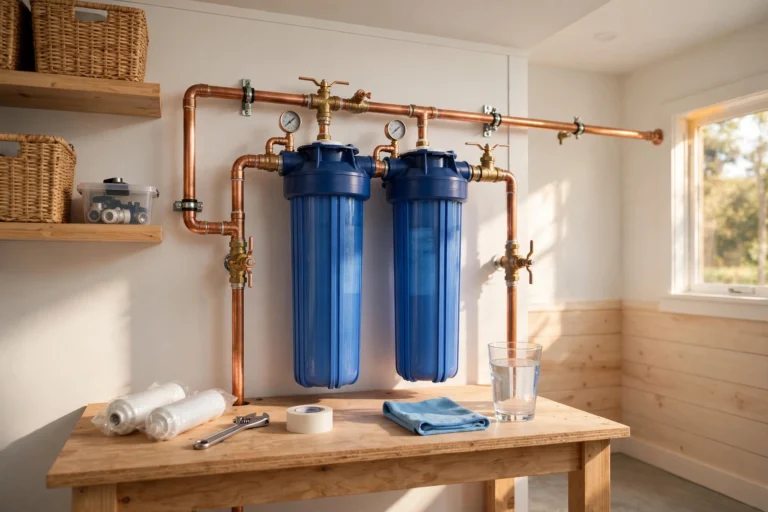
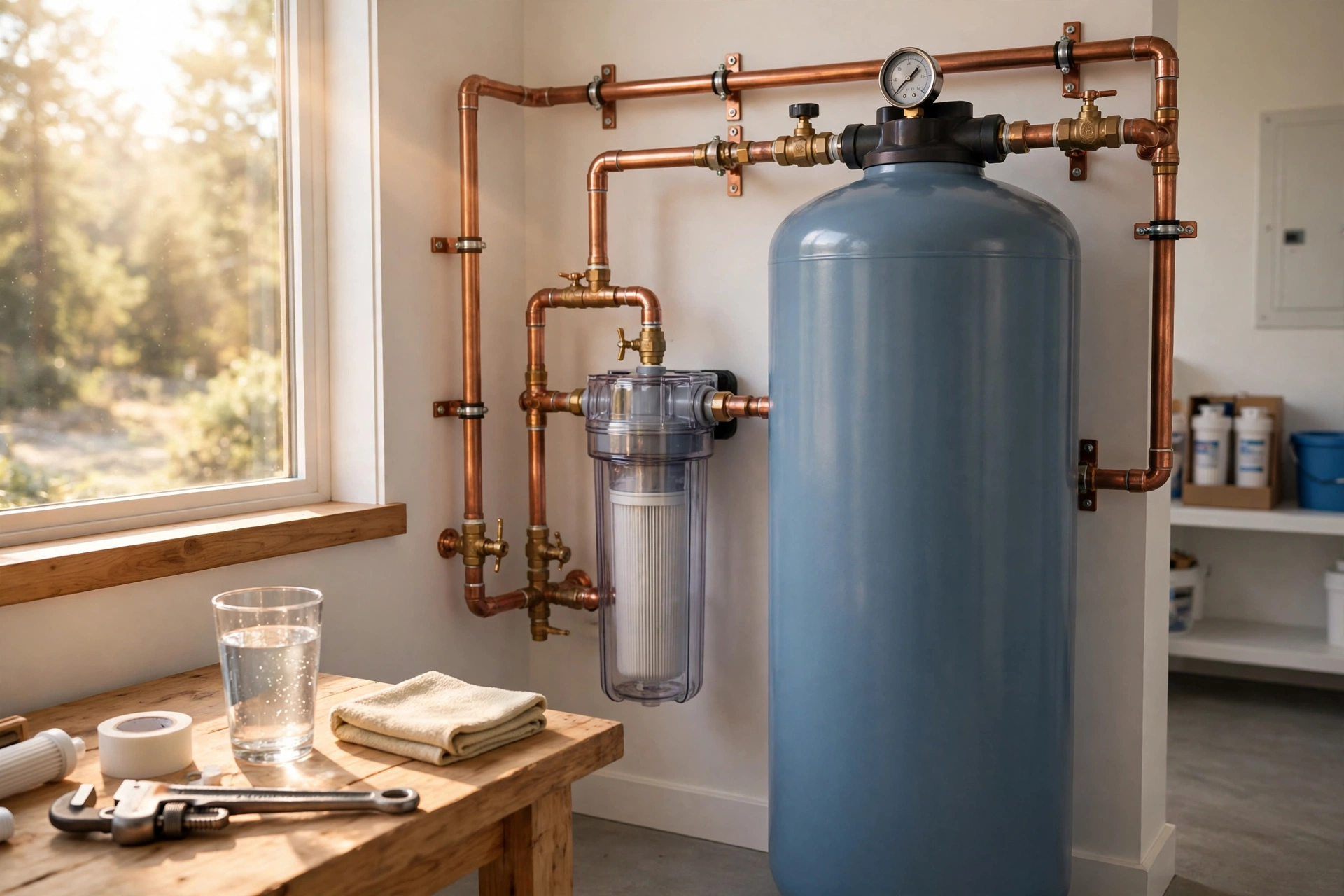
The system is built in layers, and each layer has a specific job. First, a 20 inch pre-filter catches sediment, rust and silt before they reach the main tank, which protects the media and your appliances. Next, the main tank pairs activated carbon with KDF media. Carbon is the workhorse for chlorine, taste and odor, the things you notice most in a shower or a glass filled from the bathroom tap. KDF helps with chlorine as well and supports the carbon stage.
Aquasana rates the Rhino to reduce 97 percent of chlorine, with performance tested to NSF/ANSI 42 and the tank certified to NSF/ANSI 61 for material safety. Those are meaningful certifications for a whole-house carbon system, and they are also specific. NSF/ANSI 42 covers aesthetic effects like chlorine, taste and odor. It is not a claim that the tank removes lead, PFAS or microplastics the way a reverse osmosis membrane does at a single tap.
That distinction matters for this site. The U.S. Environmental Protection Agency has studied point-of-use and point-of-entry systems for PFAS removal (see the EPA research summary): point-of-use RO held PFAS to below detection, while point-of-entry carbon needed very large media volumes and contact time to approach the same result. The honest setup we recommend to friends has not changed: a whole-house system like the Rhino at the entry for sediment, chlorine and whole-home protection, plus RO at the kitchen tap for drinking water. Our countertop reverse osmosis comparison covers that second layer.
After the main tank, the Rhino adds a salt-free conditioner stage and a post-filter. The conditioner is the part to read carefully, in the next section.
The Salt-Free Conditioner: Helpful, But Not a Softener
Here is the misunderstanding that causes most disappointment with this system. Salt-free conditioning does not remove calcium and magnesium from your water, and it does not soften water the way a salt-based softener does. What it does is change how scale-forming minerals behave, so they are less likely to stick hard to pipes, fixtures and heating elements.
Aquasana is upfront about the limits in its own listing, and we will be too. The scale claim is aimed at homes with moderate hardness, under about 15 grains, and low iron. If your water is very hard, if you have slippery-soft water as a goal, or if iron staining is your main problem, a conditioner stage alone will not solve it. Test your water first. A simple home test or your city water report will tell you whether you are in the range where this system shines, or whether you need a dedicated softener or iron system alongside it, or instead of it.
For a city-water home with moderate hardness where chlorine taste, shower smell and scale buildup on fixtures are the daily annoyances, that honest scope is still a good fit. Just buy it for what it is.
Living With It: Install, Size and the Filters You Still Change
The Rhino is a big system. The main tank needs real floor space near your main line, a drain or shutoff plan for install day, and enough room to service the pre-filter housing. Many owners hire a plumber, and that cost belongs in your mental total, even though we never quote prices in our guides. Confident DIYers with main-line plumbing experience do install these, but cutting into the main is not a first plumbing project.
Once it is in, daily life is simple, which is the point. There is no salt to haul, no backwash cycle to listen for, and no cartridge stack to swap every few months. What does remain: the pre-filter and post-filter. Those smaller filters still change a few times a year, depending on your sediment load, and skipping them will shorten the main tank life and drop your pressure. Put the change dates on the calendar the day it is installed, the same advice we give for every system in our water filters for microplastics guide.
Flow is the other living-with-it check. The Rhino is rated at about 7.0 GPM service flow, which suits many homes but can feel tight in a larger multi-bath home when a shower, a dishwasher and a washing machine run together. Check that rating against your home size before you order, and confirm your pipe size matches the fittings in the kit you choose. One more install note worth reading before you decide to DIY: Aquasana ties its warranty coverage to proper installation and its guidance points to a licensed plumber, so check the current warranty terms first if keeping that coverage matters to you.
Honest Trade-Offs
No review on this site skips the downsides. One: the upfront commitment is the highest in our whole-house roundup, and professional installation can add to it. Two: it does not soften truly hard water, despite the conditioner stage. Three: it is not a drinking-water solution on its own for PFAS, microplastics or dissolved contaminants, you still want RO at the tap you drink from. Four: it takes up significant utility space and is not renter friendly. Five: the main tank lasts for years, but the small pre and post filters are an ongoing cost and chore, not a one-time purchase. Together, those trade-offs point to a specific buyer, and the next section names who that is.
Who Should Buy the Aquasana Rhino EQ-1000, and Who Should Skip It
Buy it if: you own your home, you are on city water with chlorine taste and odor as the main complaint, your hardness is moderate, and you value a long-life tank over a lower upfront cost with regular cartridge swaps. It is also a sensible pick if you are building a layered setup and want the entry layer handled for years while RO handles drinking water.
Skip it if: you rent, your main problem is iron, sulfur or very hard water, you need proven softening, or your budget fits a cartridge system better to start. The alternatives below cover each of those cases, and starting smaller is a perfectly good plan. A whole-house housing you actually maintain beats a flagship tank you stretch to afford and then neglect.
If the Rhino Is Not Your System: Three Picks From the Same Guide
A deep dive should help you leave with the right product, not just the featured one. These three are all from our whole-house roundup, all from recognizable brands, and each solves a different version of the problem.
iSpring WGB32B-PB 3-Stage Whole House System
The iSpring WGB32B-PB is our first recommendation for most homes and holds a 4.7 star rating across about 2,457 Amazon ratings. Three large cartridges run sediment, coconut-shell carbon block, and a lead-reducing third stage, rated at 15 GPM. It costs far less upfront than a tank system, and replacement cartridges are widely available. The honest trade-offs: you will change cartridges roughly yearly, it does not soften water or reduce TDS, and hard water shortens cartridge life.
iSpring WGB32BM 3-Stage Iron and Manganese System
If you are on a well and orange staining is the clue, the iSpring WGB32BM is built for your water, with a third stage targeting iron and manganese. It holds a 4.6 star rating across about 1,411 Amazon reviews, at the same 15 GPM class as its sibling. The honest ceiling, straight from the manufacturer: the iron stage handles up to about 3.0 ppm iron and 1.0 ppm manganese. Past that, you need a dedicated iron system, and a water test should come before any order.
A. O. Smith AO-WH-Filter Whole House System
The A. O. Smith AO-WH-Filter is the simpler tank alternative: one carbon tank rated for 600,000 gallons or about 6 years, certified for chlorine reduction, filtering 96.9 percent of chlorine taste and odor per the listing. A. O. Smith is a water-heater name most homeowners already know. The honest trade-offs: at 7 GPM it is slower than the Rhino class and the iSpring systems, tight for a large multi-bath home, and a single carbon stage does not address iron, sulfur or dissolved solids. Small home, city water, minimal upkeep: this is a strong middle path.
Aquasana Rhino EQ-1000 at a Glance
| Product | Best for | Specs and notes |
|---|---|---|
| Aquasana Rhino EQ-1000 | Homeowners who want a long-life tank for chlorine and taste at every tap | Carbon and KDF tank rated 1,000,000 gallons or about 10 years, 97 percent chlorine reduction claim, NSF/ANSI 42 tested and 61 certified. Salt-free scale inhibition, not softening. |
| iSpring WGB32B-PB | Best all-round cartridge system for most homes | 4.7 stars, about 2,457 ratings. 3-stage sediment, carbon and lead-reducing, 15 GPM. Yearly cartridge changes. |
| iSpring WGB32BM | Well water with iron and manganese within limits | 4.6 stars, about 1,411 reviews. 3-stage with iron filter, 15 GPM. Iron cap about 3.0 ppm, test first. |
| A. O. Smith AO-WH-Filter | Small homes that want a simpler long-life tank | Single carbon tank, 600,000 gallons or about 6 years, 96.9 percent chlorine taste and odor. 7 GPM, lowest flow here. |
Frequently Asked Questions
Does the Aquasana Rhino EQ-1000 remove microplastics?
Its sediment pre-filter can physically catch larger particles, including larger microplastics, before they reach your taps. But a carbon tank is not an RO membrane, and it should not be sold as membrane-level microplastic removal for drinking water. Pair it with point-of-use RO for the water you drink, as explained in our reverse osmosis, PFAS and microplastics guide.
Does the Rhino soften water?
No. Its salt-free stage conditions water to reduce how hard scale sticks to fixtures, without removing hardness minerals. Aquasana limits that claim to moderate hardness and low iron. Truly hard water still needs a softener.
How long does the Aquasana Rhino EQ-1000 last?
The main tank is rated for 1,000,000 gallons or about 10 years in a typical home. The smaller pre-filter and post-filter change much more often, a few times a year depending on sediment, and keeping up with them protects the main tank.
Can I install the Rhino myself?
It is possible for an experienced DIY plumber, since it cuts into the main line and needs space, shutoff access and careful fitting work. Many owners hire a plumber, and that is the safer call if you are unsure where your main shutoff is or how your line is laid out.
Do I still need a reverse osmosis system with a Rhino?
For drinking water, yes, if PFAS, microplastics or dissolved contaminants are your concern. The EPA point-of-entry research found whole-house carbon needs very large media volumes to match what a point-of-use RO membrane does at one tap. The Rhino handles the whole house, RO handles your glass.
Is the Aquasana Rhino EQ-1000 worth it over a cartridge system?
It is worth it if you will stay in the home for years, your water fits its scope, and you value rare main-media changes over a lower starting cost. If you may move, rent, or want to start with a test-and-learn step, the iSpring cartridge system above is the smarter first move.
Get the Weekly Swaps
One short email a week: the newest microplastics studies in plain English, plus the swaps that are actually worth your money. Join free and we will send you our room-by-room microplastic checklist to get you started.
Get Our Free Room-by-Room Microplastic ChecklistJoin the newsletter and get the checklist free →
Browse Our Full Amazon StorefrontAll our whole house water filter picks in one place →
Join Our Free Facebook GroupNon-Toxic Family Living: parents sharing swaps that work →
Add Us as a Preferred Source on GoogleOne tap, and our guides show up first in your Google results →
Keep Reading
- Whole-House Water Filters: What They Do That RO Does Not
- The Best Water Filters for Microplastics in Water
- Countertop Reverse Osmosis Systems Compared
- Reverse Osmosis Filters, PFAS and Microplastics
Think of the Rhino as the quiet layer. It will not make headlines at the kitchen tap the way an RO system does, and it should not try to. What it does, for a decade at a time, is take chlorine, sediment and bad taste out of every shower, tap and load of laundry in the house, and protect everything downstream. If that is the job you need done, and your water test says your home fits its scope, the Aquasana Rhino EQ-1000 earns its place on the main line.