Whole-House Water Filters: What They Do That RO Doesn’t
As an Amazon Associate I earn from qualifying purchases. This post contains affiliate links, which means I may earn a commission if you buy through them, at no extra cost to you.
The quick version: A reverse osmosis system guards one faucet really well. Whole house water filters guard everything else: every shower, every bathroom tap, the laundry and the appliances, by treating water where it enters your home. They are not a replacement for RO at the drinking tap, and we will be honest below about what they cannot do. If you want one proven cartridge system for a typical city or well home, start with the iSpring WGB32B-PB 3-stage system. If you would rather install a big tank once and mostly forget it, look at the Aquasana Rhino EQ-1000 further down.
Already have RO covered? Our countertop reverse osmosis comparison handles the drinking-water end. This guide is about the rest of the house.
Point of Entry vs. Point of Use: Two Different Jobs
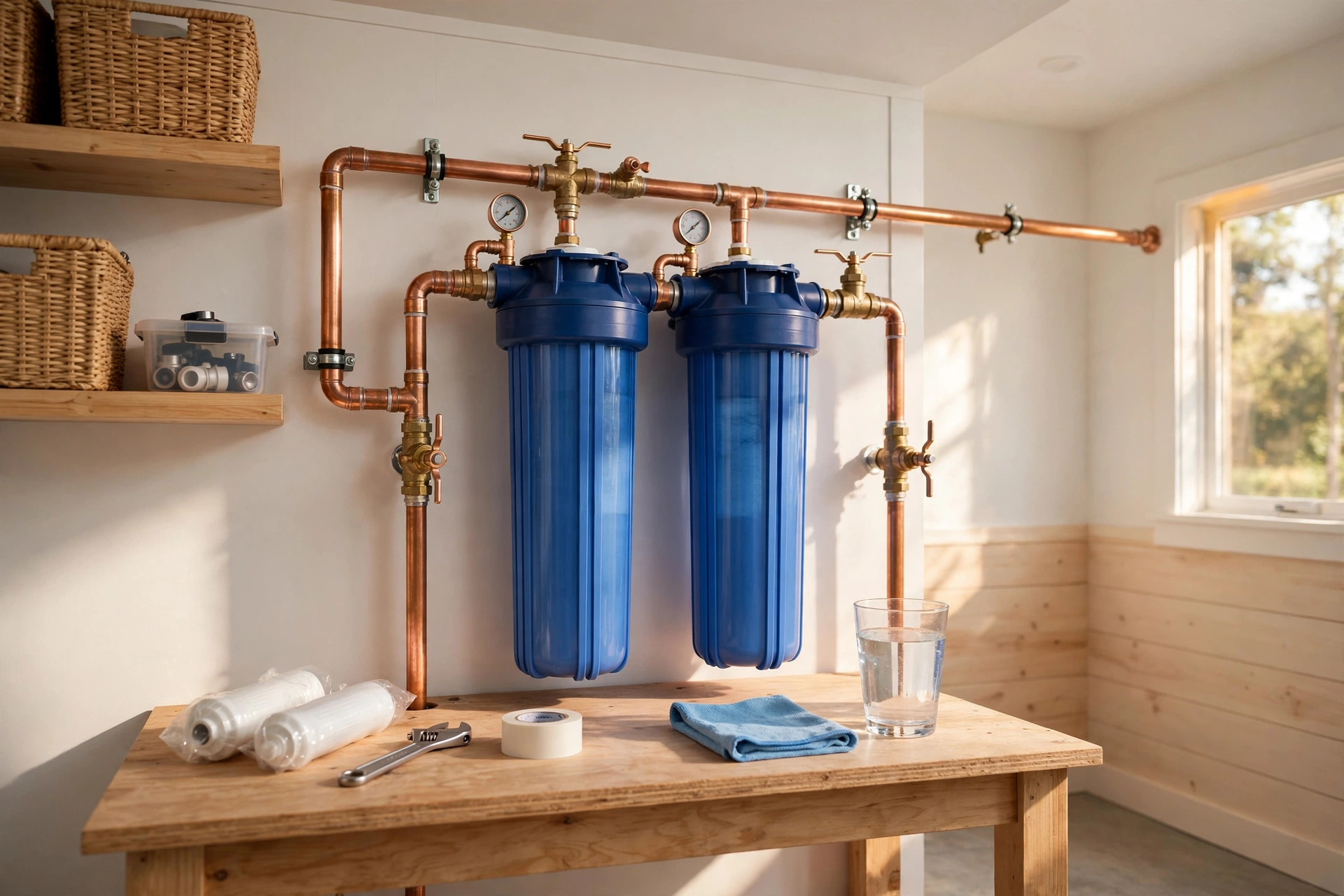
Water filters come in two families. Point-of-use systems treat water at one place, usually the kitchen sink: a countertop RO unit, an under-sink filter, a pitcher. Point-of-entry systems, which is what whole house water filters are, sit on the main line where water enters the home, so every drop reaching a tap, showerhead or washing machine has passed through them first.
That difference decides what each is good at. A whole-house system is the right tool for problems that show up everywhere: sediment that clogs fixtures and wears out appliance valves, chlorine you smell in the shower and that dries skin and hair, rust and iron staining, and grit that shortens the life of water heaters and washing machines. Filtering at the entry also protects any point-of-use filter you own, because an RO membrane fed with sediment-heavy, chlorine-heavy water wears out faster.
Here is the honest limit, and it matters. Most whole-house systems are carbon and sediment filters, not RO membranes, and the research backs up treating the two differently. The U.S. Environmental Protection Agency has studied point-of-use and point-of-entry systems for PFAS removal (see the EPA research summary): RO held PFAS to below detection at one tap, while point-of-entry carbon needed very large media volumes and contact time to do the same job, and whole-house RO needs storage tanks, pumps and remineralization to be practical at all. A Duke University and NC State study of 76 point-of-use filters and 13 whole-house systems found the same pattern: under-sink RO achieved near-complete PFAS removal, while whole-house results varied widely. So the setup we recommend to friends is layered: a whole-house filter at the entry for sediment, chlorine and everyday protection, and RO at the one tap you drink from for microplastics, PFAS and dissolved contaminants. Neither makes the other pointless. They do different jobs.
One more microplastics note. Larger microplastic particles in incoming water are the kind of thing a fine sediment stage can physically catch, and keeping them out of your plumbing is worthwhile. But no honest whole-house listing should promise membrane-level microplastic removal at every tap, and the picks below do not claim it. If drinking-water microplastics are your main worry, start with our guide to water filters for microplastics and treat this article as the second layer.
Before You Buy: Size, Source and a Water Test
Three quick checks save most of the returns in this category. First, flow rate: systems are rated in gallons per minute (GPM), and an undersized system means a sad shower when the laundry runs. Small homes get by around 7 to 10 GPM; a family home with two or more bathrooms should look at 10 to 15 GPM. Second, know your source. City water usually means chlorine or chloramine, sediment and taste; well water adds iron, manganese and sulfur, which need dedicated stages, and one pick below is built for exactly that. Third, test before you spend. A basic home water test, or your city water quality report, tells you whether you actually have an iron or lead problem, and the right system follows from the result, not the marketing.
The Picks: Cartridge Systems Most Homes Should Start With
iSpring WGB32B-PB 3-Stage Whole House System
The iSpring WGB32B-PB is our first recommendation for most homes, and it holds a 4.7 star rating across about 2,457 Amazon ratings, the strongest review record in this guide. Three 20 inch by 4.5 inch cartridges run in sequence: a 5-micron sediment filter, a coconut-shell carbon block for chlorine, taste and odor, and a third stage built to reduce lead, the detail that sets it apart from basic sediment-and-carbon setups. It is rated at 15 GPM with 1 inch fittings, and the first two filters are third-party tested to NSF/ANSI standards. The honest trade-offs: it does not soften water or reduce TDS, hard water shortens cartridge life, and at roughly 50 pounds and over two feet tall it needs real space near your main line. Budget for the annual cartridge set as an ongoing cost, not a surprise.
iSpring WGB32BM 3-Stage Iron and Manganese System
If you are on a well and your sinks wear orange stains, the iSpring WGB32BM is the sibling model built for your water: same 15 GPM, three-stage layout, but the third cartridge targets iron and manganese alongside the sediment and carbon stages. It holds a 4.6 star rating across about 1,411 Amazon reviews, with a matching 4.6 at other major retailers. Cartridges are rated up to 100,000 gallons, roughly a year for many households. Now the honest ceiling, straight from the manufacturer: the iron stage handles up to about 3.0 ppm iron and 1.0 ppm manganese. Past that, and many wells are past that, you need a dedicated iron system rather than a cartridge, and no listing copy should talk you out of a water test first. Within its limits, this is the well-water pick we would hand a friend.
Express Water Heavy Metal 3-Stage Whole House System
The Express Water Heavy Metal system is the pick for older city homes where the worry list is specific: lead, arsenic, chromium and chlorine. Its three stages run sediment, then a KDF media stage aimed at heavy metals, then carbon, rated up to 100,000 gallons with 1 inch connections. Versions include pressure gauges on the housings, a genuinely useful touch, because a dropping gauge tells you a cartridge is loading up before your shower pressure does. The honest trade-offs: it is one of the physically largest cartridge systems here, it is an indoor install, and like every carbon system on this page it does not reduce TDS. Measure your utility space before ordering, and keep RO at the kitchen tap for drinking-water duty.
The Big Tanks: Install Once, Maintain Rarely
Cartridge systems ask for a filter swap a few times a year. Tank systems flip that deal: a bigger install and a higher upfront cost, in exchange for media rated in hundreds of thousands of gallons. These are the two worth your attention, plus a simpler single-tank option.
Aquasana Rhino EQ-1000 Whole House System
The Aquasana Rhino EQ-1000 is the flagship name in this category, and the highest-ticket system in this guide. The main tank pairs activated carbon with KDF media and is rated for 1,000,000 gallons or about 10 years, with a 20 inch pre-filter for sediment, a post-filter, and a salt-free conditioner stage that inhibits scale. Aquasana rates it to reduce 97 percent of chlorine, with performance tested to NSF/ANSI 42 and the tank certified to NSF/ANSI 61. The honest trade-offs deserve equal time: the salt-free stage conditions water to reduce scale, it does not soften it, and Aquasana’s own listing limits the claim to homes under about 15 grains of hardness with low iron. The pre and post filters still change every few months even though the big tank lasts a decade, the system is large, and many owners pay for professional installation. Buy it for chlorine, taste and whole-home coverage, not as a softener substitute.
A. O. Smith AO-WH-Filter Whole House System
The A. O. Smith AO-WH-Filter is the simple end of the tank category: one carbon tank, rated for 600,000 gallons or about 6 years, certified for chlorine reduction, filtering 96.9 percent of chlorine taste and odor per the listing. A. O. Smith is a water-heater name most homeowners already know, and the appeal is the ownership story: install it, and there are no cartridges on a schedule for years. The trade-off is flow and scope. At 7 GPM it is the slowest system here, fine for a smaller home and tight for a large multi-bath house at peak hour. And a single carbon stage does one job patiently; it does not address iron, sulfur or dissolved solids. Small home, city water, low patience for maintenance: this is your pick.
Home Master HMF2SmgCC 2-Stage System
Some cities disinfect with chloramine instead of chlorine, and chloramine is harder to remove: it needs catalytic carbon and contact time, which is what the Home Master HMF2SmgCC is built around. Stage one is a multi-gradient sediment filter stepping down from 25 microns to 1 micron; stage two is a radial-flow cartridge of KDF85 and catalytic carbon, rated by the manufacturer for up to 95 percent reduction of chloramine and chlorine, at 10 GPM for about 95,000 gallons. The honest trade-offs: it is a city-water specialist, so well owners with iron or sulfur should look at the WGB32BM above; the big housings need mounting room; and replacement cartridges cost more than standard ones. If your city report says chloramine, this system was designed for your water.
The Budget Starting Point
Culligan WH-HD200-C Whole House Filtration System
Not every home needs a full system on day one. The Culligan WH-HD200-C is a single heavy-duty filter housing with 1 inch stainless-reinforced ports, a clear sump so you can see what the cartridge has caught, a built-in bypass valve, and certification to NSF/ANSI 42 and 372 for materials and structural integrity. It takes standard Big Blue style cartridges at 10 GPM, so you choose the job: sediment for grit and rust, or carbon for taste and odor. The honest framing: this is a housing, not a treatment plant. With a sediment cartridge it will not fix chlorine taste or lead, cartridge life is shorter than the big systems at roughly 10,000 to 24,000 gallons depending on the cartridge, and changes can be a little messy. As an affordable first layer that protects everything downstream, it earns its place.
Whole House Water Filters at a Glance
| Product | Best for | Specs and notes |
|---|---|---|
| iSpring WGB32B-PB | Best all-round pick for most homes | 4.7 stars, about 2,457 ratings. 3-stage sediment, carbon and lead-reducing cartridges, 15 GPM. No softening, no TDS reduction. |
| iSpring WGB32BM | Well water with iron and manganese | 4.6 stars, about 1,411 reviews. 3-stage with iron filter, 15 GPM. Iron cap about 3.0 ppm; test first. |
| Express Water Heavy Metal | Older city homes worried about heavy metals | 3-stage sediment, KDF and carbon, up to 100,000 gallons. Large footprint, indoor install, no TDS reduction. |
| Aquasana Rhino EQ-1000 | The flagship install-once tank system | Carbon and KDF tank rated 1,000,000 gallons, 97 percent chlorine reduction claim. Salt-free scale inhibition, not softening. |
| A. O. Smith AO-WH-Filter | Small homes that want minimal upkeep | Single carbon tank, 600,000 gallons or about 6 years, 96.9 percent chlorine taste and odor. 7 GPM is the lowest flow here. |
| Home Master HMF2SmgCC | Cities that disinfect with chloramine | 2-stage gradient sediment plus KDF85 catalytic carbon, 10 GPM, about 95,000 gallons. City-water specialist, pricier cartridges. |
| Culligan WH-HD200-C | A budget first layer of protection | Single heavy-duty housing, 10 GPM, clear sump and bypass. Housing only; treatment depends on the cartridge you choose. |
Frequently Asked Questions
Do whole house water filters remove microplastics?
Partly, and it is worth being precise. A fine sediment stage physically catches larger particles, including larger microplastics, before they reach your taps and appliances. But a carbon whole-house system is not an RO membrane, and it should not be sold as membrane-level microplastic removal for drinking water. For the water you drink, pair it with point-of-use RO; our guide to reverse osmosis, PFAS and microplastics explains why the membrane matters.
Do I still need a reverse osmosis system if I have a whole-house filter?
For drinking water, yes, if microplastics, PFAS or dissolved contaminants are your concern. The EPA’s point-of-entry research found whole-house carbon needs very large media volumes to match what a point-of-use RO membrane does at one tap. The whole-house system’s job is sediment, chlorine and protection for the whole home; the RO system’s job is your glass of water.
What size whole house water filter do I need?
Match the flow rating to your home. Around 7 to 10 GPM suits a small home, and 10 to 15 GPM suits a family home with two or more bathrooms. An undersized system does not filter worse, it just cannot keep up when several fixtures run at once, and you feel it as low pressure.
Can I install a whole-house filter myself?
Cartridge systems are within reach of a confident DIYer with plumbing experience, since they cut into the main line; tank systems are heavier, and many owners hire a plumber. Renters generally cannot install either, which is one more reason countertop RO exists. Not sure where your main shutoff is? That is your answer: hire it out.
How often do whole-house filters need maintenance?
Cartridge systems typically want new filters every 6 to 12 months, or sooner in sediment-heavy water. Tank systems stretch the main media to 6 to 10 years but still use small pre and post filters that change a few times a year. Either way, a neglected filter eventually becomes part of the problem, so put the change date on the calendar the day you install it.
Will a whole-house filter soften my water?
No. Filters and softeners are different tools. Some systems, like the Aquasana above, include salt-free scale inhibition, which reduces how hard scale sticks to fixtures without removing the minerals. Truly hard water still needs a softener, and the honest listings say so.
Get the Weekly Swaps
One short email a week: the newest microplastics studies in plain English, plus the swaps that are actually worth your money. Join free and we will send you our room-by-room microplastic checklist to get you started.
Get Our Free Room-by-Room Microplastic ChecklistJoin the newsletter and get the checklist free →
Browse Our Full Amazon StorefrontAll our whole house water filter picks in one place →
Keep Reading
- The Best Water Filters for Microplastics in Water
- Countertop Reverse Osmosis Systems Compared
- Reverse Osmosis Filters, PFAS and Microplastics
- Clearly Filtered Water Pitcher Review
Think of your home’s water in layers and the decision gets simple. A whole-house filter at the entry takes sediment, chlorine and grit out of every tap, shower and load of laundry, and protects everything downstream, including the RO system at your kitchen sink that handles the drinking-water contaminants carbon cannot. Start with the iSpring WGB32B-PB if you want the proven all-rounder, size it honestly, test your water first, and your house will feel the difference long before your glass does.