Christmas Tree Alternatives: Potted, Wooden and DIY Options That Actually Work
As an Amazon Associate I earn from qualifying purchases. This post contains affiliate links, which means I may earn a commission if you buy through them, at no extra cost to you.
The quick version: If you want a real, living tree that keeps going after December, the Green Promise Farms Dwarf Alberta Spruce is the pick: decorate it in its pot, then plant it outside in the new year. If you want one non-plastic tree that works as the main family tree at full ornament-hanging scale, that is the vidaXL Wooden Christmas Tree. The Costa Farms Norfolk Island Pine is the cozy tabletop version that lives on as a houseplant, and the ceramic tree and the free DIY ideas below are honest supporting acts, not replacements.
One honest note before the list: an alternative tree changes the tradition a little. A potted spruce holds fewer ornaments than a seven-foot fir, and a wooden tree has no pine smell. What you get back is no PVC shedding fragments in your living room, no tree at the curb in January, and nothing to store in a plastic bag in the attic. For a lot of families, that trade is exactly the point.
Why Look for a Third Option at All?
Our real vs. artificial Christmas tree guide works through the full comparison, and the short version is that both sides have a real cost. A cut tree is grown, trucked, displayed for a few weeks and then discarded, and most landfills are not where a tree biodegrades gracefully. A PVC artificial tree avoids the yearly waste but is plastic from trunk to tip, sheds tiny fragments as it ages and gets handled, often carries lead stabilizers and flame retardants in older models, and eventually becomes the bulkiest piece of plastic a household ever throws out.
So a growing number of families are asking a different question: what else can hold the lights, the ornaments and the Christmas-morning photos? The good news is that the third options are genuinely good this year. Nurseries ship real potted evergreens to your door, wooden trees have grown from tabletop novelties into full-size designs, and some of the best alternatives cost nothing because they are built from a ladder, a branch or the houseplant already sitting in your corner. This guide sorts them by the only question that matters: which one can actually be your tree, and which ones are lovely decor standing next to it.
How We Picked These
No PVC, no plastic foliage: every pick below is alive, solid wood, or ceramic. Recognizable brands only, with listings and reviews we could verify, and every catch printed on the pick itself.
Judged as trees, not decor: can it hold lights and ornaments, anchor a room, and survive a household with kids? Where the honest answer is “not really,” the pick is labeled decor-only so nobody buys a tabletop ornament expecting a Christmas morning centerpiece. We research and compare; we do not invent testing claims.
Get Our Free Room-by-Room Microplastic ChecklistJoin the newsletter and get the checklist free →
The Picks at a Glance
| Pick | Type | Size | After Christmas | Best for |
|---|---|---|---|---|
| Green Promise Farms Dwarf Alberta Spruce | Living, plantable | #3 container, roughly 2 to 3 feet on arrival | Plant it in the yard | Families who want the plant-it-after tradition |
| Costa Farms Norfolk Island Pine | Living houseplant | 16 to 22 inches | Lives on indoors for years | Tabletops, small spaces, a second tree for the kids’ room |
| vidaXL Wooden Christmas Tree | Solid pine wood and bamboo | About 59 inches tall | Breaks down flat, reuse every year | The main family tree, minus the plastic |
| Best Choice Products Ceramic Tree | Ceramic, pre-lit | 24 inches | Box it up, reuse every year | Decor-only glow for mantels and sideboards |
The Living Trees: Decorate It, Then Keep It
A potted tree is the only alternative that gives you more tree every year instead of less. Both of these are real, living evergreens shipped in their nursery pots, and both keep working long after the ornaments come off. They ask for a little plant care in return, and the care rules are different for each one, so read the catches before you choose.
Green Promise Farms Dwarf Alberta Spruce: The Plant-It-After Tree
The Green Promise Farms Dwarf Alberta Spruce (Picea glauca ‘Conica’) is the classic living Christmas tree done right. It arrives in a #3 nursery container, a real landscape spruce with that perfect dense cone shape, hardy in USDA zones 3 through 8. Set the pot inside a decorative basket or crock, water it, decorate it, and when the holidays end it goes outside: either into a planting hole if your ground is workable, or into an unheated garage to wait for spring planting. Dwarf Alberta spruces grow slowly, only a few inches a year, so one tree can mark a decade of Christmases in the yard, and kids who helped decorate it tend to check on “their” tree all year.
Now the honest rules, because this is where living trees usually die. A spruce is an outdoor plant that needs winter cold; kept in a warm, dry living room for a month, it dries out and may never recover. Plan on about a week indoors in the brightest, coolest spot you have, keep the soil evenly moist, and move it back out in stages. Its foliage is also very dense, which means ornaments rest on the surface rather than dangling inside the branches, and heavy heirloom pieces will overwhelm it at this size. Treat it as a small, real tree with real limits and it is the most satisfying option in this guide.
Costa Farms Norfolk Island Pine: The Tree That Becomes a Houseplant
The Costa Farms Norfolk Island Pine takes the opposite path: this one never goes outside at all. Norfolk Island pines are tropical trees sold as houseplants, and this 16 to 22 inch size arrives ready for a tabletop, a desk or a child’s bedroom. The soft, symmetrical tiers look unmistakably like a miniature Christmas tree, it takes lightweight ornaments and a strand of small lights beautifully, and in January it simply goes back to being a handsome houseplant that can live indoors for years and eventually reach several feet tall in a bright spot.
The catches are about climate and scale. It is not frost hardy, so in most of the country it can never be planted out; if the plant-it-in-the-yard tradition is the whole appeal, buy the spruce above instead. The branches are soft, so ornaments need to be light, and like any houseplant it wants real light and regular watering rather than a dark corner and good intentions. One sizing note: Costa Farms sells bigger Norfolk pines too, but the tabletop listing here is the one with the deep, happy review history, and it is the right scale for a second tree or a small apartment.
The Built Alternatives: Wood and Ceramic
Not everyone wants to keep a plant alive, and renters may have nowhere to plant one. These two are the reusable middle path: no plastic foliage, no watering, and years of use from a single purchase. One of them can genuinely be your main tree. The other one knows it cannot, and that honesty is why it made the list.
vidaXL Wooden Christmas Tree: A Real Main Tree, Built From Pine
The vidaXL Wooden Christmas Tree is the alternative we would point a family to first if a living tree will not work. It stands about 59 inches tall and is built from solid pine wood and bamboo in a natural, unfinished finish: a central trunk with tiered wooden branches you assemble, hang with ornaments and lights, and then take apart flat in January, so storage is a slim bundle instead of a plastic storage bag the size of a kayak. Because the branches are solid wood, it handles real ornament-hanging with children better than anything else in this guide, and the clean Scandinavian look suits the way a lot of families actually decorate now.
The trade-offs are aesthetic and practical. It reads modern and minimal, not lush and green, and there is no pine scent unless you add a simmer pot or a wreath to the room. Assembly is part of the deal every December, lightweight ornaments sit best on the outer branches, and very heavy pieces belong on a sturdier hook. In exchange you get a full-size tree experience with zero plastic, zero shedding and zero needles in the carpet. Of everything on this page, this is the one that replaces a traditional tree rather than accompanying it.
Best Choice Products Ceramic Christmas Tree: Decor, and Proud of It
The Best Choice Products 24-Inch Pre-Lit Ceramic Christmas Tree is the modern version of the ceramic tree so many of us grew up seeing on a grandmother’s sideboard. At two feet tall in white ceramic with the lights built in, it needs no watering, no assembly and no ornament box: set it on a mantel, a kitchen counter or a guest room dresser and the room is decorated. It stores in a small box, comes back out unchanged every year, and makes a genuinely lovely night-light glow through December.
Label it clearly, though: this is decor, not a tree substitute. There is nowhere to hang the family ornaments, no presents gather under a sideboard, and ceramic plus small children within grabbing range is a combination to plan around, so give it a high, stable home. As the only tree in a small apartment, a dorm or a bedroom, it works. As a supplement to one of the living or wooden trees above, it is perfect. Just do not buy it expecting Christmas morning to happen around it.
Browse Our Full Amazon StorefrontAll our non-toxic holiday picks in one place →
The Free Alternatives: Ladders, Branches, Books and the Plant You Already Own
Some of the most-shared alternative trees online cost nothing, because they are built from things already in the house. They are not all equal, and a few are decor experiments rather than family trees, so here is the honest tour.
The ladder tree. Lean a wooden ladder against the wall, secure it so it cannot slide, and zigzag string lights down the rungs with ornaments hung between them. This is the strongest of the DIY options for families: it has real height, holds a surprising amount of decoration, and kids can genuinely help build it. The non-negotiable is stability; anchor the top to the wall and keep climbers off it, because a ladder invites exactly one idea in a five-year-old’s mind.
The branch or driftwood tree. A large fallen branch, stood upright in a heavy pot filled with stones or sand, makes a sculptural tree that shows off a small collection of beautiful ornaments better than a full tree does. Beach driftwood works the same way. It is free, it stores in a corner, and it suits households whose ornament collection is small and loved rather than large. It will not hold lights and baubles at family-tree scale, and a determined pull can topple a badly weighted pot, so weight it like you mean it.
The book tree. Stack hardcover books in shrinking layers, green spines out if you have them, wrap lights around the pile and put a star on top. Book lovers adore it, and as a reading-nook decoration it is charming. As a family tree it is decor-only: it is heavy, it sheds dust, toddlers treat it as a climbing and pulling opportunity, and your books spend a month as furniture. Do it for the corner, not for Christmas morning.
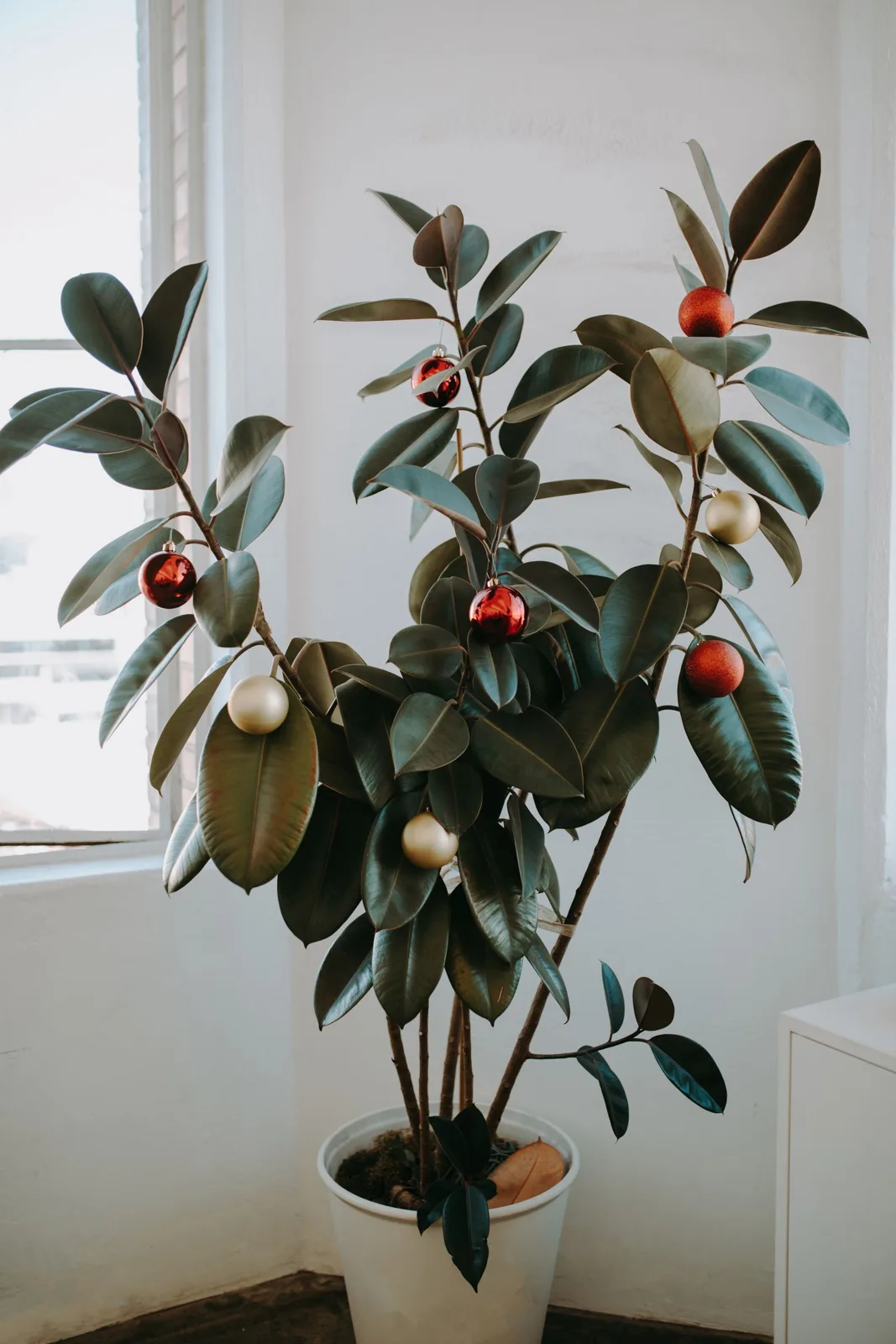
Decorate the houseplant you already own. This is the hero of this article, literally: the photo at the top is a potted rubber plant wearing baubles, and it looks wonderful. A fiddle leaf fig, a rubber plant or a big monstera can carry lightweight ornaments and a short string of lights for the season, then go back to work cleaning your air in January. Keep ornaments light, keep lights LED and cool, and skip anything with a curious cat, because a decorated plant is also a cat toy display.
Decorate an outdoor tree instead. If you have an evergreen in the yard, string it with outdoor lights and weatherproof ornaments and let it be the tree the neighborhood sees, while a small indoor option handles the living room. Families who try this often say the Christmas-morning part was never about the tree’s address; the presents, the lights and the photos all still happen. It is also the only option that makes your tree bigger every single year.
Join Our Free Facebook GroupNon-Toxic Family Living: parents sharing swaps that work →
So Which Alternative Actually Works for a Family With Kids?
Here is the verdict we would give a friend. If your children are old enough to care about the ritual of decorating and planting, the potted spruce is the best story in this guide: a real tree, a real planting day, and a growing marker of childhood in the yard. If you need one tree that does the whole job this year, ornaments, lights, presents underneath, photos in front, with nothing alive to keep alive, the wooden tree is the honest answer. The Norfolk pine is the beloved second tree: a bedroom, a playroom, a small apartment, or the practice tree younger kids decorate their own way. The ceramic tree and the DIY builds are the supporting cast, and there is no shame in that; most houses already run a main tree plus decor.
And if your family reads all of this and still wants the big cut tree from the lot? That is a legitimate choice, and our guide to real vs. artificial trees will help you choose it well and dispose of it properly. Pair whichever tree you choose with the lower-plastic trimmings: our safer Christmas lights and ornaments picks cover the glass, wood and felt end of the ornament box, and plastic-free gift wrapping finishes the scene under any tree.
Add Us as a Preferred Source on GoogleOne tap, and our guides show up first in your Google results →
Christmas Tree Alternative Questions
Can you really plant a potted Christmas tree after the holidays?
Yes, if you buy a species that is hardy where you live and you respect its limits indoors. A Dwarf Alberta spruce is hardy in zones 3 through 8 and can be planted out after roughly a week inside, or held in an unheated garage and planted in spring if the ground is frozen. The failures happen when a tree spends a month in a hot, dry living room and then gets shocked by a move straight into deep cold. Short indoor stay, steady watering, gradual move outside: that is the whole recipe.
Is a Norfolk Island pine a real Christmas tree?
It is a real, living evergreen tree, but a tropical one. It will never grow in a cold-climate yard; it lives its whole life as a houseplant, which is exactly why it suits apartments and warm climates. Think of it as a permanent indoor tree that dresses up for December, not as a future yard tree.
Can a wooden tree hold a family’s real ornaments?
Mostly, yes. A solid pine and bamboo tree at full height handles standard ornaments, lights and a topper without trouble, and kids can decorate it themselves. Save the heaviest heirloom pieces for a sturdy hook or the mantel, distribute weight across the branches, and remember it is a frame for ornaments rather than foliage they nestle into.
Are living trees a problem for allergies?
They can be for some households. Cut and potted evergreens can carry outdoor mold spores and pollen into the house, and the warm indoor air lets them circulate. If tree allergies are your reason for switching, the wooden or ceramic options avoid the issue entirely, and they are also the picks for anyone whose main goal is zero shedding of any kind, plant or plastic.
What is the best alternative for a very small space?
A tabletop living tree. The Norfolk pine gives you a real, green, ornament-holding tree in under two feet, and it stays useful as a houseplant all year. If you want zero plant care, the ceramic tree gives the same footprint with the lights built in. Both beat a tiny plastic tabletop tree, which combines the smallest possible charm with the same shedding plastic as its full-size cousins.
Keep Reading
- The head-to-head this guide builds on: real vs. artificial Christmas trees, the science and the verdict.
- Shopping for the people on your list: the non-toxic Christmas gift guide has 90 low-plastic picks by recipient.
- Small gifts, all sorted: non-toxic stocking stuffers for women, men, kids, teens and anyone.
- Dress the tree, whichever tree it is: safer Christmas lights and ornaments.
- Under the tree matters too: plastic-free gift wrapping without glitter or plastic tape.