Can You Microwave Stainless Steel? The New Containers That Say Yes
As an Amazon Associate I earn from qualifying purchases. This post contains affiliate links, which means I may earn a commission if you buy through them, at no extra cost to you.
Metal in the microwave is the one kitchen rule everybody learns young, usually right after somebody’s fork turns a leftover burrito into a light show. So when Misen, the knife and cookware brand, launched Misenware, stainless steel food storage containers it says you can microwave, our first reaction was the same as yours: absolutely not. Our second reaction was to read the fine print. The claim is oddly specific for a marketing line, the rules are strict, and a German research institute ran about a thousand experiments on this exact question almost twenty years ago. Here is what checks out, what does not, and what we would buy today.
The quick version: Whether metal sparks in a microwave depends on its shape, not on the word metal. Sharp points and thin edges concentrate the energy until it arcs; smooth, thick, rounded steel spreads it out, and in controlled testing it heated food safely, sometimes more evenly than plastic. Misenware is built to those rules and two national outlets have tested it without sparks, but it is a pre-order product with real limits, including no use in 1200W microwaves. If you want to reheat in the container today, glass is still the proven route: our top pick is the Pyrex Simply Store 18-Piece Set, with the Rubbermaid Brilliance Glass 18-Piece Set as the leakproof meal-prep option. Both are compared in our guide to the best glass food storage containers.
Storing food in plastic now? Our plastic-free food storage guide covers the full swap.
Get the Weekly Swaps
One short email a week: the newest microplastics studies in plain English, plus the swaps that are actually worth your money. Join free and we will send you our room-by-room microplastic checklist to get you started.
Get Our Free Room-by-Room Microplastic ChecklistJoin the newsletter and get the checklist free →
What Is Misen Actually Claiming?
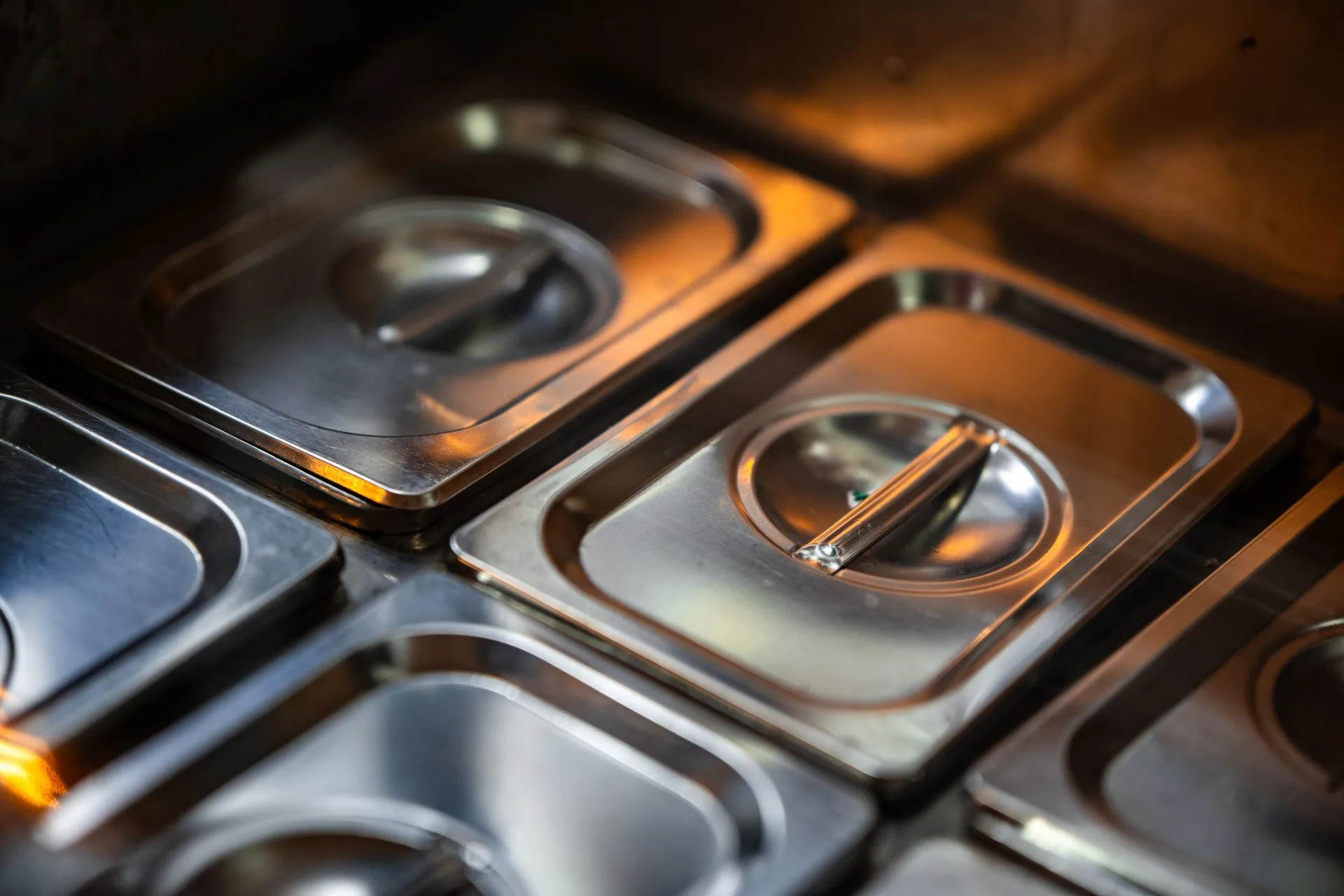
Misenware containers are made from 304 stainless steel, 1.0 mm thick, with rounded corners and no sharp edges. They come in three sizes sharing one footprint (2.95, 4.64 and 6.34 cups), they nest, and every size takes the same universal lid: tempered glass with a silicone rim, leakproof, with a steam vent. The steel body is oven and grill safe to 932 degrees Fahrenheit; the lid is oven safe to 450. The microwave claim is stated as tested limits, not a blanket promise: lab-tested safe in a 1000W microwave for up to 10 minutes at a time, and in an 1100W microwave for up to 5 minutes at a time.
Yes, the lid can go in too, at the same limits, as long as the steam vent is open. Two warnings come with that: the lid gets extremely hot, so use mitts or a towel, and expect a burst of steam when you lift it. The rules for the container itself are just as specific:
- Never microwave it empty. Misen says an empty container can damage your microwave.
- One container at a time, never two.
- Keep it off the microwave’s walls, metal plate and rack. Contact can spark or leave burn marks.
- No cutlery or foil in the oven alongside it.
- Do not use it in a 1200W microwave, or in a 915 MHz microwave (the commercial frequency, also found in very old home units).
The interest is real: Misen announced the line on Kickstarter on June 22, 2026, and the campaign raised over $2.7 million from more than 18,000 backers. WSJ’s Buyside team tested the containers and reported no sparking, a hot steel body, and a seal so tight you have to pop the vent to get the lid off. The Kitchn’s reviewer microwaved in them for over a month with no issues, and flagged the same con we would: the metal heats faster than glass, so grab it with a mitt. The sets are pre-order only, direct from Misen, with shipping estimates running from November to mid-December 2026 depending on the set. They are not sold on Amazon.
Why Forks Spark and a Smooth Steel Tub Might Not
Microwaves heat food because the waves pass into it and shake its water molecules. Metal does the opposite: it reflects the waves. That reflection is not the dangerous part by itself. The danger is what happens to the electric field at the metal’s surface. Where metal comes to a sharp point, a thin edge or a crumpled fold, the field concentrates into a tiny area, the same way lightning prefers a rod. Concentrate it enough and the air itself breaks down in a spark. That is arcing, and it is why fork tines, twist ties, gold trim on plates and wadded foil are the usual suspects.
A thick, smooth container with rounded corners gives that field nothing to concentrate on. The currents spread across a broad surface instead of piling onto a point, so there is no spark gap. Shape is the whole story. It is also why an open steel tub can heat food at all: the waves cannot reach the food through the walls, so the food heats from its exposed top surface while the steel conducts heat around it. That is why food in metal often heats more evenly, but more slowly.
The empty rule has a physics reason too. An oven expects food to absorb the energy it puts out. An empty metal container absorbs almost nothing and reflects almost everything back at the magnetron, the part that generates the waves, and running it that way can damage the oven. Every serious maker of microwave-rated metal puts “never empty” at the top of the rule list, and it is not legal boilerplate.
What the Research and the Authorities Actually Say
The strongest evidence behind the claim is not from Misen at all. In 2007, researchers at the Fraunhofer Institute for Process Engineering and Packaging in Germany ran about 1,000 microwave heating experiments with rigid steel and aluminium food containers, across four household ovens. The result: not a single spark, no damage, no unusual wear on the ovens. Food heated more uniformly than in plastic, though sometimes more slowly, in the worst case about three times slower for small containers. Their conditions will sound familiar by now: lid off, one filled container at a time, centered on the glass turntable, with a gap of at least 2.5 cm from the walls.
Two honesty notes belong with that study. It was commissioned by a metal packaging industry group, so the funding had an interest in the outcome, and the containers tested were food-industry trays, not retail storage sets. Neither fact erases a thousand spark-free runs, but you deserve to know who paid. The official US guidance is narrower than either the hype or the fear. The USDA’s microwave food safety fact sheet puts metal pans on its not-safe list, full stop. The same fact sheet explicitly allows small pieces of smooth aluminum foil to shield food, under strict rules: new foil only, covering no more than a quarter of the food, shaped smoothly, kept at least an inch from the walls. The authorities were never saying no metal at all. They were saying shape and use decide, and the default answer for random metal objects is no.
Misenware is not even the first retail attempt. Black+Blum has sold a microwave-rated stainless steel meal prep range on Amazon since 2023, with tighter limits (1000W maximum, two minutes per cycle) and the same rules about dents, empty containers and metal contact. The constraints are a property of the physics, not one brand’s legal department. Its set is in the picks below.
The Fine Print: Honest Cons Before You Pre-Order
The 1200W exclusion is big. A large share of full-size US microwaves run at 1200W. If yours is one of them, Misenware’s own instructions say do not use it in your oven, full stop. Check the sticker inside your microwave door before you spend anything.
The container gets hot. Every tester says the same thing: the steel body and glass lid come out hot enough to need a mitt or a towel. Glass gets hot too, but steel conducts faster and feels it sooner.
One at a time, and slower. Leftovers night with four containers means four separate runs, and metal’s top-down heating can run slower than glass. Stir halfway if you want the middle hot.
It is a pre-order of an unproven product. Shipping estimates run from November to mid-December 2026, there is no long-term track record, and the questions that matter for steel, like whether lids keep sealing and bodies resist dents over years of use, cannot be answered by any launch review. A dent is not just cosmetic here: Black+Blum’s instructions say a major dent or deep scratch makes a steel box unsuitable for the microwave, and the same logic applies to any brand built on smooth geometry.
The lid rules differ by brand. Misen’s glass and silicone lid is microwave-rated with the vent open. Black+Blum’s lid can stay on vented too, but it is polypropylene, a plastic, which matters if keeping plastic off hot food is your whole reason for switching. Read each brand’s lid fine print before you buy.
How It Compares: Steel Dreams vs the Glass You Can Buy Today
Set the three routes side by side and the trade is clear. Glass reheats in the container, has decades of track record, and arrives in two days; its honest cons are weight, breakability, and the plastic lids on most sets, which is why our standing advice is to vent or remove lids and keep them off hot food. Ordinary stainless storage is the toughest, lightest option for the fridge, freezer and lunch bag, but standard steel is not microwave-rated and we will not pretend otherwise. Microwave-rated steel is the only route that promises store-and-reheat in one metal container, and it asks for wattage checks, one-at-a-time patience and mitt handling in return.
Swapping notes with other parents doing the same container shuffle? That is half of what our free Facebook group talks about every week.
Join Our Free Facebook GroupNon-Toxic Family Living: parents sharing swaps that work →
What to Buy Now: Our Top Picks
Start with the picks we already recommend in our food storage coverage, because they solve the actual everyday problem, hot food in plastic, today. Our PFAS in food packaging explainer leads with the same two sets below, and our glass food storage guide compares them in full. The steel options follow, labeled honestly: one is genuinely microwave-rated, and two are excellent storage sets that are not, and never claim to be.
| Pick | Microwave? | Best for | Honest trade-off |
|---|---|---|---|
| Pyrex Simply Store 18-Piece Set | Yes, glass body | Everyday leftovers and in-container reheating | Lids are plastic, keep them off hot food and out of the microwave |
| Rubbermaid Brilliance Glass 18-Piece Set | Yes, per listing | Meal prep and leak-prone commutes | Lids are plastic; the Brilliance line sells glass and Tritan sets under lookalike names, so confirm the material on the listing before you buy |
| BLACK+BLUM Microwavable Stainless Steel Lunch Box Set | Yes, steel, with limits | Reheating in steel today, no pre-order | 1000W max, 2 minutes per cycle, and the lid is polypropylene |
| U-Konserve Nesting Trio | No, storage only | Lunches, snacks and fridge storage in steel | Not microwave-rated; move food to glass to reheat |
| U-Konserve Square Stainless Steel Container, 30 oz | No, storage and oven | One big steel workhorse for storage and oven use | Not microwave-rated; single container, not a set |
Browse Our Full Amazon StorefrontAll our food storage picks in one place →
Our top pick for reheating today: Pyrex Simply Store 18-Piece Set
The Pyrex Simply Store 18-Piece Set is the boring, correct answer while the steel experiment plays out, and it is the same set we lead with in our PFAS packaging explainer. Glass does not reflect microwaves, does not need a wattage check, and reheats without the container joining the meal. The set covers the sizes a family actually uses. The honest con is unchanged: the lids are plastic, so let food cool before lidding and keep the lids out of the microwave.
The leakproof meal-prep pick: Rubbermaid Brilliance Glass 18-Piece Set
If your leftovers travel, the Rubbermaid Brilliance Glass 18-Piece Set earns its keep with latching lids that actually seal, which is why it sits near the top of our glass storage guide. One honest label warning, because this line is genuinely confusing: Rubbermaid sells Brilliance sets in both glass and clear Tritan under very similar names, so check the material line on the listing and pick the version you mean to buy. The lids are plastic either way, with the same cool-before-lidding rule.
Microwave-rated steel you can buy today: BLACK+BLUM Microwavable Stainless Steel Lunch Box Set
The BLACK+BLUM Microwavable Stainless Steel Lunch Box Set is the proof of concept that predates the Misenware headlines: three 600 ml steel boxes from the Meal Prep range, the only Black+Blum range rated for the microwave. The limits are tighter than Misen’s: 1000W maximum, two minutes per cycle, stir and repeat, one at a time, never empty, on a glass turntable. Two honest flags. Only the Meal Prep range carries the rating; the brand’s standard steel lunch boxes are explicitly not microwave-safe. And the lids are BPA-free polypropylene with a silicone seal, so if plastic touching hot food is what you are avoiding, vent the lid and know what it is made of. Dented or deeply scratched boxes should retire from microwave duty.
Steel for storage, honestly not for the microwave: U-Konserve
The U-Konserve Nesting Trio is what most people actually need steel for: three nesting stainless containers (5, 9 and 16 oz) with leak-proof silicone lids, for lunches, snacks and fridge storage that will outlast any plastic tub. Need one big container instead? The U-Konserve Square Stainless Steel Container, 30 oz is the 900 ml workhorse version, with a silicone lid and an oven-safe listing for the steel body. Neither is microwave-rated, and the brand does not claim otherwise, so the routine is store in steel, reheat in glass. If that two-step does not bother you, this is the durable, lower-drama way to own steel today.
The Verdict
Promising, and more grounded than the headline suggests. The physics is real, the Fraunhofer testing is extensive even with its industry funding disclosed, the USDA guidance was always shape-specific rather than absolute, and two independent outlets have now run Misenware without sparks. But promising is not proven for your kitchen. The 1200W exclusion rules out a big share of US microwaves, the handling is fussier than glass, and a pre-order product has no durability record. Our honest sequence: reheat in glass today, watch the first year of owner reviews, and let the category earn the switch. If your microwave is 1000W or 1100W and you love being early, the pre-order is a reasonable bet rather than a reckless one. Just read the wattage sticker first.
Frequently Asked Questions
Can you microwave stainless steel?
Only steel specifically designed and rated for it: smooth, thick, rounded containers with no sharp edges, used one at a time, never empty, within the maker’s wattage limits. Random stainless items, cutlery and standard lunch boxes stay out. When in doubt, the default answer is still no.
Is Misenware sold on Amazon?
No. As of October 2026 it is a pre-order sold directly by Misen, with shipping estimates running from November to mid-December 2026 depending on the set. The microwave-rated steel you can order today is the Black+Blum Meal Prep range in the picks above.
Sources: Misen, Misenware product and use-and-care pages, at misen.com; WSJ Buyside, “Misen’s Plastic-Free Storage Containers Do Things Tupperware Can’t,” at wsj.com; The Kitchn, Misenware review (September 1, 2026), at thekitchn.com; Fraunhofer Institute for Process Engineering and Packaging IVV, “Experimental Study on Microwaveability of Metal Packages made from Steel (tin plate) and Aluminium” (short report, 2007), at steelforpackagingeurope.eu; USDA Food Safety and Inspection Service, “Microwave Ovens and Food Safety,” at fsis.usda.gov (archived PDF); Black+Blum, “Instructions for Safe Use” for the Meal Prep stainless steel range, at dwn.alza.cz.
Add Us as a Preferred Source on GoogleOne tap, and our guides show up first in your Google results →