Women’s Fall and Winter Clothing in Natural Fibers: Build It From the Skin Out
Women’s Fall and Winter Clothing in Natural Fibers: Build It From the Skin Out
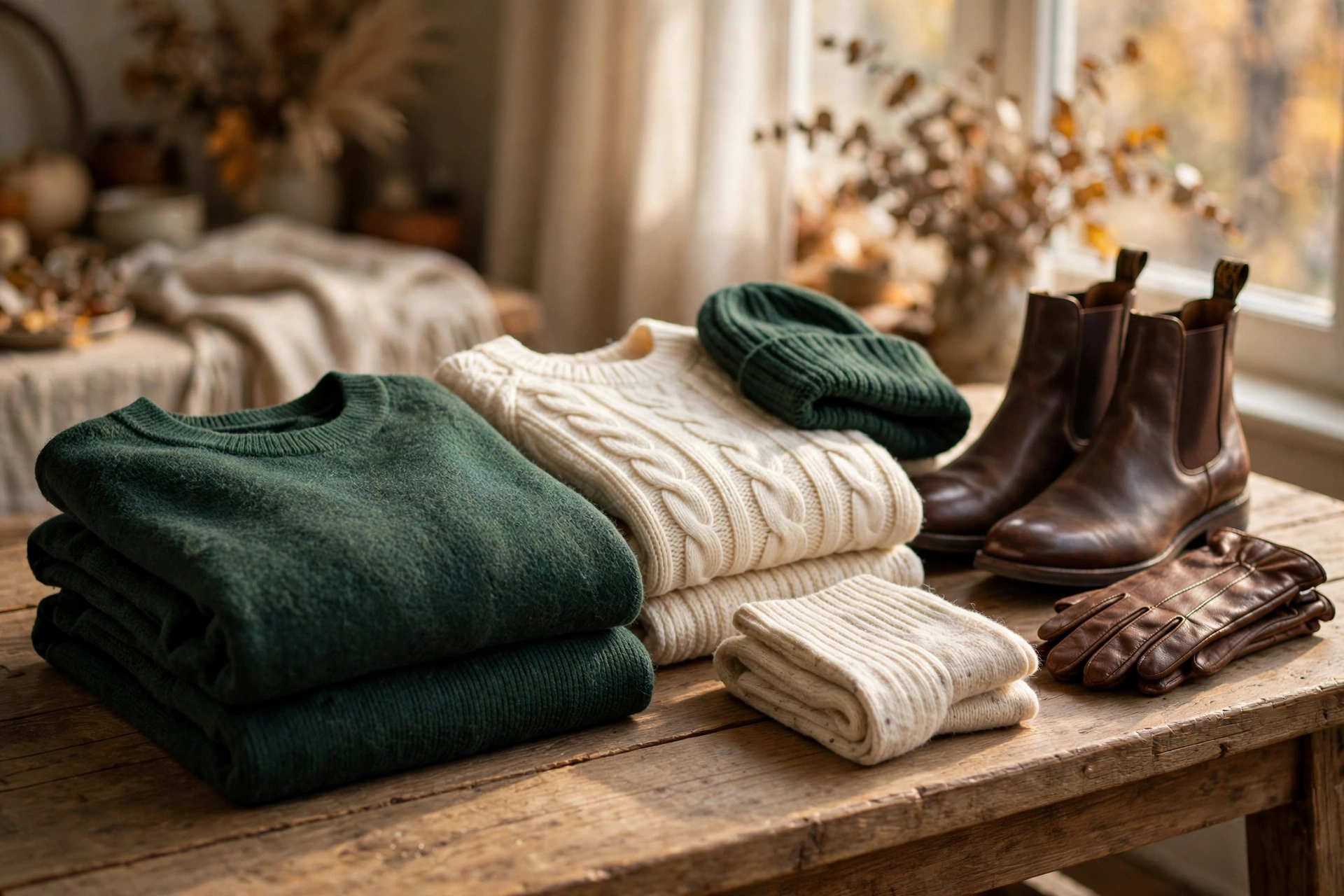
Disclosure: this post contains affiliate links. If you buy through them, we may earn a commission at no extra cost to you. We never claim to have tested products in our own home unless we say so plainly, and we have not tested these clothes. What follows is a close read of the listings, the fiber contents, and the research.
Here is the scene most winter clothing guides skip. It is 7 a.m. in January, the house is cold, and you are dressing in layers that will stay on your skin for the next twelve hours. The thermal under the sweater. The leggings under the pants. The socks inside the boots. That first layer touches you all day, gets washed more than anything else you own, and in most closets today it is polyester.
So we went looking for the opposite of the default women’s fall winter clothing outfit: a full cold-weather wardrobe built from fibers that were grown or raised, not extruded. Then we tried to argue ourselves out of our own top pick. Here is how that went.
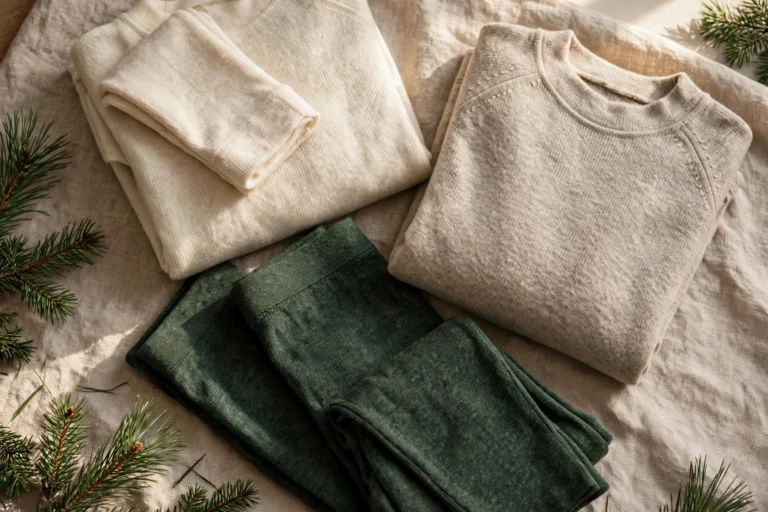
The short answer: if you buy one thing, buy the layer against your skin, and buy it heavy. The MERIWOOL Women’s Heavyweight 400g Merino Base Layer is 100 percent merino wool at 400 grams per square metre, the heaviest women’s merino base layer weight commonly sold, in a fine 18.5 micron knit. It is not perfect, and the case against it is below. But every other piece matters less than this one, because this is the layer you live in.
What are you actually buying?
A single long-sleeve crew, sized for women, in 100 percent merino wool. The weight is the headline: most women’s thermals sit at 150 to 250 grams per square metre. This one is 400. That is not a marketing adjective, it is a measurable spec, and it puts this top in a different warmth class from the midweight crews that fill most roundups, including our own merino base layers guide.
The fineness matters as much as the weight. The listing states 18.5 micron fiber, the fine grade that sits against skin without the scratch people remember from old wool sweaters. The listing linked here is the Pink Heather colourway in a small; the same top runs across a full women’s size range, and MERIWOOL sells it as a winter-season piece, not a three-season one. That honesty about season is a good sign. Brands that call a 150 weight top a winter thermal are the ones to watch.
Get the Weekly Swaps
One short email a week: the newest microplastics studies in plain English, plus the swaps that are actually worth your money. Join free and we will send you our room-by-room microplastic checklist to get you started.
Get Our Free Room-by-Room Microplastic ChecklistJoin the newsletter and get the checklist free →
The case against it
Before the evidence, the objections. If this top cannot survive its own weaknesses stated plainly, the verdict above is worth nothing. Here are the five strongest, with our honest answers.
“400 grams is too warm for real life.” Sometimes true. This is a winter-weight layer for cold houses, cold commutes, and outdoor days. In a heated office under a sweater it can run hot, and women in mild climates will be happier at 250 weight. Our answer is not to pretend otherwise: the Smartwool below is the 250 weight version of this same idea, and for a lot of readers it is the right buy. The verdict stands for genuinely cold weather, which is the season this article is about.
“MERIWOOL is not Smartwool.” True. It is a smaller, base-layer-only brand without Smartwool’s retail footprint, and if track record is your top criterion, the quarter zip below outranks it. Our answer: on the two numbers that decide warmth and comfort, 400 grams and 18.5 micron, this top beats the bigger brand’s heaviest women’s weight. Spec beats fame here, but we are not hiding the trade.
“Pure merino is fragile.” True, and it is the objection with the most physics behind it. A 100 percent merino knit has no nylon core to take abrasion, so it wears faster under pack straps, seatbelts, and rough laundry than a blend does. Our answer: that is the honest price of a zero-plastic layer, and you manage it with care, not denial. Cold gentle washes, no hot dryer, a fabric shaver for pills. If your base layer lives under heavy straps daily, buy a blend and accept the nylon; the socks below make exactly that trade on purpose.
“It costs real money for a shirt nobody sees.” True of every good base layer, and it is why the outfit is ranked this way. The layer against your skin is worn the most hours and washed the most often. Spending there first, and less on the visible sweater, is the whole buying plan below.
“Wool sheds too, so why bother?” Partly true, and it is the objection from our own side. Wool and cotton both release fibers in the wash. The difference is what those fibers are and how long they last, and the evidence below gives you the real numbers, including the part that cuts against natural fibers. Short version: a wool fiber is not a microplastic, and it does not persist like one.
Does the fiber actually matter, or is this overthinking?
It matters most exactly where this outfit starts: the layer in your breathing zone, worn for the longest hours. In a small pilot study from the University of Memphis, reported in October 2026, wearing a polyester T-shirt raised the microplastics measured in a person’s breathing zone by up to 42 percent compared with cotton, at roughly 2,000 particles per cubic metre. It was a pilot with a small sample, and we cite it as one. It was also funded by the cotton industry’s Cotton Foundation, which has its own interest in cotton beating polyester, so we weigh its result with that in mind. But it measured the route nobody thinks about: your shirt is the closest textile to your nose and mouth, all day.
The wash is the second route, and the numbers there are older and bigger. De Falco and colleagues, in Scientific Reports in 2019, found that washing synthetic garments releases large quantities of microfibers, with fabric construction and wash cycle changing the total substantially; read it at nature.com. Hernandez and colleagues found in Environmental Science and Technology in 2017 that polyester fabrics shed heavily in the wash, and how a fabric is built changes the total. That is why there is no fleece anywhere in this outfit, even though fleece is the default women’s winter layer in most stores.
Now the part that cuts the other way. Natural fibers shed plenty too: in real household loads studied by Lant and colleagues in PLoS ONE in 2020, most fibers released came from natural fabrics, simply because they shed readily. The difference is the ending. In biodegradation testing by Zambrano and colleagues at North Carolina State University, published in Marine Pollution Bulletin in 2019, cotton fibers biodegraded about 76 percent over 243 days in aquatic testing, while polyester showed no meaningful degradation. A wool or cotton fiber that escapes is short-lived. A polyester fiber persists. That, not zero shedding, is the honest case for this outfit.
You can also shed less of either kind. The same 2020 work found that a cold, short cycle cut fiber release by about 30 percent. Wool helps twice over: it resists odor, so a merino layer can be worn several times between washes, and every skipped wash is a shed event that never happens.
Why does fabric weight decide more than brand does?
Because warmth in a base layer is mostly trapped air, and fabric weight is the honest proxy for how much fiber is there to trap it. The market clusters at three weights. Around 150 grams per square metre is a cool-weather layer. Around 250 is the versatile midweight most brands lead with. At 400, the weight of our verdict pick, you are in true winter territory: single-digit mornings and unheated houses.
Most guides rank by brand and features and treat the weight as a detail. Read listings the other way around: weight first, then fiber content, then micron count. A 250 weight top from a famous brand will not out-warm a 400 weight top from a smaller one, and a blend that hides its polyester share in the fine print is not a natural fiber layer at all. Which brings us to the label problem.
What do the labels actually prove?
Two labels do real work in this outfit, and they answer different questions. GOTS, the Global Organic Textile Standard, certifies organic fiber content and holds the supply chain, processing, and labelling to rules checked by an independent certifier. The Pact pants below carry it. OEKO-TEX Standard 100 is narrower: the finished product was lab-tested against a list of more than 1,000 harmful substances. It says nothing about organic fiber or how a garment was made. The cable sweater below carries OEKO-TEX certification HK020 148434, and the MERIWOOL bottoms carry an OEKO-TEX certificate too.
Notice what neither label promises: anything about shedding. That claim lives in the fiber choice itself, and in how you wash.
Join Our Free Facebook GroupNon-Toxic Family Living: parents sharing swaps that work →
If not this one, then which?
Nine more pieces complete the outfit, ranked by how much each matters. Every pick is a name brand, every fiber content is from its listing, and every synthetic share is stated, not buried.
If you want the bigger brand, or run warm: the Smartwool Women’s Classic Thermal Merino Base Layer 1/4 Zip. Same idea at 250 grams per square metre, 100 percent merino, with a quarter zip that vents heat the crew cannot. It is the lead women’s pick in our merino base layers guide, and at REI this line’s women’s quarter zip is rated 4.7 stars from 383 reviews; an REI figure, labelled as such because it is not an Amazon one. Buy this instead if your winters are mild or you trust the bigger name.
For your legs, the matching half of the system: the MERIWOOL Women’s Base Layer Bottoms. A lightweight merino thermal pant, the 190 weight in MERIWOOL’s line, OEKO-TEX certified, in charcoal grey. Legs tolerate a lighter weight than your core because pants go over them. One honest note: the listing’s fabric field does not state a clean percentage for this exact item the way the 400g top’s does, so we call it a merino thermal bottom, which is what the listing supports, and no more.
The pants problem, answered honestly: the Pact Organic Cotton Women’s Gauze Wide Leg Pant. The truth about women’s winter pants on Amazon: natural fiber options are thin on the ground, and most insulated women’s pants are nylon shells. These are 100 percent organic cotton double gauze, GOTS certified, sizes XS to XXL, and the listing itself classifies them as a spring, summer, and early fall pant. We will not pretend a gauze pant is a winter pant. Worn over the merino bottoms above, though, the system works for fall and mild winter days: wool insulates, cotton covers, neither layer is plastic. On the coldest days this is the outfit’s weakest link, and we would rather say so than sell you a nylon pant as a natural pick.
The tee under everything: the Fair Indigo Women’s Organic Pima Cotton T-Shirt. A relaxed crew neck in 100 percent organic Pima cotton, fairly made in Peru with OEKO-TEX tested dyes, pre-washed and pre-shrunk. On mild days it is the top; on cold days it is the soft layer between skin and wool for anyone who finds even fine merino a touch much at first. It anchors our lower-plastic clothing swaps too: Pima’s longer staple makes a tee that lasts.
The sweater, where cotton beats acrylic: the Amazon Essentials Women’s Fisherman Cable Sweater. A cable knit crewneck in 100 percent cotton, OEKO-TEX Standard 100 certified, in plus sizes, ranked #58 in Women’s Pullover Sweaters on Amazon when we checked in November 2026. Most affordable women’s sweaters are acrylic, plastic yarn with good marketing. This one is the classic fisherman cable in an actual plant fiber, and the direct counterpart of the cotton sweater in our men’s natural fiber outfit. The trade-off: cotton is less warm for its weight than wool and holds moisture, so this is a town sweater over merino, not a wet-weather layer.
The socks, where we accept the blend on purpose: the Darn Tough Women’s Hiker Micro Crew, Style 1903. The blend is 59 percent merino wool, 39 percent nylon, and 2 percent Lycra, stated in the open because this is the one place the outfit deliberately trades purity for lifespan. Socks take more abrasion than any other garment you own, Darn Tough knits these in Vermont, and the company guarantees them for life. A guaranteed sock kept for a decade can shed less over its life than pure wool pairs that hole out and get binned. If your line is zero synthetics, skip this one; the math that earns it a place here is durability, not purity.
The hat, the easiest swap in the whole outfit: the Minus33 Ridge Cuff Beanie. One hundred percent merino wool in a double-layered interlock knit, one size, sold for men and women. Most beanies on Amazon are 100 percent acrylic, plastic knitted into the shape of warmth. This one is the fiber those beanies imitate. A fall and town hat rather than an expedition hat, and one size will not fit every head equally well, but as a first swap nothing here is simpler.
The gloves, in leather and sheepskin: the UGG Women’s Turn Cuff Sheepskin Gloves. The fabric is 100 percent sheepskin, water resistant, from a brand that built its name on sheepskin. Leather and sheepskin block wind and mold to your hands instead of delaminating like coated synthetic gloves. The honest cons: town and driving gloves, not ski gloves; spot cleaning by a leather specialist; and UGG sells several similar styles, so check the listing you land on is the Turn Cuff sheepskin one.
The boots, and the outfit’s one big ticket: the Thursday Boot Company Women’s Duchess Chelsea Boots. A pull-on ankle boot in 100 percent leather with a leather lining and rubber sole, in women’s sizes 5 to 12. Leather blocks wind, sheds slush, breaks in to your foot, and can be conditioned for years instead of cracking like synthetic uppers. The cons are the usual leather ones: a break-in period, regular conditioning, and an ankle height that makes it a fall and mild-winter boot, not a deep snow boot. It is also the outfit’s highest-ticket piece, which is why it sits last in the buying plan.
And the one we would skip: the prAna Koen pant, a popular women’s style from a brand we like and have recommended for men. Its own listing specs put the fabric at 81 percent nylon, 10 percent polyester, and 9 percent elastane. That is a plastic pant wearing a natural brand’s reputation, exactly the label trap this article exists to catch. We name it without linking it. Check the fabric line on every pair of pants you consider, including ours.
Browse Our Full Amazon StorefrontAll our women’s natural fiber clothing picks in one place →
What we would actually buy
Concrete, in order. First, the verdict top and the bottoms as a set. The MERIWOOL 400g crew plus the MERIWOOL base layer bottoms are the system everything else hangs on. Buy one set first and let your own thermostat settle the 400 versus 250 argument before buying a second set.
Second, the hat and the socks. The Minus33 beanie and two pairs of the Darn Tough Hikers are the smallest spend in the outfit, and the two pieces most likely to be acrylic or polyester blends in your current rotation.
Third, the sweater and the tee. The cotton cable sweater replaces the acrylic one you own when it wears out, not before, and the Fair Indigo tee covers mild days and wool-sensitive mornings. Replace by attrition; a working wardrobe thrown out in one weekend is waste wearing a halo.
Last, the boots and gloves. The Duchess Chelseas and the UGG sheepskin gloves are buy-it-for-years purchases. Make them when your current pair dies, and condition the leather twice a season. Skip the matching synthetic sets entirely: the fleece zip-up, the acrylic beanie-and-glove gift set, the nylon insulated pant. This outfit already covers each of them in a fiber that breaks down.
Rapid-fire: the questions everyone asks
What is the best natural fiber for women’s winter clothing?
Merino wool, for anything against skin. It insulates when damp, resists odor so it needs less washing, and biodegrades at end of life. Cotton covers tees, sweaters, and pants; leather covers gloves and boots.
Do wool and cotton clothes shed microplastics?
No. They shed natural fibers, which are not plastic. Cotton fibers biodegraded about 76 percent over 243 days in the Zambrano et al. 2019 aquatic testing, while polyester showed no meaningful degradation. What escapes breaks down.
How do I wash merino without ruining it?
Cold water, gentle cycle, mild detergent, air dry. Odor resistance means most pieces need washing only after several wears, and cold short cycles cut fiber release by about 30 percent per Lant et al. 2020. Heat plus agitation is what felts wool.
Is there a truly warm natural fiber winter pant for women?
Not that we could verify on Amazon, and we looked. The honest system is a merino base bottom under a natural fiber pant, which is what this outfit does. Any guide selling a nylon insulated pant as a natural pick hopes you skip the fabric line.
What should I replace first if my whole wardrobe is synthetic?
The base layer. It touches the most skin, sits in your breathing zone, and gets washed the most. Then the hat and socks, and the visible pieces as they wear out. Our fleece alternatives guide and organic cotton underwear guide cover the rest of the closet.
Add Us as a Preferred Source on GoogleOne tap, and our guides show up first in your Google results →
Keep reading
Building the other half of the household? The men’s fall and winter clothing guide builds the same skin-out system for men. For the base layer science in full, our merino base layers guide covers adult and kids weights side by side, the fleece alternatives guide handles the jacket layer this outfit leaves out, and lower-plastic clothing swaps covers the everyday staples beyond winter.
Our verdict survived its own case against it, which is the only kind worth printing. Start with the layer against your skin, buy it heavy, and let the rest follow by attrition.