The Best Non-Toxic Laundry Soap for Families in 2026
Some of the links below are affiliate links. If you buy through them, we may earn a small commission at no extra cost to you. We only recommend products we would use in our own homes. Read our full affiliate disclosure
If you’re shopping for non toxic laundry soap for your family, the label is almost never the full story. Most detergents marketed as “natural,” “free and clear,” or “gentle” still contain ingredients that irritate skin, disrupt hormones, or pollute waterways. The labeling is soft, the regulation is minimal, and the ingredient lists are built to look cleaner than they are. If you’ve already started reducing your family’s exposure to microplastics in drinking water and kitchen products, laundry detergent is the next logical place to look.
This guide covers what’s actually hiding in conventional detergents, which certifications to trust, and which natural laundry soap options consistently perform well in 2026. By the end, you’ll know exactly what to buy or how to make it yourself, depending on whether you’re dealing with sensitive skin, an HE washer, cold-water cycles, or a tight budget. No sponsored picks, no vague recommendations.
THE QUICK ANSWER
The best non toxic laundry soap for most families is Branch Basics, an EWG Verified concentrate that covers laundry and household cleaning in one product. For sensitive skin and infant laundry, Molly’s Suds Original Unscented Powder has the simplest ingredient list. If you are switching on a budget, Seventh Generation Free & Clear carries EPA Safer Choice certification and costs the least per load.
Best overall: Branch Basics + Oxygen Boost
Best for babies: Molly’s Suds Original Unscented
Best on a budget: Seventh Generation Free & Clear
Best zero-waste: Blueland Laundry Tablets
What’s hiding in your laundry detergent
Conventional detergents are engineered to clean, but the ingredient list is often full of compounds that have no business touching a baby’s onesie. The problem isn’t that these products don’t work. The problem is what else they’re doing while they clean.
The worst offenders on most ingredient lists
Synthetic fragrance (listed as “fragrance” or “parfum”) is one of the biggest red flags. This single word can hide dozens of undisclosed chemicals, including phthalates, which are endocrine disruptors, and volatile organic compounds (VOCs) that linger in fabric long after the wash cycle ends. Regulators don’t require manufacturers to disclose what’s inside a fragrance blend, so you’re essentially trusting a black box.
Optical brighteners are UV-reactive chemicals added to make whites look whiter. They don’t rinse out. They coat your fabric, sit against your skin all day, and accumulate in waterways where they’re toxic to aquatic life. They contribute nothing to actual cleaning.
Surfactants like sodium lauryl sulfate (SLS) and sodium laureth sulfate (SLES) are common in liquid detergents. Both can strip skin oils and trigger eczema flares in sensitive users. SLES carries an additional problem: it’s made through a process called ethoxylation that often leaves behind 1,4-dioxane, a likely human carcinogen according to the EPA, as a contamination byproduct. Nonylphenol ethoxylates (NPEs) fall into the same category and are flagged as endocrine disruptors in environmental toxicology research.
Other red-flag ingredients worth scanning
Quaternary ammonium compounds (quats) appear in many “antibacterial” or fabric-softening formulas and are linked to respiratory sensitization and aquatic toxicity. Preservatives like methylisothiazolinone (MI), methylchloroisothiazolinone (MCI), and benzisothiazolinone are well-documented skin sensitizers, especially problematic for babies.
Formaldehyde-releasing preservatives such as DMDM hydantoin and quaternium-15 slowly off-gas formaldehyde into the air and onto fabric. Phosphates, synthetic dyes, and chlorine bleach round out the list. Scan labels for these exact names before buying any detergent, whether it’s marketed as natural or not.
How to decode labels and certifications
Front-of-label language like “plant-based,” “natural,” or “clean formula” is unregulated. Any brand can use those words on any product. What actually matters is whether a third party reviewed the formula against real health and environmental criteria.
Certifications that carry real weight
EPA Safer Choice is the strongest signal available for U.S. laundry products. It’s a government-administered program where every ingredient is reviewed against EPA health and environmental criteria, and compliance is verified through auditing. If a detergent carries this seal, the formula has been scrutinized, not just the marketing. EWG Verified is the next best option: it’s nonprofit-run using EWG’s own ingredient standards, and it requires full ingredient disclosure while excluding chemicals flagged in their toxicology database. A detergent carrying either of these certifications has cleared a real bar, that’s a meaningful distinction from standard “clean” marketing.
Labels that don’t tell you much about safety
USDA Organic is designed for agricultural products, not cleaning formulas. A detergent with a USDA label may contain organically sourced ingredients, but that says nothing about whether the full formula is safe. Leaping Bunny means the product wasn’t tested on animals, which is a legitimate ethical commitment, but not a toxicity indicator. “Natural” and “clean formula” mean nothing legally. These labels aren’t necessarily bad; they just don’t tell you whether the product is safe to use on your kid’s pajamas.
The microplastics connection: why your wash routine matters beyond skin safety
Every time you wash a garment made from polyester, nylon, acrylic, or any other synthetic fabric, it sheds microplastic fibers into the wastewater. Most treatment plants don’t catch all of them. Those fibers end up in waterways, in soil, and eventually in the food supply. This is already a documented problem at scale, and your home washing machine is a direct contributor. One peer-reviewed analysis of consumer apparel textiles measured fiber loss across dozens of fabrics and found shedding varied enormously depending on material and construction.
How washing habits affect microplastic shedding
Cold-water cycles and lower spin speeds reduce the mechanical stress on fabric, which reduces fiber shedding. Some research suggests that less-alkaline, liquid detergent formulations may also reduce microfiber release compared to harsh surfactant blends. The evidence isn’t perfectly settled, but the direction is consistent: gentler washing conditions mean fewer fibers leaving your machine. A Guppyfriend Washing Bag catches a meaningful share of what does shed, and it’s the simplest add-on if you wash a lot of synthetics. Our related guide covers the synthetic clothing problem in depth, and laundry habits are a core part of that conversation.
What this means when you choose a detergent
Choosing a fragrance-free, plant-based laundry detergent without harsh surfactants isn’t just better for sensitive skin. It’s part of a broader effort to reduce the chemical load and physical stress your wash cycle puts on both fabric and waterways. Wash temperature and spin settings matter too, check out our related guides on how to avoid microplastics in your food, water, and home for the full picture.
The best non toxic laundry soap options in 2026, compared
Rather than ranking these by number, here’s how to pick based on your actual situation. Each recommendation is specific: format, certifications, and who benefits most.
| Product | Format | Certification | Best for | HE safe |
|---|---|---|---|---|
| Branch Basics + Oxygen Boost | Liquid concentrate | EWG Verified | One product for laundry and whole-home cleaning | Yes |
| Molly's Suds Original | Powder | Fragrance-free formula | Sensitive skin and infant laundry | Yes |
| Meliora Laundry Powder | Powder | EWG Verified, MADE SAFE | Compostable, low-waste packaging | Yes |
| Seventh Generation Free & Clear | Liquid | EPA Safer Choice | Budget and easy availability | Yes |
| ECOS Hypoallergenic | Liquid | EPA Safer Choice | Lowest cost per load | Yes |
| Blueland Laundry Tablets | Tablet | Plastic-free packaging | Zero-waste, pre-measured dosing | Yes |
| Dropps Laundry Pods | Pod | Fragrance-free options | Convenience with no measuring | Yes |
Branch Basics: best for whole-home simplicity
Branch Basics is built around a single concentrate you dilute for different jobs, so one bottle covers laundry, counters, glass, and the bathroom. It is EWG Verified and completely fragrance-free, and that second part is what families notice first. Reviewers with eczema-prone kids or scent-triggered allergies keep making the same point: it smells like nothing at all, not “fresh linen,” just nothing. The Oxygen Boost powder that pairs with it is two ingredients, sodium percarbonate and sodium bicarbonate, with no chlorine bleach, and it does the real work on odors and set-in stains.
The tradeoffs are significant and we are not going to bury them. This is the most expensive option in this guide and it is not close. Depending on how you dilute the concentrate, independent reviewers put the true cost somewhere between roughly $0.75 and $1.60 per load, several times what a good powder runs. Laundry is also the weakest job this product does. Long-term users report towels feeling stiff after a few months, and testers who compared the concentrate against Branch Basics’ own laundry powder found the powder cleaned better. On everyday food and dirt stains reviewers rate it well. On set-in grease it needs the Oxygen Boost, and even then it trails enzyme detergents.
We still put it first because of what it replaces. When four bottles under the sink become one, you stop reading four ingredient lists, you stop storing four plastic jugs, and a recurring decision disappears from your week. For families whose laundry is mostly everyday loads, that trade is worth making. If you are buying strictly for laundry performance, buy a powder instead and spend the difference somewhere else.
Molly’s Suds: best for sensitive skin and infant laundry
Molly’s Suds Original Unscented Powder has the shortest ingredient list here: sodium carbonate, sodium bicarbonate, magnesium sulfate, and unrefined sea salt, all printed on the bag. Powder does not need the preservatives that liquid formulas require, which removes an entire category of skin sensitizers before you open it. A bag runs about 70 loads and lasts most families months, so the cost per load lands well under any concentrate. It is deliberately low-sudsing, which is exactly what an HE machine wants.
There are no enzymes in it, so ground-in dirt and set-in grease need pretreating. Molly’s own directions tell you to mix the powder into a paste and work it into the stain first, which works but is an extra step on a busy night. In cold water the powder does not always dissolve fully, and the complaint that comes up most often is white marks left on dark clothes. Families switching over from conventional detergent also tend to see dingy whites for the first several washes. That is not the detergent failing. It is optical brighteners no longer masking mineral buildup that was already in the fabric.
For infant laundry and eczema-prone skin this is still the first thing we hand people. Fewer ingredients means fewer things to react to, and there is no fragrance blend hiding anything unlisted. Run it warm rather than cold, pretreat what needs it, and it handles normal family laundry week after week without drama.
Meliora: best low-waste powder
Meliora Laundry Powder carries both EWG Verified and MADE SAFE, meaning two independent organizations reviewed the formula instead of one. The packaging is the other draw. The canister is cardboard and steel, refills arrive in a paper bag, and no plastic enters your laundry room at any point in the cycle. The formula is biodegradable and septic-safe, and reviewers who have rebought it repeatedly describe performance on normal loads as solid and consistent.
It costs more per load than Molly’s Suds, and it is a smaller company, so stock runs out more often. Being a powder, it inherits the same limits: no enzymes, so heavy-soil loads need pretreating, and cold water can leave residue if the cycle is short.
Choose Meliora when the packaging matters to you as much as the formula does. Two certifications is a meaningfully stronger signal than one, and this is the only pick in the guide that leaves nothing plastic behind.
Seventh Generation Free & Clear: the easiest switch to make tonight
Seventh Generation Free & Clear carries EPA Safer Choice, the strongest certification in this guide. Every ingredient is reviewed against government health and environmental criteria and compliance is audited, so the formula itself has been examined rather than just the marketing around it. Because it is a liquid, it dissolves at any water temperature, which erases the single most common complaint about the powders. It costs a fraction of the concentrates and you can pick it up tonight at Target or Walmart.
The plastic jug is a real tradeoff on a site about reducing plastic, and there is no refill system to soften it. Stain performance sits in the middle: better than the powders on grease, well behind enzyme-heavy conventional detergents on anything set in. The more practical problem is the shelf itself. Seventh Generation sells a lot of nearly identical bottles and only some of them are Free & Clear, with scented versions sitting right next to them. Read the label every time, including on reorders.
This is the pick when the barrier is inertia rather than budget. A certified detergent you actually buy tonight beats a better one you keep meaning to order. For most families making a first switch, it is the easiest yes in the guide.
ECOS Hypoallergenic: lowest cost per load
ECOS Hypoallergenic is also EPA Safer Choice certified and usually the cheapest per load in this group. It uses plant-derived surfactants with no optical brighteners and no dyes, and like Seventh Generation it is a liquid, so cold cycles are not a problem.
It is mild, and reviewers say so consistently. Fine on everyday loads, underwhelming on anything set in. It comes in the same large plastic jug. ECOS also sells a wide scented lineup, some of it using essential oils, which still count as fragrance for anyone sensitive, so the Hypoallergenic Free & Clear version is the specific one to look for.
When you are running laundry every single day, cost per load stops being a detail and becomes the whole decision. This is the pick for large families and high volume, and it clears the same government-audited bar as our budget pick above.
Blueland Laundry Tablets: best zero-waste option
Blueland Laundry Tablets are bare tablets with no film wrapped around them, which is unusual in this category. Dosing is built into the tablet, so overdosing an HE machine is not possible, and no plastic jug ever enters the laundry room. Refills ship in paper. Fragrance-free versions are available, and those are the ones we would point you toward.
Tablets cost more per load than powder, and the complaint that comes up most is incomplete dissolving on short or cold cycles. That is worth knowing before you rely on one for a fast wash.
There is context worth having here too. Blueland led the 2023 coalition that petitioned the EPA to require safety testing on PVA, the dissolving film used in most pods, and the EPA denied that petition. Blueland also sells the film-free alternative, so it is not a neutral voice in that argument. We cover the full PVA question in our non-toxic cleaning products guide. None of that changes what the tablet actually is, and it remains a well-made product. It just means you should read Blueland’s own materials on PVA knowing what the company has at stake.
Dropps: most convenient, with one open question
Dropps pods are the lowest-effort option in this guide. One pod in the drum and you are finished. No measuring, no jug, no powder to dissolve. Fragrance-free options are available, and the cardboard packaging is a genuine improvement over a plastic bottle.
They share the tablet dissolving complaints on short or cold cycles, and the cost per load runs above powder. The bigger question is the film. Dropps pods use polyvinyl alcohol, or PVA, and whether it fully breaks down after it dissolves is genuinely unsettled. A 2021 study estimated that a large share of the roughly 17,200 metric tons used in U.S. detergent pods each year passes through wastewater treatment without breaking down. Industry-funded expert panels concluded the opposite, and the EPA declined to act on the petition asking for testing. Nobody in that argument is neutral, including the study’s lead author and the brands selling alternatives.
Our position has not changed since we wrote about this in our cleaning products guide: the question is unsettled, and we are not going to pretend otherwise. Dropps is a well-formulated, genuinely convenient pod, and if you find the EPA’s reasoning persuasive it is a reasonable buy. If the open question bothers you, the film-free tablet costs about the same.
Our Best Non-Toxic Cleaning Picks
We keep our favorite lower-tox cleaning products in one place, from everyday sprays and dish soap to laundry and refill systems, so you can clean your home without second-guessing the ingredients.
See Our Non-Toxic Picks →How to choose non toxic laundry soap for infants
For newborn and infant laundry, prioritize fragrance-free powder formats with the fewest ingredients possible. Meliora and Molly’s Suds are the most practical commercial picks. If you want complete ingredient control, the DIY powder recipe below is the safest option, just skip the essential oils entirely. Avoid any product with optical brighteners, synthetic fragrance, or quaternary ammonium compounds; these are the most common triggers for infant skin reactions and respiratory irritation.
Join Other Families Making the Switch
We run a Facebook group where families share what is actually working, ask questions, and compare notes on products. No pressure and no sales pitch, just people figuring this out together.
Join the Group →What to realistically expect from a chemical-free laundry detergent
Hypoallergenic and plant-based laundry detergents handle everyday loads very well: sweat, food stains, body oils, and general grime. Where the gap with conventional detergents shows up is on set-in grease, grass, and heavy-soil stains, where enzyme content and wash temperature matter more than anything else.
Stain removal and cold-water performance
Most leading options in this category are formulated specifically for cold-water cycles, which is energy-efficient and appropriate for the majority of family laundry. For tougher stains, pretreatment with a concentrated version of the same detergent or a safe enzyme-based stain spray bridges most of the performance gap. Branch Basics paired with its Oxygen Boost is the strongest performer on difficult stains among the options covered here. Most other picks handle routine loads well, with pretreatment recommended for anything stubborn.
HE washer compatibility
All of the products above are HE-safe. Low-sudsing formulas are essential in HE machines, since excess suds cause residue buildup and can interfere with the wash cycle. If you go the DIY route covered below, keep doses small and place the powder directly in the drum rather than the dispenser for better dissolution.
A simple DIY non toxic laundry soap recipe (borax-free)
If you want full control over every ingredient, this borax-free powder recipe covers most household laundry without any of the red-flag chemicals found in conventional detergents. It’s the simplest homemade laundry detergent recipe for families with young children, and every ingredient is traceable.
The basic powder recipe
- 1 bar castile soap, finely grated
- 1 cup washing soda
- 1 cup baking soda
- 1 cup fine sea salt or kosher salt
- 20 to 30 drops essential oil (optional; skip entirely for newborn laundry)
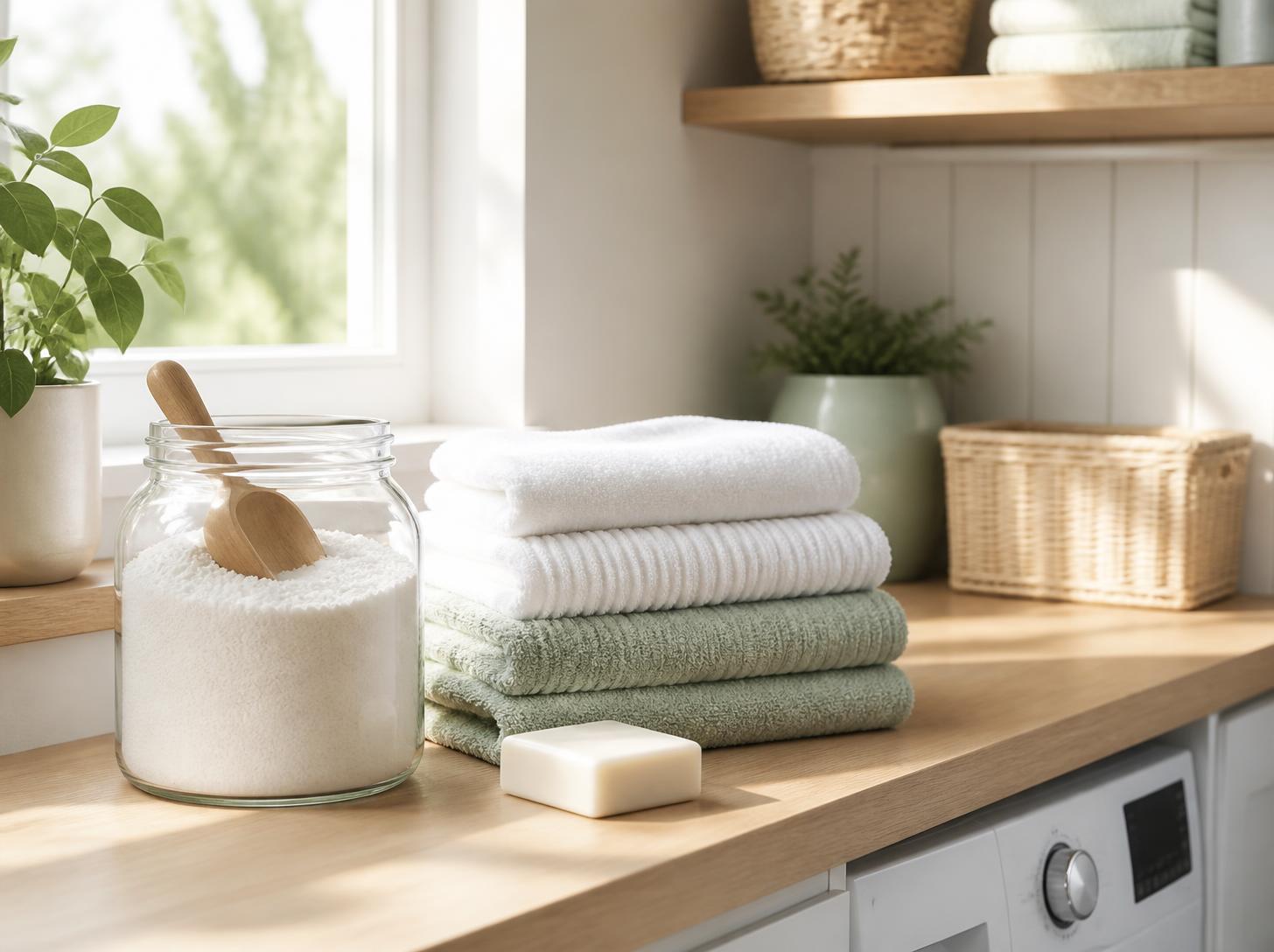
Mix the dry ingredients first until uniform. Add the grated castile soap and blend thoroughly. Use 1 to 2 tablespoons per load in a standard washer and 1 tablespoon in HE machines. Place directly in the drum rather than the dispenser.
Preparation and storage tips
Grate the castile soap as finely as possible so it dissolves evenly and doesn’t clump in the drum. Store the finished powder in an airtight glass jar or lidded container in a low-humidity area. If your water is very hard, add an extra tablespoon of washing soda per load. This recipe is not ideal for heavy-soil loads, and performance on set-in stains will be modest compared to enzyme-rich commercial options. For a newborn’s laundry, skip the essential oils entirely.
Frequently Asked Questions
What’s actually hiding in laundry detergents labeled “natural” or “gentle”?
Front-of-package claims are often marketing. Many products still contain undisclosed synthetic fragrance (listed as “fragrance” or “parfum”), optical brighteners, surfactants like sodium lauryl sulfate (SLS) or sodium laureth sulfate (SLES), and other additives that can irritate skin or harm waterways. Labels omit many problematic ingredients, and regulation of these claims is minimal.
Which specific ingredients should I scan for and avoid on detergent labels?
Look for and avoid synthetic fragrance (“fragrance” or “parfum”), optical brighteners, sodium lauryl sulfate (SLS) and sodium laureth sulfate (SLES), nonylphenol ethoxylates (NPEs), quaternary ammonium compounds (quats), preservatives like methylisothiazolinone (MI), methylchloroisothiazolinone (MCI) and benzisothiazolinone, formaldehyde-releasing preservatives such as DMDM hydantoin and quaternium-15, plus phosphates, synthetic dyes, and chlorine bleach. These are linked to skin sensitization, endocrine disruption, persistence on fabric, or aquatic toxicity.
Are label claims like “plant-based” or “clean formula” trustworthy?
No. Those front-of-label terms are unregulated and can be used by any brand regardless of ingredients. Rely on third-party reviews and certifications rather than marketing language to verify health and environmental safety.
Which certifications should I trust when choosing a safer laundry soap?
EPA Safer Choice is the strongest signal for U.S. laundry products, because the program reviews every ingredient against EPA health and environmental criteria and audits compliance. EWG Verified is the next best option. It’s nonprofit-run, requires full ingredient disclosure, and applies EWG’s own ingredient standards.
What should I choose if I need a detergent for sensitive skin or for babies?
Avoid products with synthetic fragrance, optical brighteners, harsh surfactants (SLS and SLES), quats, and known skin-sensitizing preservatives like MI, MCI, and benzisothiazolinone. Choose formulas vetted by credible third parties such as EPA Safer Choice or EWG Verified. Molly’s Suds and Meliora are the two we point parents to most often. Test any new product on a small batch of clothing first.
How do I pick a non toxic detergent if I have an HE washer or wash in cold water?
Choose low-sudsing formulas that are explicitly labeled for HE washers, and look for products advertised or tested to perform in cold-water cycles. Blueland and Dropps are the easiest picks here, since the dosing is pre-measured and the sudsing is controlled by design. HE compatibility and cold-water performance are both important selection criteria when shopping for safer detergents.
Can I make a safe laundry soap at home if I’m on a tight budget?
Yes. DIY is a real option for budget-conscious families, but the same ingredient rules apply: avoid synthetic fragrances, optical brighteners, and known sensitizers or aquatic toxins. If you make your own, stick to simple, fully disclosed ingredients like castile soap, washing soda, and baking soda, and patch-test fabrics for skin reactions before full use.
The bottom line
For families, the best non toxic laundry soap is one with a short, recognizable ingredient list, no optical brighteners or synthetic fragrances, and a credible third-party certification. Pick a certified detergent from the list above, or make the simple powder version if you want full ingredient control. Either way, the goal is the same: a fragrance-free, eco-friendly laundry detergent that cleans effectively without adding unnecessary chemical exposure to your home.
What you put in your washing machine affects more than clean clothes. It affects the air in your laundry room, your family’s skin, and the water that leaves your home. The detergent you choose is one part of a broader strategy that includes the fabrics you buy, how you wash them, and what you filter. Our guides cover all of it, from synthetic fabrics and microplastic fiber filtration to water filtration and safer kitchen swaps.
Start with one swap. Branch Basics or Molly’s Suds if you’re ready to invest; Seventh Generation Free & Clear if you want to start tonight at Target. Switching to a non toxic laundry soap doesn’t have to be complicated to make a real difference.
Explore more of our non-toxic family articles
- What Clothing Sheds the Most Microplastics?
- How to Avoid Microplastics in Your Food, Water, and Home
- Microplastics in Water: 5 Powerful Filters That Actually Work
- Microplastics in the Kitchen: What You’re Really Cooking With
- Microplastics in the Kitchen: 12 Simple Swaps to Protect Your Family
- The Ultimate Guide to Plastic-Free Food Storage
- The Ultimate Beginner’s Guide to Microplastics