Best Air Purifiers for Microplastics and Dust (2026)
Affiliate disclosure: We may earn a small commission when you buy through the links on this page, at no extra cost to you. We only recommend products we would tell a friend about. Read our full affiliate disclosure
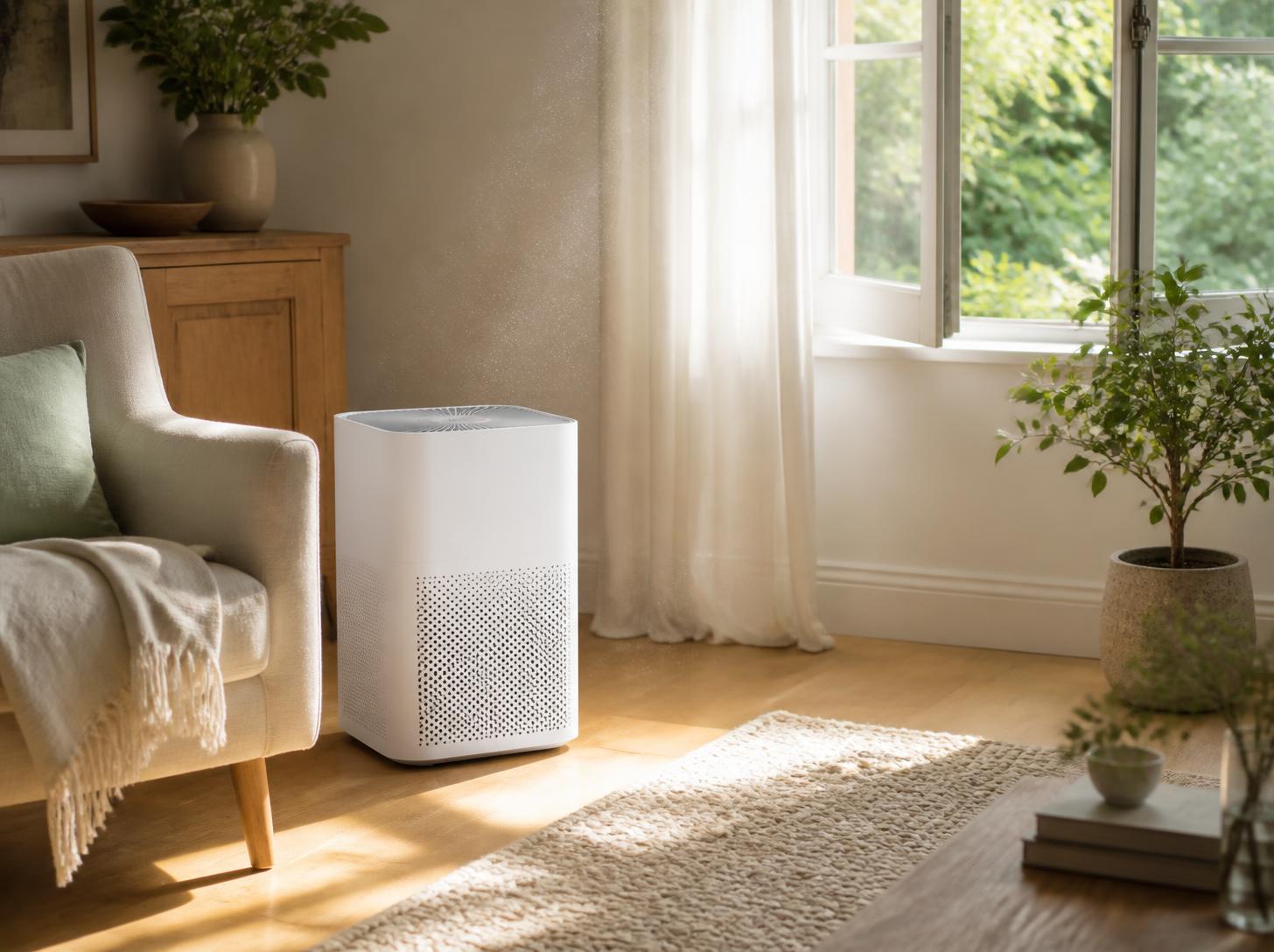
You know that moment when the afternoon sun comes through the window at just the right angle, and suddenly you can see everything floating around the room? All those little specks drifting through the light that were completely invisible ten seconds ago?
We always assumed that was dust. Some of it is. But a good share of what is drifting through that sunbeam is plastic fiber, shed from the carpet, the curtains, the couch, and the pile of laundry waiting to get folded. Once you know it is there, it is a little hard to unsee.
Here is the part that really got our attention. Researchers keep finding more plastic in indoor air than in outdoor air, and most of us spend about ninety percent of our lives inside. The air we worry least about is the air we breathe the most.
The good news is that this one is genuinely fixable, and it does not take much. A decent air purifier pulls a real share of those fibers out of the room, and for most families the Coway Airmega AP-1512HH Mighty is the one we would buy without overthinking it. Independently verified performance numbers, fits in a normal bedroom, and filters that will not wreck your budget.
Below are the best home air purifiers for microplastics we would actually put in our own house, how to work out what size you need, and a free lookup tool that tells you in about thirty seconds whether a model is a plain filter or something more complicated. We will also be straight with you about what a purifier cannot do, because no machine fixes this on its own.
Quick Answer
The best home air purifier for microplastics and dust uses a true HEPA filter, has a clean air delivery rate high enough for your room size, and does not produce ozone. Here are our picks for 2026:
- Best overall: Coway Airmega AP-1512HH Mighty
- Best with no ionizer at all: Coway Airmega Mighty2
- Best budget pick: Levoit Core 300S-P
- Best for pets and odors: Winix 5510
- Best for bedrooms and round-the-clock use: Blueair Blue Pure 311i Max
- Best for chemical sensitivity and smoke: Austin Air HealthMate Plus
- Best premium pick: IQAir HealthPro Plus XE
Why Indoor Air Deserves Attention
A 2024 systematic review published in the Journal of Exposure Science and Environmental Epidemiology pulled together the available research on microplastics in indoor and outdoor air. When the researchers calculated how much people actually breathe in, indoor exposures came out higher than outdoor exposures. Infants had the highest calculated doses of any age group, followed by preschool-age children.
That last part is the reason we wanted to write this guide. Small children spend more time close to the floor, where fibers settle and get stirred back up, and they breathe more air relative to their body size than adults do.
We want to be careful here. Researchers have confirmed that these particles are in indoor air and that we inhale them. What those particles do to us over a lifetime is still being studied, and anyone who tells you otherwise is getting ahead of the science. Reducing avoidable exposure is sensible. Panic is not.
Where the fibers come from
Almost all of it is textile. Polyester carpet, synthetic curtains, upholstered furniture, fleece blankets, and the clothes we wear and wash. These shed constantly, not just when disturbed. We wrote about which fabrics shed the most in our guide to what clothing sheds the most microplastics, and the same materials behave the same way sitting in a living room.
This matters for a practical reason. A purifier is downstream of the problem. It catches what is already floating. Swapping a polyester rug for wool or cotton over time does more than any machine, but it also costs more and takes longer, so most of us do both.
What Actually Catches Airborne Plastic
Three things matter, and only three. Everything else on the box is marketing.
1. A true HEPA filter
A true HEPA filter captures 99.97% of particles at 0.3 microns. Airborne plastic fibers are generally larger than that, which is good news, because it means a plain mechanical filter handles them well. You do not need exotic technology.
2. A clean air delivery rate that matches your room
Clean air delivery rate, or CADR, measures how much filtered air the machine actually produces. The EPA notes that you should choose a portable air cleaner with a CADR large enough for the room you plan to use it in, and that the higher the CADR, the more particles it can filter and the larger the space it can serve.
A rough rule: aim for a CADR of about 65 for every 100 square feet. A 300 square foot bedroom wants roughly 195 or better. We come back to sizing further down.
3. Running it consistently
A purifier does nothing when it is off. Fibers are shed continuously, so the machine needs to run continuously to keep up. This is why noise and energy use matter more than people expect, and why we included a pick that is specifically good at running all day without anyone noticing.
How to Check Any Air Purifier in 30 Seconds
This is the most useful thing in this article, and almost nobody mentions it.
The California Air Resources Board maintains a public list of certified air cleaning devices. Any purifier sold in the United States has to be on it. The list sorts every model into one of two categories, and that single word tells you what technology is inside.
- Mechanical: physical filtration only. No ions, no ozone generated. This is a plain filter and a fan.
- Electronic: includes ionizers, electrostatic filtration, photocatalytic oxidation, hydroxyl generators, and units with UV components. These have been tested and produce no more than 50 parts per billion of ozone, but they are capable of generating some.
Search the model number, read the category, decide for yourself. It takes half a minute and it cuts through every marketing claim on the box.
We want to be fair about what this means. Electronic does not mean dangerous. It means there is a second mechanism at work beyond a filter, and some people, particularly anyone with asthma or a respiratory condition, have been told to avoid those entirely. If that is you, the list makes the decision easy. If it is not, an electronic unit may be a perfectly good buy, and one of our picks is exactly that.
What to Skip
Skip anything sold as an ozone generator. The EPA is clear that some air cleaning devices fail to destroy pollutants completely and instead produce new indoor pollutants that irritate the eyes, throat, and nose. That is the opposite of the goal.
Be skeptical of any purifier that claims to destroy or eliminate particles rather than trap them. Destruction claims are hard to verify and have not always held up. A filter that physically captures a fiber and holds it is boring, provable, and enough.
Ignore the biggest square footage number on the box. Manufacturers often advertise coverage at one air change per hour, which is far too slow to matter for allergens or fine particles. The number that counts is the one based on roughly four to five air changes per hour, and it is usually a quarter of the size of the headline figure.
The 7 Best Home Air Purifiers for Microplastics and Dust
Below are the 7 air filters we have researched, used our selves and recommend to all our readers.
Coway Airmega AP-1512HH Mighty — Best Overall
Best for: Most families. Bedrooms and medium living rooms up to about 361 square feet.
Coway Airmega AP-1512HH Mighty is the purifier we recommend when someone asks us for one answer. Its CADR figures of 246 for dust, 240 for smoke, and 233 for pollen are AHAM Verifide, which means a third party tested and confirmed them rather than the manufacturer simply publishing a claim. In a category full of invented numbers, that matters.
The outer pre-filter is a washable mesh that never needs replacing, just a rinse every few weeks. There is an air quality sensor with a color-coded light, an auto mode that adjusts fan speed on its own, and an eco mode that shuts the fan off once the air stays clean. Coway backs the AP-1512HH with a three-year warranty, and plenty of owners report units still running after five or more years.
One thing to know before you plug it in. The AP-1512HH Mighty includes a bipolar ionizer that Coway calls Vital Ion, and that is why it appears under the electronic category on the CARB list. It can be switched off from the control panel, and we would switch it off. The filter does the work.
Pros: Independently verified performance. Washable pre-filter. Three-year warranty. Reasonable filter costs.
Cons: Loud on the highest fan speed. Ships with the ionizer enabled, so you have to turn it off yourself. The design is not going to win any awards.
Coway Airmega Mighty2 — Best With No Ionizer At All
Best for: Anyone who would rather not own an ionizing device, including households managing asthma.
Coway launched the Airmega Mighty2 in March 2026 as the direct successor to the AP-1512HH, and the most interesting change is what they removed. There is no ionizer. It is three-stage mechanical filtration: a washable pre-filter, then a combined activated carbon and HEPA filter rated for a full year.
Coway lists CADR figures of 240 for smoke, 242 for dust, and 249 for pollen, so the Mighty2 sits in the same performance class as the original. It adds a laser particle sensor that reads PM1, PM2.5, and PM10 separately, and it runs between 19 and 50 decibels depending on speed.
The honest caveat is that those numbers are currently Coway’s own. At the time we wrote this, the Airmega Mighty2 had not yet appeared in the public AHAM directory. That is completely normal for a new product and certification usually follows, but it is a real difference from the older model and you deserve to know it.
Pros: No ionizer to disable. Modern sensor and controls. One-year filter life. Same performance class as the original.
Cons: Performance figures are not yet third-party verified. Newer product with less long-term owner feedback. Costs more than the AP-1512HH.
Levoit Core 300S-P — Best Budget Pick
Best for: A single bedroom, nursery, or home office. Rooms up to about 219 square feet.
For roughly a hundred dollars, the Levoit Core 300S-P is the easiest way to put clean air in the room where someone sleeps, and sleeping is where a purifier earns its keep. Eight uninterrupted hours of breathing in one room is the best return you will get from one machine.
The Core 300S-P uses an H13 filter, carries an AHAM Verifide CADR of 145, and drops to about 24 decibels in sleep mode, which is quieter than most rooms already are. The app handles scheduling and filter tracking, and replacement filters run about thirty dollars a year, among the lowest in this guide.
Two honest notes. Levoit markets the Core 300S-P as covering more than a thousand square feet, which is the one-air-change-per-hour figure and not a number we would plan around. Use 219. Separately, Levoit’s parent company removed HEPA language from some of its marketing after a challenge through BBB National Programs, so we would rely on the AHAM CADR figure rather than the brand’s own filtration claims.
Pros: Excellent value. Very quiet in sleep mode. Cheapest filters here. Small footprint.
Cons: Genuinely small room coverage despite the marketing. No washable pre-filter. Not enough machine for an open living area.
Winix 5510 — Best for Pets and Odors
Best for: Homes with cats or dogs, cooking smells, or a room that needs odor control as much as particle control.
The Winix 5510 replaced the much-loved Winix 5500-2, which was discontinued in the United States in May 2025. It carries a CADR of 253 across about 392 square feet and adds WiFi, an app, and a real-time air quality monitor that the old model never had.
Where the 5510 separates itself is the carbon. Winix uses a washable carbon filter with real granular material rather than a thin fabric sheet lightly dusted with charcoal, and that is the difference between a unit that reduces litter box and cooking odors and one that only claims to. If odor is your actual problem, this is the pick.
The Winix 5510 ships with PlasmaWave switched on. That is Winix’s ionizing feature, and it is why this model also sits in the electronic category on the CARB list. Turn it off. The HEPA and carbon stages handle the job, and the button is right on the panel.
Pros: Serious carbon filtration for odors. Washable carbon filter. Air quality sensor and app. Strong CADR for the price.
Cons: PlasmaWave is on by default. Loud at maximum speed. The advertised square footage is the inflated one-air-change figure.
Blueair Blue Pure 311i Max — Best for Bedrooms and Round-the-Clock Use
Best for: Anyone running a purifier 24 hours a day, light sleepers, and people who want to move one unit between rooms.
The Blueair Blue Pure 311i Max works differently from everything else on this list, and it is worth understanding rather than dismissing. Their HEPASilent system gives particles a small electrical charge before they reach the filter. Because the particles are charged and cling more easily, the filter itself can be less dense, and air moves through with far less resistance.
That one design choice is where all of the 311i Max‘s advantages come from. It delivers a CADR of 250 while drawing 38 watts on high, less than an old incandescent bulb, which works out to a couple of dollars a month running constantly. It sits at 23 decibels on low and never passes 50 on high. It weighs 7.3 pounds, so people actually carry it from room to room instead of leaving it in one place forever. A dense filter cannot do all of those things at once.
Now the part you need before you buy. Because the charging step is electrostatic, the 311i Max appears under electronic on the CARB list. The ozone question is the one that matters there, and Blueair has better documentation than most: certified by CARB and separately verified by Intertek at under 5 parts per billion, a tenth of the legal ceiling. The ionizing element also cannot be switched off, and the filter media is a high-quality particle filter rather than true HEPA grade, with the electrostatic step closing that gap.
So here is our honest read. For most households the Blue Pure 311i Max is a good machine and a fair trade, quiet and cheap to run in a way nothing else here matches. If you or your child has asthma and has been advised to avoid ionizing devices entirely, this is not your pick, and the Coway Airmega Mighty2 above is.
Pros: Remarkably quiet and energy efficient. Strong CADR. Light enough to move. Ozone verified under 5 parts per billion. AHAM Verifide.
Cons: Electrostatic stage cannot be turned off. Filter media is not true HEPA grade. Listed as electronic on the CARB list, which will matter to some households.
Austin Air HealthMate Plus — Best for Chemical Sensitivity and Smoke
Best for: Households dealing with wildfire smoke, formaldehyde, off-gassing from new materials, or chemical sensitivity. Also the pick if you want the least plastic in the machine itself.
Almost every purifier in this guide lives inside a molded plastic shell. The Austin Air HealthMate Plus does not. The housing is solid steel, which is a reasonable thing to care about when the whole point of the purchase is reducing plastic in the air you breathe. It draws air in from all sides rather than one face.
Inside the HealthMate Plus is a four-stage system built around roughly fifteen pounds of activated carbon blended with zeolite, plus a medical-grade HEPA stage. That carbon volume is the real story. Most units in this guide hold a few ounces. This one holds pounds, and that is what lets it handle gases, smoke, and formaldehyde rather than just particles. The filter is rated for about five years, which softens the cost over time.
The HealthMate Plus is also purely mechanical, so it appears under mechanical on the CARB list with nothing to switch off. Worth noting that Austin Air makes some strong marketing claims about clinical proof and endorsements that we are not going to repeat, because we could not verify them to our own standard. The steel housing and the carbon volume speak for themselves.
Pros: Solid steel housing. Enormous carbon and zeolite capacity for gases and smoke. Purely mechanical. Five-year filter life. Built to last.
Cons: Expensive. Heavy and difficult to move. No sensor, no app, no auto mode, just a dial. Large and utilitarian looking.
IQAir HealthPro Plus XE — Best Premium Pick
Best for: Large open spaces up to about 1,125 square feet, and anyone who wants the most capable filtration available for a home.
The IQAir HealthPro Plus XE uses HyperHEPA filtration, rated to capture particles well below the 0.3 micron threshold that defines standard HEPA. For most airborne plastic fibers that extra capability is more than you need, since fibers tend to be larger. Where it earns its price is the ultrafine end of the spectrum, including nanoplastics, combustion particles, and smoke.
The HealthPro Plus XE is Swiss made, sealed carefully so air cannot slip past the filter, connects to IQAir’s AirVisual app for monitoring and control, and carries a ten-year limited warranty. It is a mechanical unit with no ionizer.
The honest limitation is cost, and not only the purchase price. Replacement filters for the HealthPro Plus XE are expensive, and it is a large piece of equipment. The housing is also ABS plastic rather than steel, so if the plastic housing itself is your concern, the Austin Air HealthMate Plus above is the better answer at a similar price.
Pros: Filtration well beyond standard HEPA. Sealed construction. Ten-year warranty. Large room coverage. No ionizer.
Cons: Very expensive to buy and to maintain. Bulky. Plastic housing despite the price.
Every Purifier We Recommend, In One Place
We keep our full list of recommended air purifiers in our Amazon storefront, so you can compare our picks in one place and find the right fit for your home.
See Our Non-Toxic Picks →| Model | Room Size | Best Room | Price | |
|---|---|---|---|---|
| Coway Airmega AP-1512HH Mighty | 361 sq ft | Primary bedroom or family room | $$ | Buy Now |
| Coway Airmega Mighty2 | 361 sq ft | Nursery or kids' bedroom | $$ | Buy Now |
| Levoit Core 300S-P | 219 sq ft | Small bedroom, nursery, or office | $ | Buy Now |
| Winix 5510 | 392 sq ft | Bedroom or den where pets sleep | $$ | Buy Now |
| Blueair Blue Pure 311i Max | 387 sq ft | Bedroom for light sleepers | $$ | Buy Now |
| Austin Air HealthMate Plus | 1,500 sq ft | Whole floor or finished basement | $$$ | Buy Now |
| IQAir HealthPro Plus XE | 1,125 sq ft | Open living area or large primary suite | $$$ | Buy Now |
$ under $150 | $$ $150 to $300 | $$$ $700 and up
Room sizes are the realistic figures based on four to five air changes per hour, not the larger numbers printed on the boxes.
How to Size a Purifier for Your Room
Measure the room, multiply the square footage by 0.65, and look for a CADR at least that high. A 250 square foot bedroom wants a CADR of about 163 or better. A 400 square foot living room wants about 260.
Buy a little more capacity than you need. A larger unit on a low, quiet setting moves the same amount of air as a small unit screaming at full speed, and you will actually leave it running. That is the whole game.
If you can only afford one, put it in the bedroom. That is eight hours of continuous breathing in a closed room, and it is the single highest-value placement in the house. Keep it a few feet from walls and furniture so nothing blocks the intake or the outlet.
What an Air Purifier Cannot Do
We would rather tell you this now than have you feel misled later.
No air purifier is plastic-free. HEPA filter media is typically spun polypropylene, which is a plastic. The housings are mostly plastic too, apart from the Austin Air. We are not going to pretend otherwise. The trade is still clearly worth it, because a filter that traps thousands of loose fibers is doing far more good than the material it is made of is doing harm sitting inside a machine.
Change the filter on schedule. A loaded filter stops working well, and leaving one in place for years past its life is the main way people end up disappointed. Write the date on the filter with a marker when you install it.
Purifiers do not touch settled dust. Anything that has landed on the floor, the shelves, or the couch is out of reach until it gets stirred back into the air. Damp dusting and vacuuming still matter, and so does opening windows when the outdoor air is decent.
And a purifier is downstream of the source. Fewer synthetic textiles in the house means fewer fibers to catch in the first place. If you want the full picture of where this stuff comes from and what else you can do, our guide to how to avoid microplastics in your food, water, and home covers the rest of the house.
Join The Conversation
We share practical, research-backed swaps with a community of families working through the same questions.
Join Our Free Facebook Group →Frequently Asked Questions
Do air purifiers remove microplastics from the air?
Yes, a HEPA air purifier captures airborne plastic fibers and fragments as air passes through the filter. Most airborne microplastics are larger than the 0.3 micron particles that HEPA filters are rated for, so a standard true HEPA unit handles them well. It reduces what is floating in the room, it does not eliminate plastic from your home.
What size air purifier do I need?
Multiply your room’s square footage by 0.65 to get the minimum CADR you should look for. A 300 square foot room needs a CADR of about 195. Ignore the largest coverage number on the box, which is usually measured at one air change per hour and is far too slow to be useful.
Are ionizing air purifiers safe?
Units sold in the United States must be tested and stay below 50 parts per billion of ozone, and many produce far less than that. The concern is not that they are dangerous outright, it is that ozone is a respiratory irritant and some people are more sensitive to it than others. If anyone in your home has asthma, choose a model listed as mechanical on the CARB certified device list.
Do air purifiers help with mold?
A HEPA filter captures mold spores that are floating in the air, which can reduce symptoms. It does not remove mold growing on a surface and it does not fix the moisture problem causing it. If you have visible mold or a musty smell, address the water source first and treat a purifier as support, not a solution.
Should I run an air purifier all the time?
Yes. Plastic fibers and dust are shed continuously, so a purifier only keeps up if it runs continuously. Most modern units cost only a few dollars a month in electricity. If noise is what stops you, size up and run it on a lower setting rather than turning it off.
The Bottom Line
For most families, the Coway Airmega AP-1512HH Mighty is the straightforward answer: verified performance, a sensible price, and filters that will not punish you every year. Switch off the ionizer and let the filter do its job. If you would rather not own an ionizing device at all, the Coway Airmega Mighty2 is the same machine without one.
Whichever you choose, put it in the bedroom, run it constantly, and change the filter on time. Cleaner air while you sleep is one of the easier wins available, and it is the kind of small change we talk about all the time. Small swap, real difference.
Explore more of our non-toxic family articles:
- The Ultimate Beginner’s Guide to Microplastics
- Microplastics in the Kitchen: What You’re Really Cooking With
- What Clothing Sheds the Most Microplastics?
- The Ultimate Guide to Plastic-Free Food Storage
- Microplastics in Water: 5 Powerful Filters That Actually Work
- Microplastics in the Kitchen: 12 Simple Swaps to Protect Your Family
- How to Avoid Microplastics in Your Food, Water, and Home