How Microplastics Get Into Your Food (And How to Reduce It)
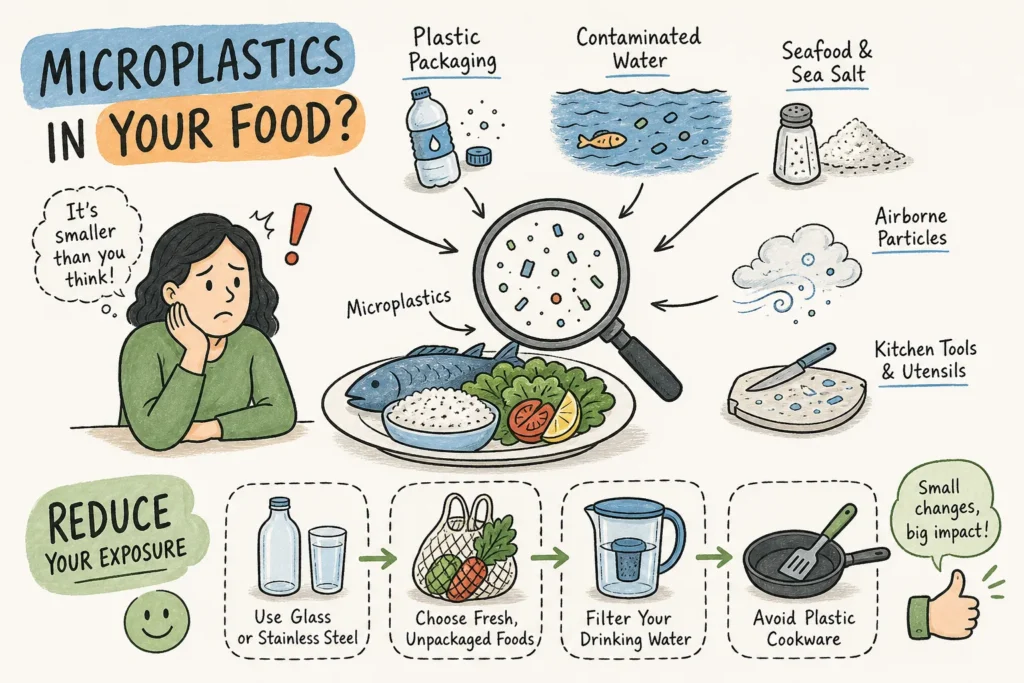
Microplastic in food is widespread: adults consume an estimated 39,000 to 52,000 microplastic particles per year through diet alone, according to peer-reviewed exposure modeling. That figure does not include what you breathe in on top of it. Plastic particles in food are not a future problem or a fringe concern reserved for people who eat a lot of seafood. They show up in apples, carrots, salt, drinking water, and the chicken nuggets in your kid’s lunch.
This article covers the full picture: where contamination begins before food ever reaches a grocery store, which specific foods carry the heaviest particle loads, what the FDA and other major agencies currently say about health risks, and how your own kitchen habits can quietly add to an already significant exposure. The guidance here draws on the same science-first approach used across Protect Your Family From Microplastics, where independent research is translated into practical decisions for families who want to act without waiting for regulatory green lights.
Key takeaways:
- Microplastic in food enters through soil, water, air, and food processing, not just packaging.
- Bottled water, shellfish, sea salt, and heavily processed proteins carry the highest measured particle loads.
- Heating food in plastic dramatically increases particle migration into what you eat.
- A fewtargeted swaps, filtered water, glass storage, and non-plastic cookware, deliver the most meaningful exposure reductions.
How Microplastic in Food Enters the Supply Before It Reaches You
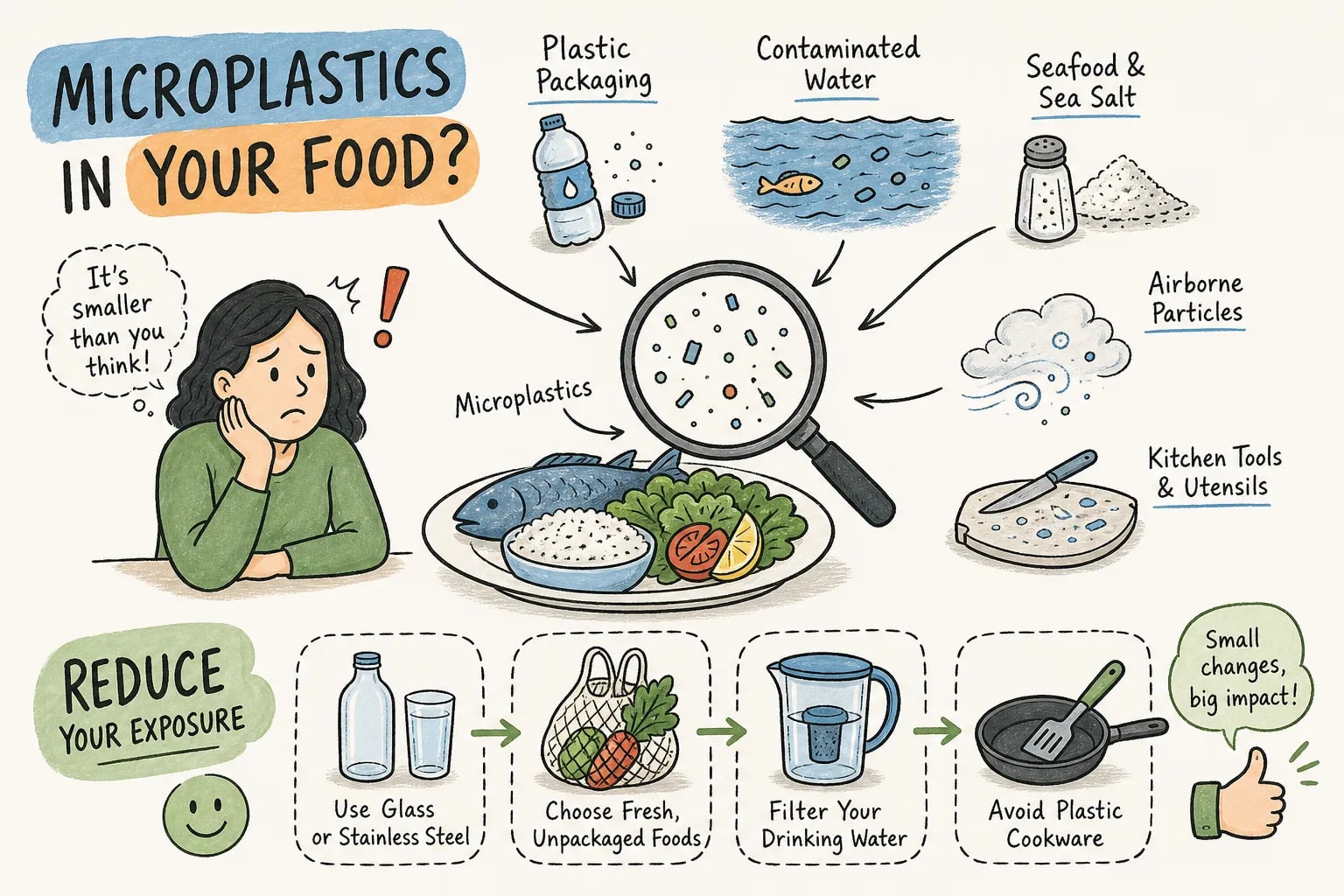
Most people think of plastic contamination as a packaging problem, something that happens at the last step before you eat. The reality is that plastic particles enter food systems at the very beginning, through water, soil, and air, long before any packaging is involved.
The ocean and waterway pipeline
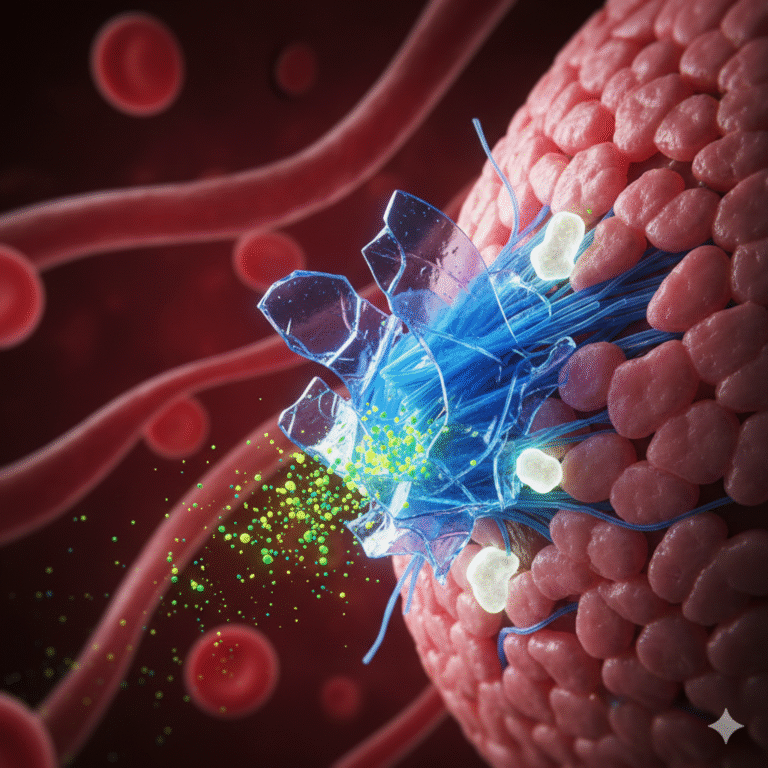
Plastic debris in marine environments degrades under UV exposure and mechanical wave action, breaking down into micro- and nanoplastic particles that disperse through the water column. Plankton, which sit at the base of the marine food chain, ingest these particles. From there, contamination concentrates as it moves up through fish and shellfish. Shellfish are particularly high-risk because they are filter feeders that process enormous volumes of water and are typically consumed whole, gut and all, meaning any particles they have ingested go directly to your plate.
How soil and irrigation water contaminate produce
Agricultural soil accumulates plastic particles through plastic mulch films used in commercial farming, sewage sludge applied as fertilizer, and contaminated irrigation water drawn from surface sources. Once particles are in the soil, they enter plant tissue through two routes: root uptake, where small particles pass through root cracks and move upward through the plant’s vascular system, and foliar deposition, where particles settle on leaf and fruit surfaces from air or irrigation spray. The result is contamination that cannot be washed away.
Studies measuring whole edible tissue have reported approximately 195,500 particles per gram in apples and above 100,000 particles per gram in carrots. It is worth noting that these figures come from specific studies with particular detection methods, and results vary substantially by study design, but even conservative estimates place commonly eaten produce well above zero. Per a typical apple serving, that particle density translates to a non-trivial dose from a food most families eat daily.
Airborne microplastic fallout on open food
Foods that never touch contaminated soil or water can still accumulate plastic particles through atmospheric deposition. Processing facilities that use plastic equipment, plastic conveyor belts, and plastic packaging materials can shed microfibers and fragments into the air during operations. During transport and open storage, food surfaces collect these airborne particles the same way any horizontal surface collects dust. This pathway is understudied relative to waterway and soil contamination, but it adds another layer of microplastic in food exposure that most people would not expect.
Which Foods Carry the Heaviest Microplastic in Food Contamination
Understanding the general pathways is a starting point. Knowing which specific foods drive the most microplastic ingestion is where that knowledge becomes actionable, and the data on certain categories may surprise you.
Seafood and shellfish: the most studied category
Breaded shrimp has been measured at over 300 fragments per serving, making it one of the most contaminated single food items documented in the research literature. Mussels, oysters, clams, and other shellfish consistently rank high due to their filter-feeding biology. Finfish carry lower loads than shellfish because you typically eat muscle tissue rather than the gut, but they are not a zero-risk category, particularly for fish sourced from heavily polluted waterways.
Salt, bottled water, and pantry staples
Sea salt and Himalayan pink salt appear repeatedly in contamination studies as among the most particle-dense everyday condiments. Bottled water is where the numbers become striking: studies have reported approximately 240,000 nanoplastics and microplastics per liter, though reported counts vary considerably by methodology and detection limit. Even at more conservative estimates, bottled water ranks as one of the largest single dietary sources of microplastic ingestion for households that rely on it as their primary drinking water. Choosing bottled water over tap to avoid contaminants is a trade-off that, from a microplastic standpoint, runs in the wrong direction.
Produce and processed foods: the less obvious sources
The apple and carrot data challenge a reasonable assumption: that eating whole, unprocessed plant foods keeps microplastic exposure low. Root uptake means the contamination is inside the tissue, not just on the surface. Peeling helps but does not eliminate it. On the processed food side, chicken nuggets and plant-based burgers show substantially higher particle counts than minimally processed proteins. A plausible explanation supported by processing studies is extended contact with plastic equipment across multiple production stages, where each machine adds to the cumulative particle load, though researchers note this causal link is still being studied.
What the Science and Major Regulators Actually Say About Health Risks
Getting an accurate read on the health evidence matters. Overstating what is known damages credibility; understating it leads to inaction on a problem that warrants real attention.
Suspected biological effects under active investigation
Systematic reviews have identified gastrointestinal inflammation, oxidative stress, endocrine disruption, and potential reproductive effects as biologically plausible consequences of microplastic exposure. These are suspected, not confirmed, harms in humans, effects demonstrated more consistently in animal and in vitro studies than in human clinical outcomes. The nanoplastic fraction, smaller than one micrometer, draws particular concern because particles at that scale can move beyond the gut wall and into other tissues, a mechanism that larger microplastic particles do not share.
Where the FDA, WHO, and EFSA stand today
All three agencies acknowledge that microplastics and nanoplastics are present in food. None have concluded that current dietary exposure causes specific disease in humans. All three are actively in an evidence-gathering and methods-development phase rather than a regulatory action phase. The FDA’s Human Foods Program, as of 2026, is investing in research to develop methods that can accurately detect, quantify, and characterize microplastic particles in food, a prerequisite for setting any meaningful exposure threshold. Systematic reviews document suspected biological effects and agency calls for more research, and the precautionary case for reducing dietary microplastic in food exposure is widely considered strong even before definitive harm thresholds are established.
How Your Cooking and Storage Habits Add Contamination at Home
Upstream contamination in the food supply is largely outside your control. What happens in your kitchen is not, and this is where many families are unknowingly adding significant plastic particle exposure on top of what already arrived in the food.
Heating food in plastic containers
Heat accelerates the release of microplastics from plastic containers, bags, and wraps into food. Microwaving is one of the highest-exposure scenarios because heat and fat in food both increase particle migration simultaneously. One published study found up to 4.22 million microplastic particles released per square centimeter of plastic surface after just three minutes of microwave heating, conditions that depended on the specific plastic type and food simulant tested, so real-world figures will vary, but the direction is clear. Even containers labeled “microwave-safe” release particles under these conditions. That label refers to structural integrity, not food safety from a microplastic standpoint.
The cookware and utensil problem
Nonstick pans with scratched or degraded PTFE coatings are a direct source of plastic particles into cooked food. Release is significantly higher from damaged surfaces, but studies detect particle shedding from intact nonstick cookware during routine cooking as well. Research shows plastic cutting boards can shed microplastic particles during cutting, with frequency and quantity depending on material wear and knife type. Plastic serving spoons and spatulas add further to the load during food prep and plating. Each additional contact point represents another transfer opportunity, and the additive effect across a single cooking session is likely meaningful even without a controlled study quantifying the total.
Practical Steps to Cut Your Microplastic in Food Intake
The goal is prioritization, not perfection, a few targeted changes will meaningfully lower your family’s exposure. The steps below are ranked roughly by impact.
Smarter buying decisions at the grocery store
- Filter your tap water with a reverse osmosis or quality multi-stage filter rather than buying bottled water. Bottled water carries one of the highest measured particle loads of any beverage, and a quality filter is a one-time investment that reduces microplastic ingestion daily.
- Swap sea salt for rock salt sourced from landlocked deposits, which consistently shows lower contamination than ocean-derived salts.
- Rinse produce under running water before eating. It will not remove particles absorbed through root uptake, but it does remove surface-deposited microfibers and fragments.
- Choose minimally processed proteins over heavily processed options like nuggets and formed patties, which show markedly higher particle counts due to extended equipment contact during manufacturing.
Safer food storage and cookware swaps that make the biggest difference
Replace plastic food storage containers with glass or stainless steel, and swap plastic wrap for beeswax wraps or reusable silicone covers. Retire scratched nonstick pans in favor of stainless steel or seasoned cast iron, and replace plastic cutting boards with wood or bamboo.
The organizing principle behind all of these swaps: eliminate plastic contact at any point where heat or fat is present, because research consistently identifies those as the conditions that increase particle migration most sharply. You do not need to replace everything at once. Start with what you use most often, the pan you cook in daily and the containers you heat food in, and work outward from there.
Start with Your Highest-Frequency Habits
Microplastic in food is real, measurable, and distributed across food categories that most families consider healthy. The science is still building toward definitive harm thresholds, but waiting for regulators to set limits before acting is not a strategy that makes sense given what is already known. The practical priorities are clear: filter your drinking water, reduce heavily processed foods, stop heating food in plastic, and make targeted cookware and storage swaps.
None of this requires a complete lifestyle overhaul. Two or three changes that touch your daily routine most often will substantially lower your family’s dietary microplastic load. The best place to start is usually the kitchen, the pan you use every morning and the containers you reach for at lunch are higher-leverage changes than anything else on the list. When you are ready to make those swaps, the independently reviewed product guides at Protect Your Family From Microplastics are built to make that process faster and more reliable than sorting through manufacturer claims on your own.
Frequently Asked Questions About Microplastic in Food
What is microplastic in food and where does it come from?
Microplastic in food refers to plastic particles smaller than 5 millimeters that enter the food supply through contaminated water, soil, air, and food processing equipment. Sources include degraded ocean plastic that accumulates in seafood, plastic mulch films and sewage sludge in agricultural soil, airborne microfibers settling on food surfaces, and plastic cookware and packaging in home kitchens.
Which foods have the highest levels of microplastic contamination?
Based on current research, bottled water, shellfish (particularly mussels, oysters, and clams), sea salt, and heavily processed proteins such as breaded shrimp and chicken nuggets consistently show the highest particle counts. Certain produce items, notably apples and carrots, also show high levels due to root uptake from contaminated soil.
Is microplastic in food dangerous to my health?
Regulatory agencies including the FDA, WHO, and EFSA have not concluded that current dietary exposure causes specific disease in humans. However, systematic reviews have identified gastrointestinal inflammation, oxidative stress, and endocrine disruption as biologically plausible effects. Most researchers and agencies are still in active evidence-gathering phases, and many health experts support a precautionary approach to reducing exposure.
How can I reduce microplastic in food at home?
The highest-impact steps are: filtering tap water instead of drinking bottled water, avoiding microwaving food in plastic containers, replacing scratched nonstick cookware with stainless steel or cast iron, switching from plastic to wood or bamboo cutting boards, and storing food in glass or stainless steel rather than plastic.
Does washing produce remove microplastics?
Rinsing produce removes surface-deposited microplastic particles and microfibers, but it does not remove contamination that has been absorbed into plant tissue through root uptake. Washing is still a worthwhile baseline habit for surface reduction.