Do Laundry Detergent Sheets Shed Microplastics?
As an Amazon Associate, we earn from qualifying purchases. If you buy through our links, we may earn a commission at no extra cost to you. We only recommend products we would buy for our own families.
The quick version: most laundry sheets and pods are held together by PVA, a synthetic plastic designed to dissolve in the wash – and the science on whether it fully disappears is genuinely contested. Our favorite is Molly’s Suds powder – a simple 4-ingredient powder with no PVA film and no plastic jug, and a hot seller for a reason. If you want the convenience of a sheet without the dissolvable plastic, the Proofed! PVA-free sheets are the rare exception. The full story, including which popular “eco” sheets still contain PVA, is below.
Laundry detergent sheets feel like the perfect swap. No heavy plastic jug, no measuring cup, no sticky pods – just a little strip you toss in the drum. They marketed themselves as the eco answer to the plastic detergent bottle, and a lot of us switched without a second thought.
Then someone asks the awkward question: what is the sheet itself made of? And the answer is uncomfortable. Most detergent sheets – and laundry pods too – are held together by polyvinyl alcohol, or PVA: a synthetic plastic film engineered to dissolve in water. “Dissolves” sounds like “disappears,” but dissolve and biodegrade are not the same thing. What follows is the honest version of the laundry detergent sheets microplastics story: what the science actually says, where it is shaky, and the five genuinely lower-plastic ways to wash your clothes.
Laundry detergent sheets and microplastics: what the science says
PVA is a water-soluble synthetic polymer. In a detergent sheet, it is the matrix that holds the cleaning agents together; in a pod, it is the outer pouch. When it hits wash water, it dissolves into the water rather than breaking into visible flakes, which is why it has mostly escaped the microplastics conversation until recently.
The study that put PVA on the map was published in 2021 by Rolsky and Kelkar in the International Journal of Environmental Research and Public Health (DOI: 10.3390/ijerph18116027). Using a model of US wastewater treatment, they estimated that roughly 77% of the PVA from laundry and dishwasher pods survives treatment plants – most of it leaving in sewage sludge, which is often spread on farmland, and the rest in treated water discharged to rivers. That worked out to more than 8,000 tons of PVA per year in the US alone.
Now the honest caveats, because they matter. It was a modeled estimate, not a direct measurement of rivers or sludge. It studied pods, not sheets – sheets use the same PVA chemistry, but nobody has modeled sheets specifically. The study was funded in part by Blueland, a company that sells film-free detergent tablets, which is a real conflict worth knowing about. And the EPA denied a 2023 petition asking for PVA safety testing, pointing to industry lab tests showing PVA biodegrading under test conditions. The evidence is genuinely contested, and anyone who tells you the case is closed in either direction is selling something.
Here is where I land on it. PVA is a synthetic plastic by any chemical definition. Whether a given treatment plant degrades it fully depends on conditions that vary wildly in the real world. If your goal is to keep plastic out of water, “probably degrades in ideal conditions” is a weaker promise than “contains no plastic at all.” That is the standard every pick below is held to.
Sheets vs pods vs powder vs liquid: the plastic ranking
It helps to see the whole laundry aisle on one plastic spectrum. From most to least plastic involved:
Pods are the worst of both worlds: a concentrated PVA pouch around every single dose, usually sold in a rigid plastic tub. The most plastic per load, full stop.
Sheets cut the jug but keep the PVA. A conventional sheet is essentially detergent embedded in a dissolvable plastic film, sold in a cardboard or plastic box. Less packaging plastic than liquid, but the PVA question from the study above applies directly.
Liquid has no PVA film, but it is mostly water shipped in a heavy plastic jug, and the jug is the highest-turnover plastic in most laundry rooms. Better on the microplastics question, worse on packaging waste.
Powder is the quiet winner. No film, no jug – just detergent in a cardboard box or bag. It is the oldest format in the aisle and, on plastic, the best one. Every powder pick below follows this logic.
One more thing before the picks: the dryer matters too. Conventional dryer sheets are disposable substrates coated in chemicals, and the heat plus tumbling is a shedding-friendly environment for synthetic fabrics. Researchers have estimated that millions of tonnes of synthetic microfibers have been emitted from apparel washing over the decades (PLOS ONE, 2020), which is why one of the picks below is a dryer-sheet replacement rather than a detergent.
The 5 lowest-plastic ways to do laundry
Every pick below contains zero PVA and zero dissolvable plastic film. They are ordered from “closest to the sheet habit” to “most committed.”
1. Molly’s Suds Original Laundry Detergent Powder (Unscented, 120 loads): our favorite
This is the format argument in product form. Molly’s Suds powder is four simple ingredients – sodium carbonate, sodium bicarbonate, magnesium sulfate, sea salt – in a recyclable bag with a scoop. No PVA matrix, no plastic jug, nothing to dissolve except the powder itself. On the plastic question, powder in a bag beats every sheet, pod, and jug in the aisle.
The honest trade-offs: powder needs to dissolve, and it can clump in cold washes – the instructions say to use warm or hot water, which is worth knowing before you blame the product. It is unscented, so if you love that fresh-laundry smell, it will not deliver it. And it costs more per load than conventional powder, which is the price of a short ingredient list.
2. Proofed! Laundry Detergent Sheets (Clean Scent, 32 ct): the PVA-free sheet
If you love the sheet format and just want the plastic out of it, this is the one. The Proofed! sheets are the rare detergent strip with no PVA or PVOH at all – the sheet is bound with plant-based NanoPress binders instead, and the whole thing is USDA Certified Biobased and packed in a recyclable cardboard box. It is proof that a PVA-free sheet is possible, which makes you wonder why the big “eco” brands have not done it.
The honest trade-offs: independent testing found the sheets take around two minutes to dissolve in cold water, which is slow enough to raise the risk of streaks or residue on dark clothes. You get 32 loads per box, so it is not the cheapest way to wash. Dissolve them fully and they behave like any other sheet – just without the plastic matrix.
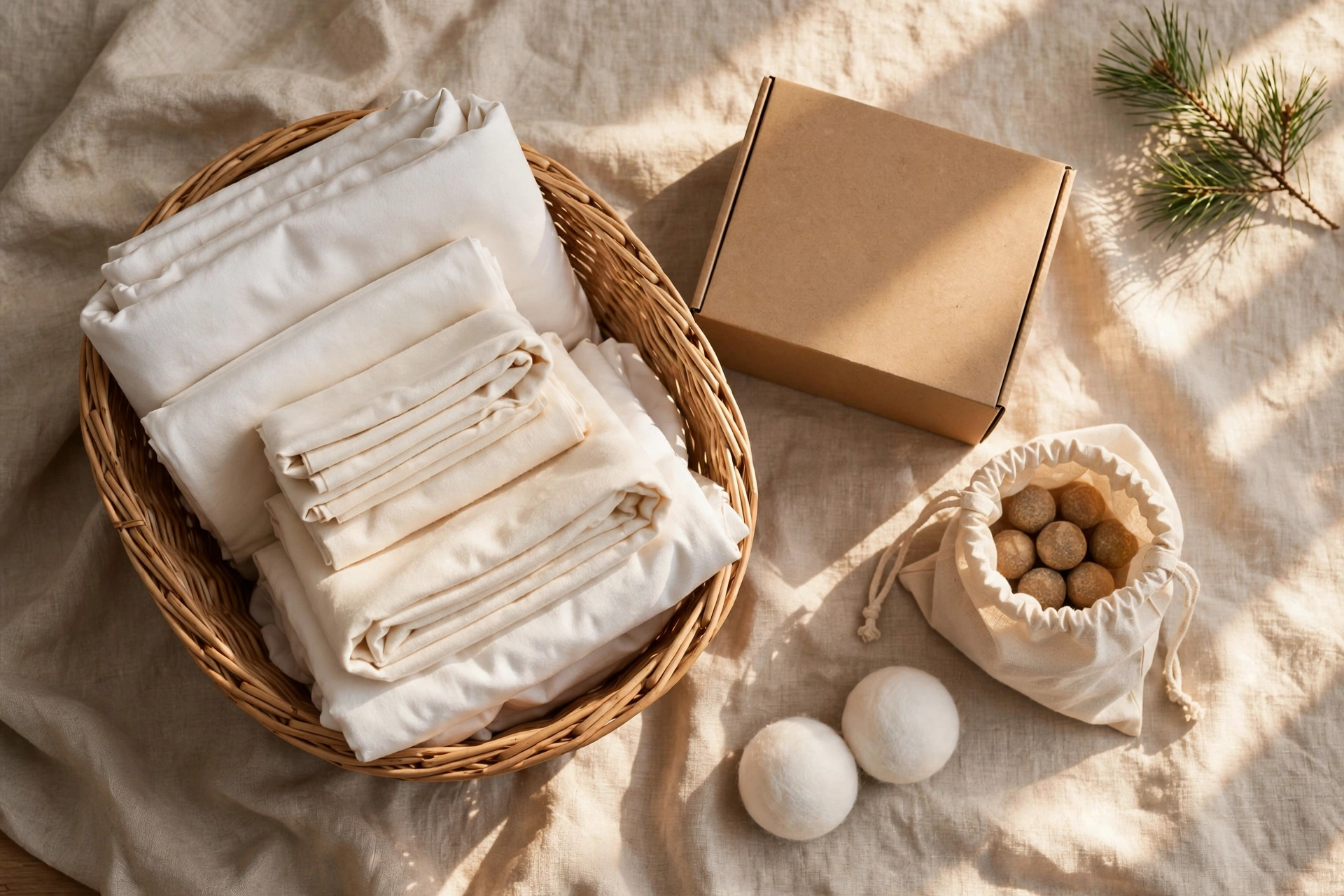
3. Smart Sheep Wool Dryer Balls (6-Pack): the dryer-sheet swap
Dryer sheets deserve a spot in this article because they are the disposable-plastic-adjacent habit most of us never questioned. A conventional dryer sheet is a single-use substrate coated in softening chemicals, tossed after every load. Smart Sheep wool dryer balls are 100% New Zealand wool, felted with no fillers or synthetics, and one set softens clothes and cuts drying time for over a thousand loads. Nothing disposable, nothing to dissolve, nothing rinsed downstream.
The honest trade-offs: they are weaker on static than a chemical dryer sheet, especially with a full load of polyester – some people still use half a dryer sheet alongside them, which is honest, not failure. They thump in the dryer, and they smell faintly of wet wool at first. Eventually they wear out and need replacing, but a thousand loads is a long runway.
4. NaturOli Soap Nuts (2 lb, seedless): the minimalist option
Soap nuts are dried soapberry shells, and the saponin inside them is a genuine natural surfactant – people have washed with them for centuries. The NaturOli soap nuts are wild-harvested, lab-tested, and packed without plastic, and the routine is beautifully simple: a few shells in the included wash bag, tossed in the drum. There is nothing synthetic to dissolve, shed, or rinse downstream, because there is nothing synthetic in the bag.
The honest trade-offs: this is the weakest cleaner of the five. It handles everyday lightly-worn clothes fine, but it is not the pick for gym clothes, greasy workwear, or heavy stains. Saponin needs warm or hot water to release properly, and the routine is fiddly – counting shells, tracking reuses, no fresh scent. Think of it as the lowest-plastic option, not the highest-performing one.
5. Nellie’s Laundry Soda (100-load tin): powder in a reusable tin
If the tin is the packaging endgame, this is it. Nellie’s Laundry Soda is a four-ingredient concentrated powder – no SLS or SLES, no fragrance, no dyes – sold in a reusable metal tin, with refill pouches available once the tin is empty. Buy once, refill from pouches, no PVA film, no jug, no single-use anything. It is septic-safe and made in Canada, and the tin looks good enough to leave on the shelf.
The honest trade-offs: powder only, no scent, and tablespoon dosing is imprecise – you will either love the simplicity or miss the measuring lines. Whites may want the brand’s separate oxygen brightener. And one availability note: the tin’s Amazon listing looked inconsistent during research, so confirm it is actually purchasable before you fall in love with it.
What the label doesn’t tell you: popular “eco” sheets that still use PVA
This is not a hit piece – it is a label-reading lesson. Several of the best-known eco detergent sheets contain PVA, and you would only know it if you read the full ingredient list instead of the front of the box.
Tru Earth lists polyvinyl alcohol in its own published ingredient list, described as a “biodegradable supporting matrix.” That is the PVA film, described honestly but quietly.
Earth Breeze has been flagged by independent reviewers noting that almost all sheet brands – even the bestselling ones – are held together with substantial PVA, by some estimates around half the sheet.
Kind Laundry publishes a full ingredient list that includes PVA outright, alongside the cleaning agents.
The point is not that these are bad products. The point is that “eco” on the front and PVA in the ingredients can coexist, and now you know to check. If a sheet brand does not explicitly say “PVA-free” or “PVOH-free,” assume the sheet is held together by dissolvable plastic film – because it almost certainly is.
Frequently asked questions
Is PVA really plastic?
Yes, chemically. Polyvinyl alcohol is a synthetic polymer – a plastic by definition – even though it dissolves in water instead of breaking into visible flakes. “Dissolves” and “biodegrades” are different things: dissolving means it disperses into the water, while biodegrading means microbes actually break it down into harmless components. Whether the second step fully happens in real-world treatment plants is exactly what the science is still arguing about.
Do detergent sheets dissolve completely in the wash?
The sheet visibly disappears, which is what “dissolves completely” means to most of us. But the PVA does not vanish – it goes out with the wastewater as dissolved polymer. The open question is how much of it treatment plants actually break down versus pass through into sludge and waterways. That is the contested part of the 2021 modeling study, and it is why “dissolves” should not reassure you on its own.
Are pods worse than sheets?
On plastic, yes. A pod wraps every dose in a concentrated PVA pouch and usually comes in a rigid plastic tub, so you get the dissolvable film plus heavy packaging. A conventional sheet at least skips the tub. But a PVA-containing sheet and a pod share the same core problem – the film – so switching from pods to sheets is an improvement, not a solution.
What about “biodegradable” PVA claims?
PVA can biodegrade under the right conditions – warm water, the right microbes, enough time. Industry lab tests show this, and it is why the EPA declined to require further safety testing. The counterargument is that real wastewater plants are not lab conditions: colder water, shorter retention times, and enormous volumes. “Biodegradable in principle” and “biodegraded in practice” are doing a lot of different work in that sentence.
What is the lowest-plastic way to do laundry?
Powder in cardboard or a reusable container, full stop. No film, no jug, no single-use dose packaging. Of the picks above, the Molly’s Suds powder and the Nellie’s tin are the lowest-plastic options, with the soap nuts as the most minimalist choice if you can live with gentler cleaning.
Keep reading
Laundry is one of the biggest microplastic sources in a home, and detergent is only half the story. These go deeper:
- Your Washing Machine Is One of the Biggest Microplastic Sources in Your Home: 5 Laundry Swaps That Actually Help – the microfiber-shedding side of the laundry equation, with the swaps that catch fibers at the source.
- Non-Toxic Laundry Soap: What to Look For – the ingredient guide to what is actually in your detergent beyond the plastic question.
- 7 Bathroom Swaps to Reduce Microplastics – the same plastic-hunting logic applied to the rest of your routine.
- 12 Everyday Kitchen Swaps to Reduce Microplastics – because the kitchen has its own dissolvable-plastic surprises.