
Best Cutting Boards to Avoid Microplastics (2026 Guide)
This article contains affiliate links. If you purchase through our links, we may earn a small commission at no extra cost to you. Full disclosure here.
Most of us grab a cutting board without thinking twice about it. But if that board is plastic, there is a good chance it is putting microplastic particles directly into your food every single time you chop, slice, or dice on it. The knife scores the surface. The surface sheds particles. Those particles end up in whatever you are preparing.
A 2023 study published in Environmental Science and Technology (via PubMed) found that a single plastic cutting board can shed anywhere from 14.3 to 50.7 million microplastic particles into food each year. That number varies by the type of plastic and how worn the board is, but even on the low end, it is not a trivial amount.
The fix is not complicated. Wood, bamboo, and glass cutting boards do not shed plastic because they are not plastic. Several excellent options are on Amazon right now, and most of them will outlast any plastic board you replace.
If you want our top pick right now: the John Boos Maple Cutting Board 18×12 is where we would start for most households. American hard maple, edge grain construction, made in the USA since 1887, and a professional kitchen standard for good reason.
Once you have prepped your food on a safe surface, the next step is storing it right. See our guide to the best glass food storage containers
This guide covers what the research actually says, which materials are safe, and which specific cutting boards we would put in our own kitchens.
Browse all our recommended cutting boards in our Amazon storefront →
In a Hurry: Best Non-Toxic Cutting Boards in 2026
Here is what we recommend, and why:
- Best overall: John Boos Maple Board 18×12 — American hard maple, edge grain, professional kitchen standard, made in the USA since 1887
- Best high-end pick: John Boos Walnut End Grain Butcher Block — end grain American black walnut, self-healing surface, the board you buy once and keep forever
- Best large board: John Boos 24×18 Maple Board — generous work surface for serious cooking, reversible, same trusted maple construction
- Best teak option: Teakhaus Edge Grain Teak Board — sustainably sourced teak, naturally antimicrobial, lower maintenance than maple
- Best budget pick: Totally Bamboo Congo Board — plastic-free bamboo surface, compact and lightweight, solid everyday board
- Best for easy cleaning: Kitchenville Tempered Glass Board 20×16 — completely non-porous, dishwasher safe, zero plastic, honest caveat on knives
Why Cutting Boards and Microplastics Are Worth Paying Attention To
Cutting boards are one of the more direct microplastic exposure points in the kitchen, because the contamination pathway is so obvious: a sharp knife against a soft plastic surface physically removes particles from the board. Those particles are already mixed into whatever you are cutting before you ever move it to a plate.
The 2023 study in Environmental Science and Technology tested both polyethylene and polypropylene cutting boards, the two most common plastic types, under normal cutting conditions. Both shed significant microplastics. Harder plastics shed fewer particles than softer ones, but neither scored zero. The cutting action itself is the mechanism, which means no amount of BPA-free labeling changes what is happening at the surface.
We want to be honest about where the science stands on long-term health effects: that research is still developing. We cover it in our Ultimate Beginner’s Guide to Microplastics. What is not in dispute is the exposure pathway. And when genuinely non-toxic alternatives work just as well, the swap is a straightforward one to make.
Where the Microplastic Exposure Actually Comes From
Not all cutting boards present the same risk. Here is how the materials break down:
Plastic Cutting Boards (PE and PP) — Highest Concern
Standard plastic cutting boards, whether labeled BPA-free or not, are made from polyethylene or polypropylene. Both shed microplastic particles when a knife cuts across the surface. Worn boards with visible score marks shed more than new ones. The marks themselves are where future cutting will remove additional material.
Wood Cutting Boards — No Plastic Concern
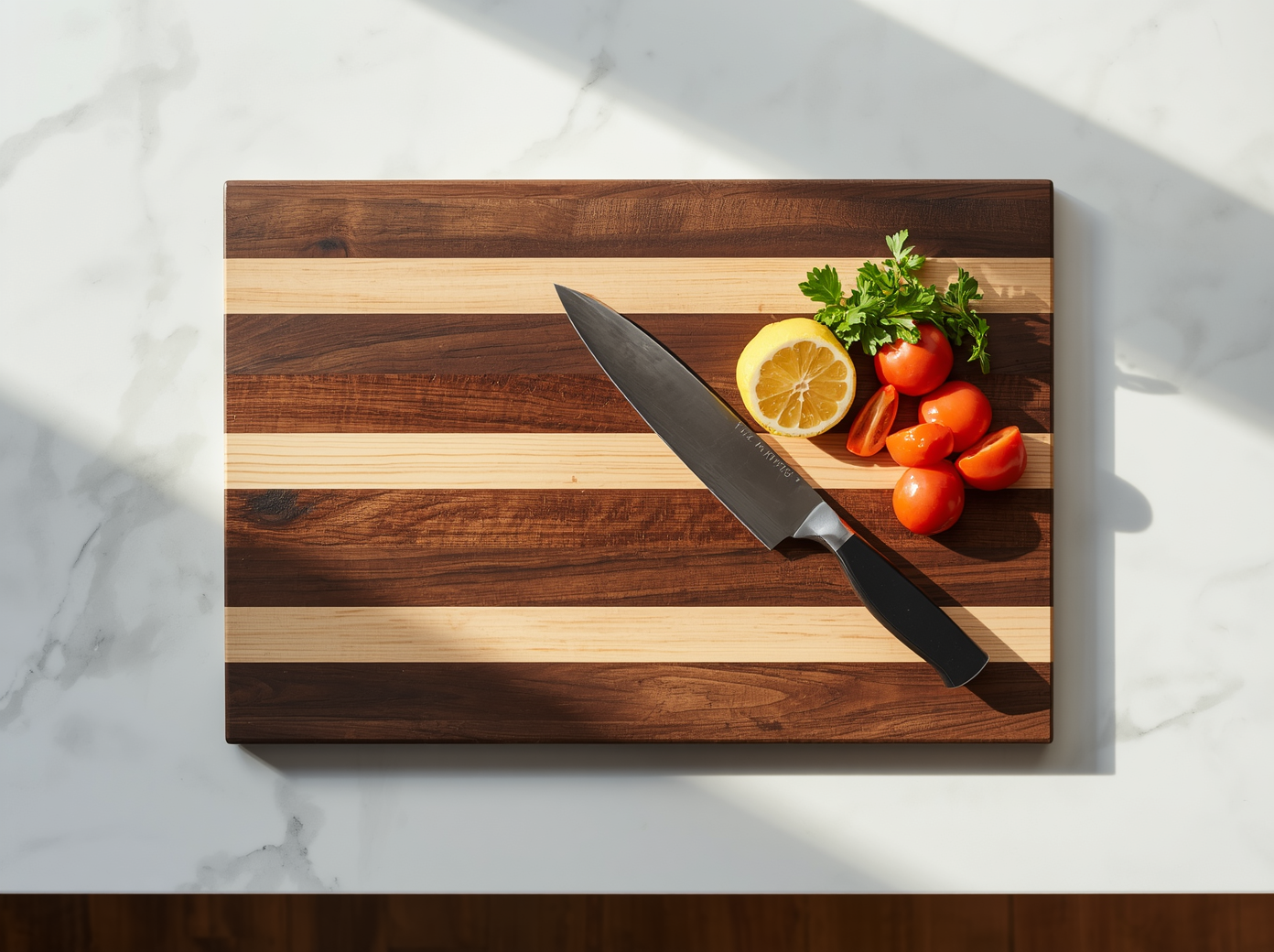
Hardwood boards, maple, walnut, teak, and similar dense woods, do not shed microplastics. The concern with wood historically was bacteria, but research has shown that hardwood’s natural grain structure traps and kills bacteria more effectively than plastic surfaces, which harbor bacteria in knife grooves that cleaning cannot reach. A well-maintained wood board is both cleaner and safer from a microplastics standpoint.
Bamboo Cutting Boards — No Plastic Concern
Bamboo is harder than most woods, which means it holds up to knife work well and shows fewer marks over time. Like wood, it does not shed microplastics. One thing to know: some bamboo boards use formaldehyde-based adhesives to bind the strands together. Look for brands that disclose food-safe adhesives, or are certified formaldehyde-free.
Glass Cutting Boards — No Plastic Concern, Knife Caveat
Glass is completely non-porous, dishwasher safe, and introduces zero microplastics. The honest limitation is that glass is harder on knife edges than wood. It works well for tasks like slicing cheese, cutting soft foods, or as a hygienic board for raw meat prep where thorough sanitation is the priority. For someone who cooks seriously and cares about their knives, a glass board works best alongside a wood board rather than as a replacement for one.
What to Look for in a Non-Toxic Cutting Board
- No plastic contact surface. The cutting surface, the side your knife actually touches, should be wood, bamboo, or glass. Rubber feet or silicone grips on the underside are fine.
- Dense grain construction. Edge grain boards are durable and hard-wearing for everyday use. End grain boards, the checkerboard pattern, are self-healing and easier on knives, but require more conditioning.
- Sustainably sourced materials. For teak, look for FSC-certified or plantation-grown sourcing. John Boos uses sustainably harvested North American hardwoods for all their boards.
- Transparent adhesives for bamboo. Some bamboo boards use adhesives to bind strands together. Look for brands that confirm food-safe glues are used throughout.
- Realistic size. For most household cooking, an 18×12 inch board is the right starting point. Going smaller creates safety issues when you need to cut larger items.
Our Recommendations: The Best Non-Toxic Cutting Boards for 2026
You can find these products and all of our other products we recommend on our Amazon Storefront. Its a great spot to find all the products we recommend if you don’t want to read all of our articles.
John Boos Maple Cutting Board 18×12 — Best Overall
Best for: Most households who want a reliable, professional-grade hardwood board that will last for years with basic care.
John Boos has been making cutting boards in Effingham, Illinois since 1887. Their maple boards are the standard in professional restaurant kitchens, and for good reason: hard maple is one of the densest, most durable woods available for this purpose. The edge grain construction means the surface holds up to serious daily knife work without deeply scoring. At 18×12 inches and 1.25 inches thick, it is the right size for most home cooks without being unwieldy.
The board ships with a reversible design, so both sides can be used, and recessed finger grips on each end make it easy to move. It comes with a sample of Boos Board Cream. Hardwood boards benefit from monthly conditioning with food-safe mineral oil, and that routine is the main maintenance ask, it is not burdensome once it becomes habit.
- Pros: American-made hard maple, professional kitchen standard, edge grain construction, reversible, 130+ year track record, available in multiple sizes
- Honest con: Requires regular conditioning to prevent warping or cracking. Not dishwasher safe. Heavier than bamboo at the same size.
John Boos Walnut End Grain Butcher Block — Best High-End Pick
Best for: Anyone who wants to buy one board for life, or who wants the most beautiful and knife-friendly cutting surface available.
This is a different category of cutting board entirely. The end grain construction, where the board is made from the cross-section of wood rather than the edge, creates the checkerboard pattern you see on professional butcher blocks. That surface is self-healing: knife marks close up over time as the wood fibers flex and recover. It is also significantly easier on knife edges than edge grain or glass surfaces.
American black walnut adds another dimension. It is naturally darker and more visually striking than maple, with its own antimicrobial properties and a slightly softer surface that is forgiving on knife blades. The juice groove around the perimeter handles meat and fruit without liquid running onto the counter. This is the board that gets passed down.
- Pros: End grain construction is self-healing and easier on knives, American black walnut is naturally antimicrobial and beautiful, juice groove, professional butcher block quality, made in the USA
- Honest con: Significant investment. End grain boards absorb more oil and require more frequent conditioning than edge grain boards, especially when new. Heavy.
John Boos Maple Board 24×18 — Best Large Board
Best for: Households that do serious cooking and need a proper work surface. Anyone who has ever felt cramped on a smaller board.
At 24×18 inches, this board functions more like a secondary countertop than a traditional cutting board, and for families who meal prep, entertain regularly, or just cook a lot, the extra surface area genuinely changes how cooking feels. The same hard maple edge grain construction as the 18×12, the same professional credentials, just more of it. Both sides are usable, which doubles the practical life of the board.
This is the board that people who already have a Boos board often wish they had bought first.
- Pros: Generous 24×18 work surface, reversible double-sided use, hard maple edge grain, American-made, same Boos quality at a larger scale
- Honest con: Heavy, this is a serious board. Requires the same monthly conditioning as all John Boos hardwood boards. At this size, hand washing takes a moment more.
Teakhaus Edge Grain Teak Cutting Board — Best Teak Option
Best for: Households that want a beautiful, lower-maintenance hardwood board, or anyone who prefers the natural oil content of teak over maple.
Teakhaus makes cutting boards from plantation-grown teak, which is one of the best materials for this purpose. Teak has a naturally high oil content that makes it water-resistant and more self-maintaining than maple without constant conditioning. The edge grain construction holds up well to daily knife work, and the board looks genuinely good on a counter.
Teak’s natural oils also give it inherent antimicrobial properties, a well-documented characteristic of the wood. For a family that wants a clean, durable board with lower maintenance requirements than maple, this is a strong pick.
- Pros: Plantation-grown teak, naturally antimicrobial, water-resistant due to natural oil content, lower maintenance than maple, edge grain construction, no plastic anywhere
- Honest con: Teak does not absorb conditioning oil as readily as maple because of its natural oil content, which is actually a benefit in terms of self-maintenance, but means traditional oiling routines need slight adjustment.
Totally Bamboo Congo Cutting Board — Best Budget Pick
Best for: Families who want to move away from plastic cutting boards without a large investment, or a secondary board for lighter tasks like fruit, bread, and cheese.
Totally Bamboo has a long track record in the bamboo cutting board category, and the Congo board is their reliable everyday option. Compact, lightweight, and completely plastic-free at the cutting surface. Bamboo is harder than most woods, which means it holds up well to cutting and shows fewer marks over time. For households where budget is the priority, this is the honest starting point.
- Pros: Plastic-free bamboo surface, affordable price point, lighter and more compact than hardwood boards, good everyday board
- Honest con: Bamboo’s hardness can accelerate knife dulling slightly compared to softer woods. Not the right pick for heavy-duty daily meal prep. Smaller surface area than the Boos boards.
Kitchenville Tempered Glass Cutting Board 20×16 — Best for Easy Cleaning
Best for: Families who prioritize sanitation and dishwasher convenience, or who want a dedicated board for raw meat prep where thorough cleaning after every use is the priority.
Glass is the most hygienic cutting surface available. Completely non-porous, so bacteria cannot establish in the surface at all. Zero microplastics. Dishwasher safe. No conditioning required. The Kitchenville board is a substantial 20×16 inches of tempered glass, scratch-resistant, heat-resistant, and built to last. It works well alongside a wood board for tasks where sanitation matters more than knife feel.
- Pros: Completely non-porous, dishwasher safe, zero microplastics, no maintenance required, generous 20×16 size, scratch and heat resistant
- Honest con: Glass is harder on knife edges than wood. Use with knives you sharpen regularly, and consider pairing with a wood board for everyday chopping. The sound of a knife on glass takes some getting used to.
How to Care for Wood and Bamboo Cutting Boards
One of the most common reasons people stick with plastic boards is that wood seems like more work. It is not, once you know the basics.
- Hand wash only. No dishwasher for wood or bamboo. The heat and moisture cycle will warp and crack them. A quick wash with warm soapy water and a rinse is all they need.
- Dry standing up. If you lay a wood board flat while wet, moisture is absorbed unevenly and the board can warp. Stand it on its edge to dry, or prop it on a drying rack.
- Oil monthly. Food-safe mineral oil or a dedicated board conditioner keeps the wood from drying out and cracking. Apply, let it sit overnight, wipe off the excess. Once a month is enough for most boards, more often when the board is new.
- Salt and lemon for odors. For a board that has picked up strong smells, sprinkle coarse salt on the surface, scrub with half a lemon, and rinse. It works better than you would expect.
The full picture of reducing microplastics across your kitchen is in our guide to microplastics in the kitchen.
What to Use to Oil and Condition Your Board
If you are buying a John Boos board, the care kit to pair with it is their own.
John Boos 3-Piece Care Set (Mystery Oil + Board Cream + Applicator) — Mystery Oil penetrates the wood grain to protect and hydrate from the inside. Board Cream, made from food-grade mineral oil and unbleached beeswax, seals the surface. The applicator makes both easy to apply without mess. All natural, all food-safe, made in the USA. This is the two-step system Boos recommends for all their boards.
Clark’s Cutting Board Oil and Wax Kit — A strong alternative for teak or bamboo boards, or anyone who prefers a lemon and orange-scented formula. Includes food-grade mineral oil, finishing wax, a custom applicator, and a buffing pad. Food-safe, made in the USA, and works on all wood types including teak and bamboo.
FAQ
Do plastic cutting boards really release microplastics into food?
Yes. A 2023 study in Environmental Science and Technology found that plastic cutting boards made from polyethylene and polypropylene shed millions of microplastic particles into food each year under normal cutting conditions. The amount increases as the board ages and develops knife score marks.
Is bamboo actually better than plastic for cutting boards?
Yes. Bamboo does not shed microplastics. It is also harder than most woods, which means it holds up well to daily use. The consideration is that bamboo’s hardness can dull knives slightly faster than softer woods like maple. For a plastic-free everyday board at an accessible price, it is one of the best options available.
Are wood cutting boards actually sanitary?
Research supports this, often surprisingly so. The natural grain structure of hardwood traps and kills bacteria rather than harboring it, which is the opposite of what happens with plastic boards that develop knife grooves. A wood board that is cleaned properly after each use is a sanitary cutting surface. Having a separate board for raw meat is still the right practice regardless of material.
What is the difference between edge grain and end grain cutting boards?
Edge grain boards are made from the long side of the wood plank. They are durable, hard-wearing, and the standard for most everyday boards including the John Boos maple range. End grain boards are made from the cross-section of the wood, creating the checkerboard pattern. They are self-healing, easier on knife blades, and considered the premium option, but they require more conditioning and are typically more expensive.
How often do I need to oil a wood cutting board?
Once a month is enough for most boards with food-safe mineral oil. New boards benefit from several conditioning sessions in the first week of use. Boards in dry climates or very heavy use may need more frequent conditioning, but a monthly routine handles the vast majority of households.
The Bottom Line
Replacing a plastic cutting board is one of the simplest, most direct microplastic swaps in the kitchen. No learning curve, no adjustment period, and the alternatives work better in almost every way.
The John Boos Maple 18×12 is where we would start for most families, a professional kitchen standard that has been proving itself since 1887. If you want to buy one board for life and never think about it again, the John Boos Walnut End Grain Butcher Block is that board. And if budget is the priority, the Totally Bamboo Congo gets you to a plastic-free cutting surface without spending much at all.
Small swap, real difference. The board you use every time you cook matters, make sure it is not adding anything to the meal.
Browse all our recommended cutting boards in our Amazon storefront →

One Comment