Dishwasher Detergents That Skip the Plastic
Dishwasher Detergents That Skip the Plastic
As an Amazon Associate, we earn from qualifying purchases. If you buy through our links, we may earn a commission at no extra cost to you. We only recommend products we would buy for our own families.
The quick version: most dishwasher pods are wrapped in PVA, a synthetic plastic film that dissolves in the wash but may not fully biodegrade, and the science is genuinely debated. The simplest way to skip the question is to skip the film: compressed tablets and loose powders. Our top pick is the Blueland Dishwasher Tablet Starter Set, unwrapped tablets in a reusable steel tin. For hard water spots, the Lemi Shine Dish Detergent Booster is an EPA Safer Choice standout. The four picks below, with honest trade-offs, are all film-free.
Dishwasher pods felt like progress. No more lugging home the giant plastic tub, no measuring, no spills – just toss a little pillow in and press start. They solved the packaging problem so neatly that most of us never asked what the pillow itself is made of.
Here is the awkward part: the pillow is plastic. Conventional dishwasher pods are wrapped in polyvinyl alcohol, or PVA (sometimes labeled PVOH): a synthetic plastic film engineered to dissolve in hot water. “Dissolves” sounds like “disappears,” but dissolving and biodegrading are two different things. This is the honest guide to the dishwasher detergent plastic problem: what the film is, what the science actually says, and four genuinely film-free ways to get sparkling dishes.
The dishwasher detergent plastic problem hiding in your pods
PVA is a water-soluble synthetic polymer, and in a dishwasher pod it is the outer pouch. When it hits hot wash water it dissolves into the water instead of breaking into visible flakes, which is why it escaped the microplastics conversation for so long. You cannot see it, so it feels like it is gone.
The study that put pod film on the map was published in 2021 by Rolsky and Kelkar in the International Journal of Environmental Research and Public Health (DOI: 10.3390/ijerph18116027). Modeling US wastewater treatment, they estimated that roughly 77% of the PVA from laundry and dishwasher pods survives treatment plants, most of it leaving in sewage sludge (often spread on farmland) and the rest in treated water discharged to rivers. We covered this science in depth in our laundry detergent sheets article, if you want the full story.
And here are the honest caveats, because they matter. It was a modeled estimate, not a direct measurement. The study was funded in part by Blueland, a company that sells film-free tablets, which is a real conflict of interest worth knowing about. And the EPA denied a 2023 petition asking for PVA safety testing, pointing to industry lab tests showing PVA biodegrading under test conditions. The evidence is genuinely contested, and anyone who tells you the case is closed in either direction is selling something.
But here is the thing: you do not need to resolve a scientific debate to make a simpler choice. Every pod sends a single-use plastic film down your drain, and every pod comes in a chunky plastic tub. Tablets and powders skip both. Whatever PVA turns out to be, using none of it is the one position nobody can argue with.
What “plastic-free” really means on a dishwasher detergent label
This is where label-reading matters, because “eco” packaging and a film-free product are not the same thing. A brand can ship its pods in a cardboard box and call the packaging plastic-free while every pod inside is still wrapped in PVA film. We ran into exactly that during research: one well-known brand’s own ingredient list confirms its “plastic-free packaging” pods use a polyvinyl alcohol film. Read the ingredients, not just the box.
Here is the quick decoder for the formats you will see:
- Pods and pacs: pre-measured detergent sealed in a dissolvable PVA/PVOH film. Convenient, but every load sends film down the drain.
- Compressed tablets: detergent pressed into a solid tab with no wrapper at all. Pre-measured like a pod, with nothing to dissolve except the detergent itself.
- Powders: loose powder you scoop. No film, no wrapper, and you control the dose, which is genuinely useful in soft-water homes where a full pod is overkill.
- Boosters: not a standalone detergent, but an add-in (usually citric-acid based) that fights hard-water spots and film. Pair one with a powder or tablet instead of reaching for a pod.
All four picks below are film-free formats: two tablets-and-powder detergents, one classic powder, and one booster for hard water. No pods, no dissolvable film, no plastic tub.
4 dishwasher detergents that skip the plastic
These are the four we would buy. Every one is a film-free format, every one is on Amazon, and every one comes with its honest trade-offs below, because there is no perfect detergent, only the right trade for your kitchen.
1. Blueland Dishwasher Detergent Tablets – our top pick
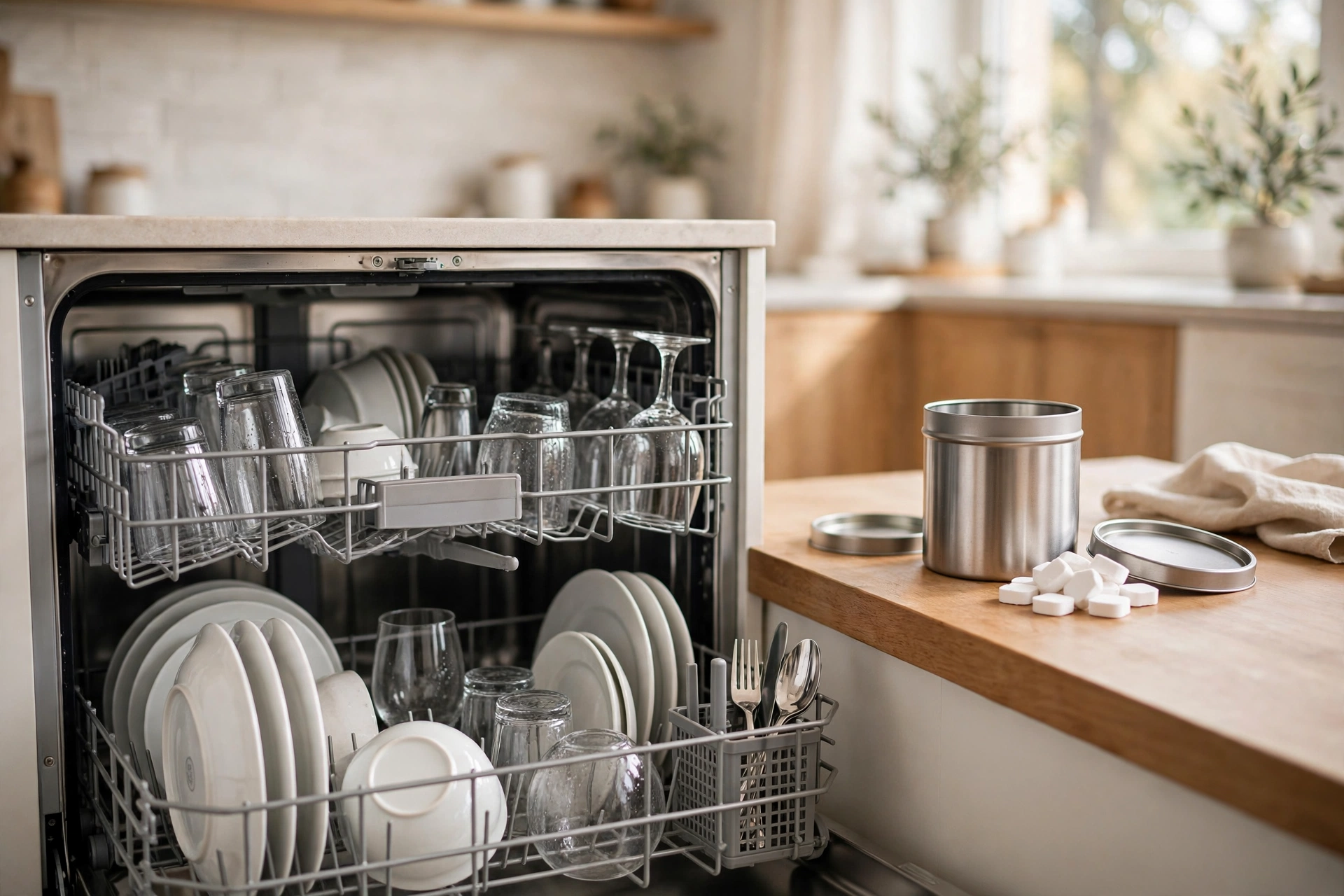
If you want the pod experience without the pod, this is it. The Blueland Dishwasher Tablet Starter Set gives you 60 compressed tablets with zero wrapper and zero PVA film, stored in a reusable steel Forever Tin instead of a plastic tub. When the tin runs out you buy paper-wrapped refills, so the plastic tub never enters your house in the first place. The tablets are USDA Certified Biobased, the listing calls them 100% plastic-free and microplastic-free, and it holds the #1 spot in dishwasher detergent on Amazon, which tells you this is not a niche experiment.
Blueland is also unusually blunt about the problem: their own product FAQ says conventional pods are wrapped in PVA film that “dissolves, but does not disappear,” with the particles persisting as microplastics and nanoplastics. You can take a company’s word with the usual grain of salt, but it is refreshing when a brand states the concern plainly instead of hiding behind “plant-based film” language.
Honest trade-offs: this is the premium option of the four, and the cost per load runs higher than grocery-store pods. Some reviewers report weaker performance on very hard water or heavily baked-on food, so if your water is brutal, pair it with the booster below rather than expecting one tablet to do everything.
2. Dirty Labs Dishwasher Detergent + Booster
Dirty Labs is one of the few brands that says the quiet part out loud: their site states that pods are made of plastic and break down into microplastics that end up in rivers, lakes, streams, and drinking water. Their answer is a hyper-concentrated powder in cardboard packaging with a wooden scoop, no film, no pod, no tub. The Dishwasher Detergent + Booster 2-pack covers 96 loads across two scents, and the powder format means you dose for your water instead of accepting a one-size-fits-all pod.
Honest trade-offs: the default scent is fragranced (Aestival), which will not suit fragrance-free households, though a Free and Clear version exists in the 2-pack. Premium pricing for the load count, and the enzyme-heavy formula dissolves best in properly hot water, so check your water heater setting if you see residue.
3. Nellie’s Dishwasher Powder (100-scoop tin)
The classic. Nellie’s Dishwasher Powder has been the zero-pod answer for years: a concentrated powder in a reusable metal tin, no film, no plastic tub, fragrance-free. One detail worth getting right: Nellie’s sells a 50-scoop size in a pouch and the 100-scoop size in the tin, and the tin is the pick here. It is the simplest product on this list, which is exactly the appeal.
Honest trade-offs: powders ask a little more of you. You measure each load, and in hard water Nellie’s can leave a white film on glasses, which is the most common complaint in reviews. If that sounds like your water, this is the pick to pair with the Lemi Shine booster below.
4. Lemi Shine Dish Detergent Booster – for hard water
This one plays a different position: it is a booster, not a standalone detergent. The Lemi Shine Dish Detergent Booster is citric-acid based, carries the EPA Safer Choice label, and sits at 4.8 stars across roughly 13,800 ratings, which is remarkable staying power. If hard water leaves your glasses cloudy no matter what detergent you use, a scoop of this alongside any of the film-free picks above usually fixes it, no pod required.
Honest trade-offs: it does not replace your detergent, it upgrades it, so budget for both. And a flag for staging day: this listing showed a brief “no offers” availability blip during research, so confirm it is in stock before you buy.
Film-free dishwasher detergents at a glance
| Product | Format | Packaging | Best for | Watch out for |
|---|---|---|---|---|
| Blueland Dishwasher Tablets | Compressed tablets | Reusable steel tin, paper refills | Pod convenience with zero film | Premium price; weaker on very hard water |
| Dirty Labs Dishwasher Powder | Concentrated powder | Cardboard tube, wooden scoop | Dosing control, strong cleaning | Scented default; needs hot water |
| Nellie’s Dishwasher Powder | Loose powder | Reusable metal tin (100-scoop) | Simple, fragrance-free classic | Can film in hard water; you measure |
| Lemi Shine Booster | Powder booster | Pair with a detergent above | Hard-water spots and cloudy glasses | Not a standalone detergent |
Dishwasher detergent plastic FAQ
Do dishwasher pods contain plastic?
Conventional pods are wrapped in polyvinyl alcohol (PVA, sometimes labeled PVOH), a synthetic plastic film designed to dissolve in hot water. Whether dissolved PVA fully biodegrades in wastewater treatment is scientifically debated: a 2021 peer-reviewed study estimated most of it survives treatment, while the EPA points to industry tests showing biodegradation under lab conditions. Either way, each pod sends a single-use plastic film down the drain.
Are “plastic-free packaging” dishwasher pods actually plastic-free?
Not necessarily. “Plastic-free packaging” usually describes the box, not the pod. During our research we found a major brand whose ingredient list confirms its eco-boxed pods still use a PVA film. If skipping the film matters to you, check the ingredients for polyvinyl alcohol or PVOH, and favor unwrapped tablets or loose powders.
Do dishwasher tablets work as well as pods?
Compressed tablets like the Blueland tablets are pre-measured like pods and include rinse-aid ingredients, so the routine is identical: one tab, press start. In very hard water, any film-free detergent may need a citric-acid booster to match a pod on spots and filming.
What is the most eco-friendly way to run a dishwasher, period?
Beyond detergent choice: run full loads, skip the pre-rinse (modern detergents need food soil to work against), and use the eco or auto cycle. A film-free detergent in a full dishwasher on an eco cycle is about as low-impact as machine dishwashing gets.
Keep reading
The dishwasher is only one corner of the kitchen. Here is where to go next:
- Do Laundry Detergent Sheets Shed Microplastics? – the full PVA science deep-dive behind this article, plus five lower-plastic laundry swaps.
- Reduce Microplastics in Your Kitchen – the room-by-room guide to the biggest plastic sources where you cook and eat.
- Best Non-Toxic Cleaning Products – lower-plastic picks for the rest of the house.
- Microplastics in the Kitchen – where the science says kitchen microplastics actually come from.