Do Protein Shaker Bottles Shed Microplastics? The Steel-Ball Problem Explained
Do Protein Shaker Bottles Shed Microplastics? The Steel Ball Is the Problem
This article contains affiliate links. If you buy through them, we may earn a commission at no extra cost to you. We never claim to have tested products we have not tested, and we say so plainly when the evidence is thinner than the marketing.
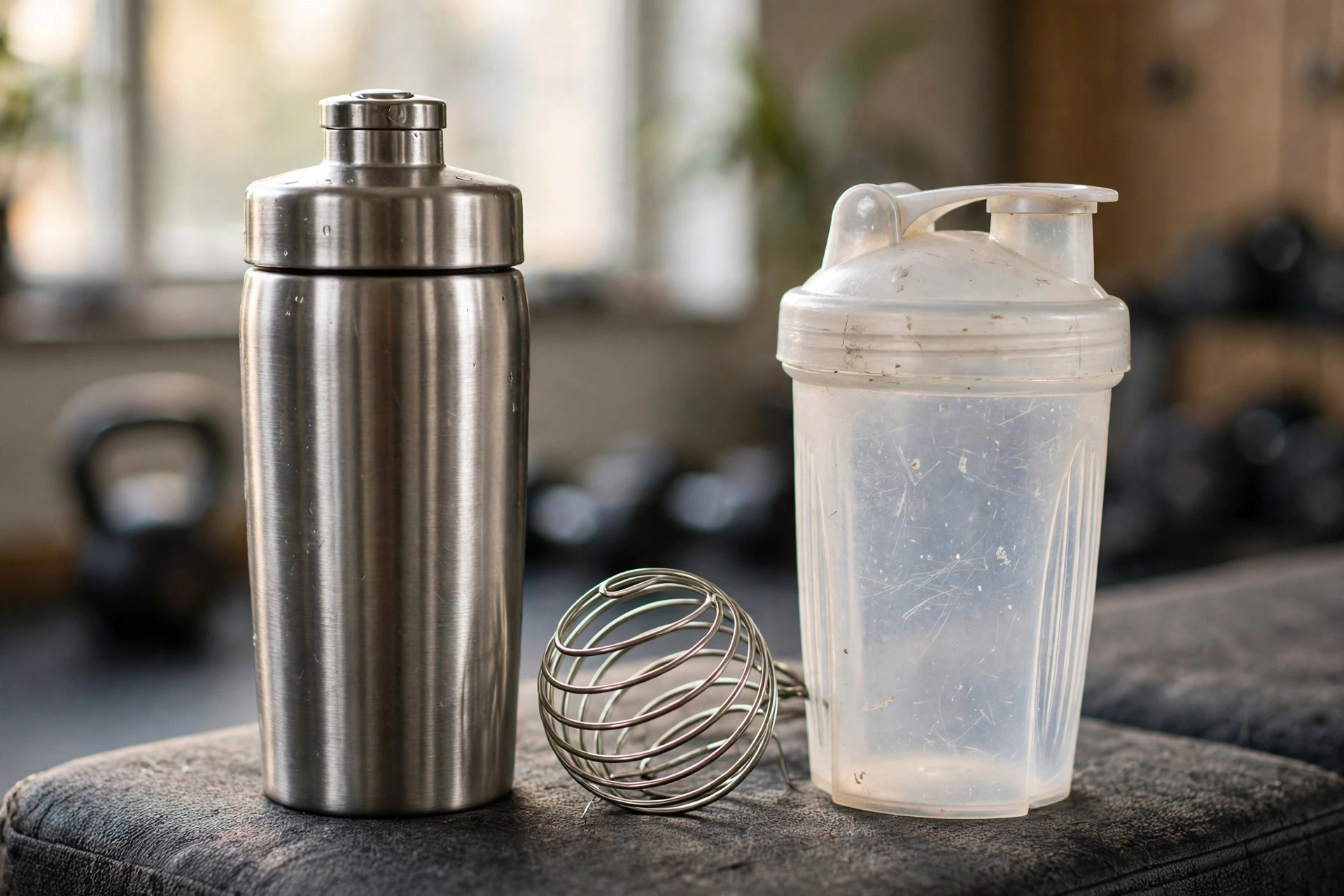
Shake a protein bottle hard enough and you can hear the problem. That steel ball rattling inside is not just mixing your shake. It is hammering the wall of the bottle, hundreds of times per shake, day after day, month after month. For years the honest answer to “does that matter?” was that nobody had actually measured it. Now somebody has, and the measurement changes what a sensible person buys.
Here is the short version. A 2026 study in the Journal of Hazardous Materials, Yang et al. 2026, tested reusable plastic shaker bottles made from polypropylene, polycarbonate and Tritan copolyester, and found that all three shed microplastic particles when shaken. The steel mixing ball made it worse, because hard steel striking and sliding against a softer plastic wall abrades that wall. The researchers modelled an annual intake of roughly 74,000 to 146,000 particles per user from this one habit. They also measured the mass, and the mass tells a calmer story, which we will get to honestly below. No health outcome was measured at all.
So the question is not really whether plastic shakers shed. They do, at least under laboratory shaking conditions. The real question is what you do about it, and how much of the fix is real versus how much is a stainless bottle with a plastic lid pretending to be plastic free. That second part is where most guides go quiet. This one will not.
So what should you actually buy?
The verdict: buy the BlenderBottle Strada Stainless Steel. It keeps the exact mixing system most people already like, a steel wire whisk ball, but puts that ball inside a double wall stainless steel cup instead of a plastic one, so the abrasion the study measured has no plastic wall to work on. Its whisk is 316 surgical grade stainless steel, stated on the listing itself. The lid is still plastic, and we will not pretend otherwise.
That is the whole recommendation in one paragraph. Everything after this is the argument: the case against that pick, the study in full, what stainless steel does and does not fix, an honest audit of the lids, and the ranked alternatives if the Strada is not your bottle. If you only read one more section, read the case against it, because a verdict that cannot survive its own objections is not worth much.
Get the Weekly Swaps
One short email a week: the newest microplastics studies in plain English, plus the swaps that are actually worth your money. Join free and we will send you our room-by-room microplastic checklist to get you started.
Get Our Free Room-by-Room Microplastic ChecklistJoin the newsletter and get the checklist free →
The case against it
The lid is plastic. Let us start with the objection that matters most, because it applies to every stainless shaker on the market, not just this one. The Strada has a push button flip lid, and BlenderBottle does not name the polymer on its listing beyond saying the product is BPA and phthalate free. Your shake still touches plastic at the lid and pours through a plastic spout. If your goal is zero plastic contact, no shaker in this article reaches it, and any guide that implies otherwise is selling you a feeling. What steel removes is the large, constantly abraded wall surface. What it does not remove is the lid. We think that trade is still clearly worth making, but you should make it with your eyes open.
The dose, honestly, is small. The particle count sounds alarming until you read the mass figure from the same study: roughly 42 to 72 micrograms of plastic per bottle per year. A microgram is a millionth of a gram. Spread across a year of daily shakes, that is a vanishingly small mass, and the study measured no health effect, in people or otherwise. If you switch bottles expecting a proven health benefit, you will be disappointed, because no such proof exists for this exposure route. The honest reason to switch is simpler: this is one of the few microplastic exposures you can cut almost to zero for the cost of one bottle, with no downside to how your shake tastes or mixes. Easy, cheap, permanent reductions are worth taking even when the risk is unproven. Hard, expensive ones deserve more scepticism.
The study never tested a steel bottle. Yang and colleagues tested plastic bottles. The claim that a steel ball inside a steel cup sheds no plastic is an inference from the mechanism, not a measured result in that paper. It is a strong inference, because there is no polymer wall in the system to abrade, but it is still an inference, and a careful reader should know the difference. Steel on steel does wear, extremely slowly, and what it sheds is metal, not microplastic, which the body handles very differently. But nobody has yet published the steel shaker version of this experiment.
It costs more and weighs more. A stainless insulated shaker costs several times what a basic plastic one does and feels it in a gym bag. You also cannot see through it, so you cannot watch the powder dissolve or judge how much is left at a glance, and the measurement marks sit inside a dark cup. Plenty of people buy a steel shaker, miss the visibility, and drift back to plastic within a month. A bottle you stop using fixes nothing.
Insulation can be a drawback. Double wall vacuum insulation keeps a shake cold for hours, which is lovely in summer. It also means the bottle is wider, may not fit every cup holder or bike cage, and should not go in the freezer the way a cheap plastic bottle can. And like most insulated steel, the cup wants hand washing if you want the finish and vacuum seal to last, even where a listing allows the lid in the dishwasher.
None of those objections overturns the verdict. The lid objection caps how much good the switch does, the dose objection caps how urgent it is, and the study objection reminds us the steel result is inferred. But the core mechanism is not in doubt: a hard ball abrading a soft plastic wall releases plastic particles, and removing the plastic wall removes that mechanism. On balance, the BlenderBottle Strada Stainless Steel is still the bottle we would buy first.
What did the study actually find?
Short answer: all three common shaker plastics shed particles when shaken, the steel ball increased the release, older and more used bottles generally shed more, and the polycarbonate bottles showed chemical damage to the surface itself, not just scratching.
The study, Yang et al. 2026 in the Journal of Hazardous Materials, came from a team spanning Southeast University in China and the University of Massachusetts Amherst, including senior author Baoshan Xing, a well known environmental chemist. Its title tells you the design: polymer specific abrasion and aging govern microplastic release from reusable plastic shaker bottles. Three things in that design deserve attention, because most news coverage flattened all of them.
First, the shedding happened without the ball too. Bottles shaken with no mixing ball still released measurable particles. Shaking alone, liquid moving against a polymer wall under pressure, is enough. The ball is an amplifier, not the whole story. That matters for the buying advice: a plastic bottle with a plastic agitator grid is not a clean fix either, because the wall itself is the source. It also matters for honesty in the other direction. If you keep a plastic bottle and simply remove the ball, you have reduced the exposure, not eliminated it.
Second, the polymer mattered. Polypropylene, polycarbonate and Tritan copolyester are the three materials that dominate the shaker aisle, and they did not behave identically. Polycarbonate showed surface etching and bond scission, which is chemistry language for the surface itself breaking down at the molecular level under mechanical stress, not merely being scratched. That is the finding that should retire the phrase “it is just a few scratches.” A degrading surface keeps producing particles as it ages, which fits the study’s other pattern: release generally rose with continued use. A bottle that sheds a little when new sheds more when it is a year old, cloudy and scored inside. If you have ever retired a shaker because it started to smell permanently of old protein, you have seen the end stage of that surface breakdown with your own nose.
Third, the particles were small. Most released particles were smaller than 20 micrometres. Small size is why the count is so high while the mass is so low, and it is also the size range researchers pay most attention to, because smaller particles are the ones with any plausible route across biological barriers. Plausible route is doing real work in that sentence. This study did not test absorption, did not feed particles to animals, and did not measure any health outcome. It measured release. Treating a release study as a harm study is the single most common error in microplastics coverage, and we flag it every time we cite one, including when the scarier reading would help our affiliate links.
Why does the steel ball make it worse?
Short answer: hardness mismatch. Steel is far harder than any shaker plastic, so every impact and slide concentrates force on the softer surface, gouging and fatiguing it. Put the same ball inside a steel cup and the mismatch disappears.
Think of it as a tiny, repeated machining process. A wire whisk ball is light, but shaking multiplies its contacts: across a twenty second shake it strikes and drags along the wall hundreds of times, and it does so loaded with liquid pressure behind it. Each contact is trivial. A year of daily shakes is hundreds of thousands of contacts, always on the same softer material. Plastics respond to that in two ways. They abrade, shedding the fine particles the study counted, and they fatigue, developing the micro cracks and surface crazing that make the next thousand contacts more productive than the last. That is why aging showed up in the results. The bottle is not a fixed source. It is a worsening one.
This is also why the material of the cup matters more than the material of the ball. People ask whether a plastic coated ball or a silicone ball would solve it. A softer ball would abrade the wall less, certainly, but it introduces its own wear surface, and the wall still sheds under plain shaking, as the no ball condition showed. Changing the wall to steel removes both pathways at once: no polymer to abrade, and no polymer to fatigue. Our guide to the best non-toxic stainless steel bottles makes the same point for everyday drinking bottles, where the exposure is gentler but the fix is identical.
One more mechanism deserves a mention, because it is the one nobody talks about: the lid threads and the cap. Every open and close drags plastic thread against plastic thread, and every flip cap snaps a living hinge that flexes and wears. Those contacts are brief and the liquid contact there is shorter than at the wall, so we rank them well below the wall and ball pathway. But they are why we keep saying steel shakers are lower plastic, not plastic free, and why the lid audit below is part of the decision rather than fine print.
Particle counts sound huge. What about the actual amount?
Short answer: by mass, very little. The same study that produced the headline count of 74,000 to 146,000 particles per year put the mass at roughly 42 to 72 micrograms per bottle per year. Both numbers are true, and you need both to think clearly.
Microplastics research lives with this tension everywhere. Particles smaller than 20 micrometres weigh almost nothing individually, so a count can be enormous while the mass stays tiny. Campaigners quote the count. Industry spokespeople quote the mass. Honest coverage quotes both and admits what neither proves: the count tells you the exposure is real and routine, the mass tells you it is not, by itself, evidence of a large chemical dose, and neither number tells you whether harm follows, because the toxicology at these sizes and doses is still being worked out.
There are two more limits in the method worth knowing. The team shook the bottles with purified water, not protein drinks, because protein interferes with particle analysis. A real shake is thicker, coats surfaces, and may change release in either direction; nobody knows yet. And the annual figure is a modelled estimate, built by scaling a laboratory shaking protocol up to a year of assumed daily use, not a measurement taken from anyone’s actual gym bottle. Modelled estimates are legitimate science. They are also exactly the kind of number that shrinks or grows when the assumptions change, so we present it as an estimate, every time.
Our position, stated once and applied across this site, is this: when an exposure is plausible, repeated daily, and cheap to eliminate, eliminating it is reasonable even before the harm question is settled. When an exposure fix is expensive or disruptive, the unproven harm matters much more in the decision. A shaker bottle swap sits firmly in the first category. That is the whole case, and it does not need inflating.
What do 18/8 and 316 actually mean, and does the grade matter here?
Short answer: 18/8 is the standard food grade stainless family (the 304 grade family), named for roughly 18 percent chromium and 8 percent nickel. Grade 316 adds molybdenum for stronger corrosion resistance and is the grade used for surgical instruments and marine hardware. For a shaker cup, either is far more than adequate. What matters more is that the wall is steel at all.
The chromium is the working ingredient in all stainless steel. It forms a thin chromium oxide layer on the surface, called the passive layer, which seals the metal and repairs itself in air when scratched. That self repairing skin is why a steel cup can be abraded by a steel ball for years without the runaway surface degradation the study found in polycarbonate. Steel does wear under abrasion, but it wears by losing minute amounts of metal, not by shedding polymer fragments, and it does not develop the micro crack networks that turn a plastic surface into a particle factory.
Grade still matters at the margins, and the picks below split honestly on it. The Hydro Flask Insulated Shaker and the STANLEY Vitalize Shaker state 18/8 stainless in their specifications. The BlenderBottle Strada Stainless Steel does not state a cup grade on its Amazon listing, so we describe it as stainless steel and no more, while noting its ball is explicitly 316. The Ice Shaker says kitchen grade stainless, a marketing phrase rather than a specification, and the BrüMate MultiShaker listing data likewise does not pin a grade. Never let a guide upgrade a vague listing into a precise grade. If the maker wanted the grade known, they would print it.
Two practical steel limits belong in any expert treatment. Acidic and salty liquids left sitting in steel for many hours can mark and eventually pit lesser finishes, so a pre workout mixed in the morning and drunk at night is fine, while a habit of storing citrus drinks in the bottle for days is not. And a dented vacuum bottle has usually lost its insulation at the dent, not its safety: a dent is a cosmetic and performance failure, where a crack in plastic is a shedding and hygiene failure. That difference, dent versus crack, is the longevity argument for steel in one line. The same steel questions come up in the kitchen, and our explainer on whether you can microwave stainless steel covers the newer steel containers honestly if that is your next rabbit hole.
If the lids are all plastic, does any of this matter?
Short answer: yes, because exposure follows surface area, contact time and abrasion, and the lid loses on all three counts compared with the wall. The wall is the big, wet, constantly hammered surface. The lid is a small surface your drink passes briefly on the way out.
Rank the parts of a shaker by how much they plausibly contribute. First, the cup wall: largest area, full contact for the whole drink, and the surface the ball abrades. Second, the mixing element itself if it were plastic, which is why every pick here uses steel or a fixed agitator rather than a loose plastic ball. Third, the gasket and threads: small, but in constant flexing contact, and worth keeping clean and replacing when they perish. Fourth, the spout and mouthpiece: brief contact, no abrasion to speak of. A steel shaker eliminates the first and largest term entirely and leaves the small ones. That is not purity. It is arithmetic.
Silicone gaskets deserve a word, because readers ask. Every pick here seals with silicone, and silicone is a polymer, just not a plastic in the microplastic shedding sense that this study measured. It is a silica based elastomer with a very different degradation profile, and our full explainer on whether silicone is actually safe works through that evidence in depth. The short version: a replaceable silicone gasket is not a reason to reject a steel bottle, and a perished, torn gasket is a reason to replace the gasket, not the bottle.
Does how you wash it change how much it sheds?
Short answer: for plastic bottles, almost certainly yes, even though this study tested shaking rather than washing. Heat, detergent and dishwasher abrasion are aging forces, and aging was one of the two variables in the study title for a reason. For steel, washing is a hygiene question, not a shedding one.
Apply the study logic to your kitchen. A plastic shaker that goes through a hot dishwasher cycle daily is being thermally aged on top of its mechanical aging. A plastic shaker scrubbed with an abrasive pad is being pre scored for tomorrow’s shake. And a plastic shaker left sealed with protein residue in a hot car is growing the biofilm that makes people scrub harder next time, in a loop that ends with the cloudy, scored, permanently sour bottle every gym bag eventually contains. Our practical rule for any plastic bottle you keep during a transition: hand wash it gently, never store a shake in it, and retire it the moment the inside is visibly scored, cloudy or holding a smell after washing. Those are not cosmetic judgments. On this evidence, they are shedding judgments.
For the steel bottle you replace it with, the care protocol is boring, which is the point. Rinse it the same day, because dried protein in any bottle is a hygiene problem long before it is a materials one. Wash with a soft brush, dry the gasket separately now and then, and descale only if your water demands it. Steel does not need babying. It needs rinsing. The one real steel failure mode is neglect of the lid: a gasket left damp and sealed for weeks will grow mould in the groove, and the fix is the unglamorous habit of storing the bottle with the lid off or ajar.
If not this one, then which?
Five alternatives, ranked by how completely they answer the study, then by how livable they are day to day. Every one has a steel cup and a plastic lid. Every one is a name brand with a real Amazon listing. We quote no star ratings here, because we could not capture clean Amazon ratings for this category in this research pass, and a rating we cannot verify is a rating we do not print.
1. The verdict, restated: BlenderBottle Strada Stainless Steel, 24 oz. The direct one for one replacement for the classic plastic BlenderBottle: same steel wire whisk system, now in a double wall insulated steel cup, with a push button locking lid and a stated 316 stainless whisk. If you already like how a BlenderBottle mixes, this is the lowest friction switch that exists. The honest cons are the case against section above: plastic lid, no visibility, more weight.
2. No loose ball at all: Ice Shaker, 26 oz. The Ice Shaker replaces the loose ball with a twist on agitator built into the lid, which also works as a strainer. If the rattling ball itself is what you want gone, this is your bottle: double wall vacuum insulation with very long cold claims, a pop top spout, and a silicone base. Two honest flags: the steel is described as kitchen grade without a numeric grade, the agitator material is not stated on the listing data we could verify, and independent reviews confirm the lid is plastic. It ranks second because removing the ball removes the amplifier entirely, even if we cannot grade its steel.
3. The stated grade pick: Hydro Flask Insulated Shaker, 24 oz. Hydro Flask states 18/8 pro grade stainless and double wall TempShield insulation, with an internal whisk ball and a leakproof flip chug lid. It is the pick for readers who want the specification printed rather than implied, from a brand whose steel bottle track record is long. The lid polymer is not named on the listing, the whisk material is not separately specified, and the chug spout is a wide, fast drink path that some people love and some find sloppy with thick shakes. If you already own Hydro Flask bottles and like the ecosystem, start here.
4. The twist lid traditionalist: BlenderBottle Radian Stainless Steel, 26 oz. The Radian is the Strada’s sibling with a screw on lid, a centre spout and a detachable carry loop, and the largest capacity in this set alongside the Ice Shaker. Same steel whisk system, same undisclosed lid polymer, same visibility trade off. Choose it over the Strada if you distrust flip lids in a gym bag, because a threaded lid is the more forgiving seal when a bottle lives sideways under a pair of shoes. The variant linked here is the one we verified; colour variants carry their own listings, so check you are on the stainless Radian and not a plastic one with a similar name.
5. The design pick: BrüMate MultiShaker. BrüMate builds the agitator into the bottle as a removable insert that doubles as an infuser, pairs it with a magnetic locking flip lid, and insulates aggressively. It is the most considered industrial design in the set and the one most likely to be borrowed by a partner for iced coffee. Its own retail materials list plastic among its materials for the lid, the steel grade is not stated, and the design flair is exactly what some buyers want and others read as parts to lose. It ranks fifth here only because this ranking rewards stated specifications, and BrüMate states fewer of them.
6. The small bottle with a storage trick: STANLEY Vitalize Shaker, 20 oz. Stanley states 18/8 stainless, integrates the strainer into the twist lid so there is no ball and no loose agitator, and screws a small powder storage compartment into the base. It is the tidiest system here and the smallest: 20 ounces is a single modest shake, not a mass gainer with oats. One secondary description calls its lid Tritan; the Amazon listing itself says BPA free without naming the polymer, so we treat the lid as plastic, polymer unconfirmed, and say so rather than repeating the claim as fact. Pick it if you travel light and value the powder compartment. Skip it if you mix big shakes.
The one we would skip: another plastic bottle, marketed as the upgrade. The premium end of the plastic shaker aisle now sells insulated plastic, antimicrobial plastic and eco labelled plastic at prices approaching steel. On the Yang et al. 2026 evidence, every one of those bottles still has a polymer wall in the abrasion path, still ages, and still sheds, whatever the label promises about BPA. BPA free was never the question here. The wall is the question. If a replacement bottle has a plastic wall, it is not a replacement for the problem this article is about, and we would not spend upgrade money on it. The same logic governs our glass food storage guide: change the contact material, not the marketing claim.
Browse Our Full Amazon StorefrontAll our stainless shaker picks in one place →
What we would actually buy
One bottle, not a collection. If you shake daily, buy the BlenderBottle Strada Stainless Steel and retire the plastic bottle it replaces the same week, because a steel bottle sitting in a cupboard while the plastic one stays in rotation is a purchase, not a change. Keep the steel whisk from your old bottle as a spare if it is the same system, and recycle or bin the scored plastic cup rather than demoting it to a second daily bottle, since a demoted bottle still gets shaken.
If the loose ball annoys you, or your shakes go through a strainer better than a whisk, buy the Ice Shaker instead and do not buy both. Two good bottles solve no problem that one good bottle does not. If you mix small shakes and want your powder carried in the bottle itself, the STANLEY Vitalize is the exception worth its smaller size.
What we would skip spending on: a second steel bottle as a backup before the first has earned it, any plastic bottle sold as a premium upgrade, replacement plastic lids bought to extend the life of a scored plastic cup, and powder storage canisters in plastic when the powder tub you already own does the same job with less shaking contact than any bottle. Spend the difference on the habit that actually protects the new bottle: a soft bottle brush and the thirty seconds it takes to rinse it the same day.
And one transition note for readers not ready to spend anything: take the steel ball out of your plastic bottle today and shake longer, or stir the powder into a little liquid first with a fork. The study found shedding without the ball too, so this is a reduction, not a solution. But it is a free reduction, available tonight, and it is the correct first step while you decide.
Join Our Free Facebook GroupNon-Toxic Family Living: parents sharing swaps that work →
Rapid-fire answers
Do protein shaker bottles shed microplastics? Yes, on the best direct evidence available. Yang et al. 2026, in the Journal of Hazardous Materials, found polypropylene, polycarbonate and Tritan shaker bottles all released particles when shaken, with or without a mixing ball.
How many particles are we talking about? A modelled estimate of about 74,000 to 146,000 particles per user per year, and, in the same study, only about 42 to 72 micrograms of plastic mass per year. Quote both numbers or quote neither.
Has anyone shown this harms your health? No. The study measured release, not harm. No health outcome was tested, and we do not claim one. The case for switching is that the fix is cheap and permanent, not that the harm is proven.
Is Tritan safer than polypropylene or polycarbonate here? All three shed in this study. The polymers behaved differently, with polycarbonate showing surface breakdown beyond simple abrasion, but no plastic in the test was a non shedder. Choosing among plastics is choosing a rate, not an exit.
Does a stainless shaker eliminate the problem? It eliminates the wall abrasion pathway, which is the main one. The lid is still plastic on every model we could verify, so the honest claim is a large reduction, not zero plastic contact.
What if I just remove the steel ball from my plastic bottle? Do it. Release fell without the ball in the study, but it did not stop, because shaking alone sheds from the wall. Treat it as a free interim step, not the finish line.
Can I filter the particles out instead? Not practically for a shake. The particles are mostly under 20 micrometres, mixed through a thick drink, and filtering a protein shake would remove the protein along with the problem. Prevention at the wall beats filtration in the glass, every time.
Glass or steel for a shaker? Steel, for this job. Glass does not shed plastic either, and we recommend it widely for storage, but a shaker gets dropped, thrown in bags and shaken hard with a metal ball inside. Steel survives the use case. Glass, in a gym bag, is a countdown.
When should I retire a plastic shaker? When the inside is visibly scored, cloudy, cracked or holding a smell after a proper wash. On this evidence those are signs of the surface aging that raises release, not just cosmetic wear.
Add Us as a Preferred Source on GoogleOne tap, and our guides show up first in your Google results →
Keep reading
- The best non-toxic stainless steel bottles, the everyday drinking version of this same material swap.
- Is silicone actually safe? What the evidence says about the gaskets and lids steel bottles still use.
- Best glass food storage containers, for the kitchen half of the same contact material logic.
- Can you microwave stainless steel? The new containers that say yes, and the science behind them.