Nanoplastics vs. Microplastics: What’s the Difference and Why It Matters
This article contains affiliate links. If you make a purchase through one of our links, we may earn a small commission at no extra cost to you. We only recommend products we would genuinely tell a friend about. Read our full affiliate disclosure for details.
When most people hear “microplastics,” they picture tiny flecks of plastic, small enough to slip past a filter but still something you could theoretically see if you looked closely enough. That picture is only half the story.
Below microplastics, there’s a whole other category of particles, ones so small that a microscope isn’t always enough to find them. These are nanoplastics, and researchers increasingly believe they may matter more for our health than the microplastics we hear about most often.
We wanted to lay out exactly what separates the two, why the size difference isn’t just a technicality, and what the research actually says (and doesn’t say yet) about each one. No scare tactics here, just a clear explanation of where the science stands in 2026.
If you’re looking for practical ways to cut down your family’s exposure to both, our room-by-room guide to reducing microplastics at home is a good next stop after this one.
For a curated selection of the best products we recommend for reducing microplastic and nanoplastic exposure, check our Amazon storefront — it’s updated regularly and includes everything from glass storage to stainless steel water bottles.
Looking for safer swaps?
We keep all of our favorite low-plastic kitchen, kids, and home products in one place, so you can skip the research and find what actually works.
See Our Non-Toxic Picks →The Short Version
- Microplastics are plastic particles between 1 micrometer and 5 millimeters wide, roughly the range from a single grain of table salt down to something barely visible without magnification.
- Nanoplastics are smaller still, generally defined as anything under 1 micrometer, with some scientific bodies drawing the line even lower, at 100 nanometers.
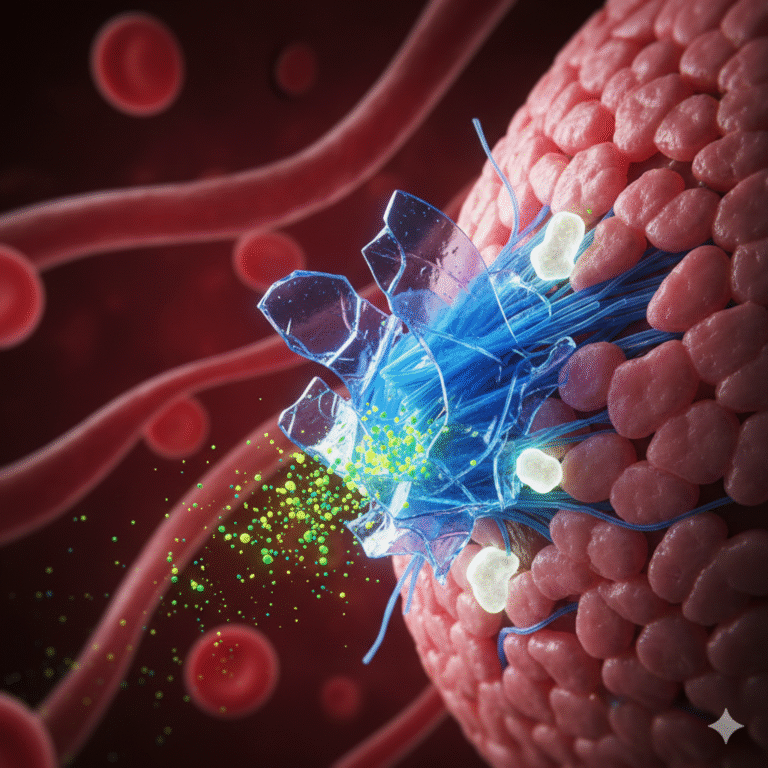
- Size isn’t just a labeling detail. It’s the reason nanoplastics can slip through biological barriers that microplastics usually can’t, including cell membranes and possibly the blood-brain barrier.
- Microplastics are easier to detect and have been studied for longer. Nanoplastics are harder to measure, which is part of why the research on them is still catching up.
- Neither particle type has a government-set “safe exposure limit” yet. Scientists are still working out how much matters and at what point it becomes a genuine health concern.
What Is the Difference Between Microplastics and Nanoplastics?
The main difference between microplastics and nanoplastics is size, and that size gap changes how each one behaves in the body. Microplastics are plastic particles between 1 micrometer and 5 millimeters wide, while nanoplastics are smaller than 1 micrometer. It’s tempting to think of “nano” as just a smaller version of “micro,” a difference in degree rather than kind, but the research suggests it’s more meaningful than that.
Scientists distinguish the two categories because size changes how a particle moves once it’s inside the body. That size gap has real physical and biological consequences, since nanoplastics are able to pass through biological membranes in ways larger microplastic particles cannot.
That membrane-crossing ability is the heart of why researchers are paying closer attention to nanoplastics specifically. Generally, more hazardous effects are expected from smaller microplastic particles, and especially from nanoplastics, which is part of why understanding their concentration in our environment and food supply has become a research priority.
How Small Are Nanoplastics Compared to Microplastics?
Nanoplastics are smaller than microplastics by a factor of at least a thousand, which puts them in the same size range as some viruses. To picture the scale, a single human hair is about 70 micrometers wide. A microplastic particle can be as large as a grain of rice or as small as roughly 1/70th the width of that hair, the smallest ones sitting right at the edge of what the naked eye can register. In other words, 1 micrometer is roughly 1 seventieth the width of a strand of hair, a size that’s already too small to see without magnification.
Nanoplastics start where microplastics end and keep going much smaller. For scale, a typical bacterium measures around 1,000 nanometers wide, and a virus like SARS-CoV-2 measures around 100 nanometers, putting nanoplastics in the same size range as some viruses. That’s small enough to move through the body in ways a grain-of-rice-sized particle simply can’t.
What Size Is Considered a Nanoplastic?
A nanoplastic is generally defined as any plastic particle smaller than 1 micrometer, though some scientific bodies use a stricter cutoff of 100 nanometers. Here’s something that surprises people: there isn’t one single, universally agreed-upon cutoff between “micro” and “nano.” Different scientific bodies use slightly different definitions, and it’s worth knowing both so you’re not confused when you see different numbers in different places.
The 1 micrometer cutoff. This is the version used by most marine and food-safety researchers. In most studies, particles ranging in size from 5 millimeters down to 1 micrometer are classified as microplastics, though there is no single universally accepted definition, and they’re distinguished from the even smaller nanoplastics, which start below 1 micrometer or below 100 nanometers depending on the study.
The 100 nanometer cutoff. This stricter definition comes from regulatory bodies focused on nanomaterials broadly, not just plastic. It sets the bar for “nano” at a smaller size, which means some particles that one group calls “micro” would count as “nano” under this definition.
Either way, the underlying point is the same. Micro means one-millionth. Nano means one-billionth. Nanoplastics are, by definition, smaller by an order of magnitude, and that difference in scale is exactly why they behave differently once they’re in the body.
Where Do Microplastics and Nanoplastics Come From?
Microplastics and nanoplastics come from the same basic sources, mostly the breakdown of larger plastic items, but they don’t always arrive the same way. Both types are found in our homes, our water, and our food, though the path each takes to get there can differ.
Microplastics mostly form when larger plastic items break down. A synthetic fleece jacket sheds fibers in the wash. A plastic cutting board loses tiny flecks every time a knife scrapes across it. A water bottle left in a hot car degrades at the surface. This kind of gradual breakdown, called fragmentation, is the primary source of microplastics in daily life.
Nanoplastics can form the same way, as the end stage of that same fragmentation process, microplastics breaking down into something even smaller over time. But they’re also sometimes produced directly, through industrial processes that create plastic at the nanoscale on purpose, for use in things like certain manufacturing applications and consumer products. That means nanoplastic exposure isn’t only “microplastics that got smaller.” Some of it starts small.
This matters for a practical reason: many of the swaps that reduce microplastic exposure, like switching from plastic cutting boards to wood, or from nonstick pans to cast iron, likely also reduce nanoplastic exposure, since they cut off the fragmentation process at the source. We walk through specific swaps for families in our guide to reducing your child’s microplastic exposure.
Are Nanoplastics More Dangerous Than Microplastics?
Early research suggests nanoplastics may pose a higher risk per particle than microplastics, mainly because their smaller size lets them cross biological barriers that larger particles can’t. That said, this is an active and developing area of science, so it’s worth being careful, because it’s easy for headlines to run ahead of the actual evidence. Here’s an honest summary of where things stand.
The research is real, but it’s still developing
A large narrative review of the current evidence, published in 2025, put it plainly: microplastics are a ubiquitously present environmental contaminant, and while research is accumulating, this remains an active and evolving field of study rather than a settled one. That’s an important distinction. Scientists have found these particles in human tissue. They have not yet established a clear, universally agreed dose-response relationship, meaning exactly how much exposure leads to what level of health effect.
What lab studies are showing
Laboratory research using human cells has produced some consistent patterns worth knowing about. A 2025 systematic review of studies on liver health found that experiments using human liver-derived cell lines consistently reported oxidative stress, inflammation, cell damage, and disruptions to normal cell function in a pattern that scaled with both the size and the dose of the particles, with nanoplastics showing the highest level of cellular stress compared to larger microplastics.
That “smaller particle, bigger effect” pattern shows up across multiple areas of nanoplastics research, which lines up with what we’d expect given how much more easily nanoplastics can cross into cells and tissue.
The honest caveat
It’s worth saying clearly: cell studies in a lab are not the same as proof of harm in a living person going about daily life. Cells in a dish are exposed to controlled, often higher concentrations than what most people encounter day to day. These studies tell us what’s biologically plausible and worth investigating further, not what’s definitely happening inside every person who has plastic particles in their body.
Some federal health guidance reflects that uncertainty directly. As of the most recent public guidance available, the FDA has indicated that, based on available research, the levels of microplastics and nanoplastics currently found in foods and the environment are not thought to be enough to pose a risk to human health. At the same time, researchers continue to flag areas of concern that deserve more study, including possible links to effects on the immune, respiratory, gastrointestinal, and liver-related systems, along with newer research exploring potential connections to reproductive and digestive health.
Both of those things are true at once. Current evidence doesn’t point to a confirmed, immediate health crisis. And scientists are taking the open questions seriously enough to keep investigating them, especially where nanoplastics are concerned.
Why nanoplastics get more research attention right now
If microplastics were discovered first and have been studied longer, why is so much current research energy shifting toward the smaller particles? A few honest reasons:
They can go places microplastics can’t. The ability to cross cell membranes, and potentially barriers like the blood-brain barrier and the placenta, is unique to particles at the nanoscale. That’s not confirmed as harmful in every case, but it does mean nanoplastics have access to parts of the body that larger particles simply don’t reach.
They’re harder to study, so there’s more we don’t know. Ironically, this is part of why concern is rising rather than falling. Better detection technology in recent years has let scientists find and measure nanoplastics that older instruments couldn’t detect at all. As the tools improve, researchers are getting a clearer (and sometimes more concerning) picture of how present these particles actually are.
Early lab findings keep pointing the same direction. As we noted above, when researchers compare microplastics and nanoplastics side by side in the same study, the nanoplastics tend to produce a stronger biological response. That consistent pattern, even across different organs and research teams, is part of why this is considered a priority area rather than a fringe concern.
How Are Nanoplastics Detected and Measured?
Nanoplastics are much harder to detect than microplastics, and the difference in detection difficulty shapes much of what we currently know. Detection technology is a huge part of this story, maybe a bigger part than most articles let on.
Microplastics are (relatively) easy to catch
For microplastics, there are now established reference methods and standardized protocols that let researchers compare results across different labs and studies with some confidence. Techniques like filtration, visual sorting under a microscope, and a chemical identification method called FTIR spectroscopy let scientists reliably confirm that a particle is, in fact, plastic, and identify roughly what kind.
This matters because it means when you read a headline like “microplastics found in bottled water,” there’s usually solid, repeatable methodology behind that claim. The field has had time to mature.
Looking for safer swaps?
We keep all of our favorite low-plastic kitchen, kids, and home products in one place, so you can skip the research and find what actually works.
See Our Non-Toxic Picks →Nanoplastics are a much harder catch
Nanoplastics analysis still presents real analytical challenges, and this isn’t a minor technical footnote. At the nanoscale, particles are too small for standard filtration to catch and too small for a regular microscope to confirm visually. Researchers need far more specialized, expensive equipment, things like electron microscopy and mass spectrometry, to even detect that nanoplastics are present, let alone measure how much.
This creates a real gap in what we can confidently say. It’s entirely possible that nanoplastics are more widespread in food, water, and our bodies than current studies show, simply because most labs don’t yet have the tools to find them reliably. That’s not speculation dressed up as fact, it’s a limitation that researchers in this field openly acknowledge.
Why this gap matters for how you read the news
When you see a study that says “no nanoplastics were detected” in a particular product, it’s worth reading that as “no nanoplastics were detected using this study’s specific method,” rather than “there are definitely none present.” As detection technology keeps improving year over year, expect the reported numbers for nanoplastics specifically to keep climbing, not necessarily because exposure is increasing, but because our ability to see what was already there is getting better.
How Do Microplastics and Nanoplastics Enter the Body?
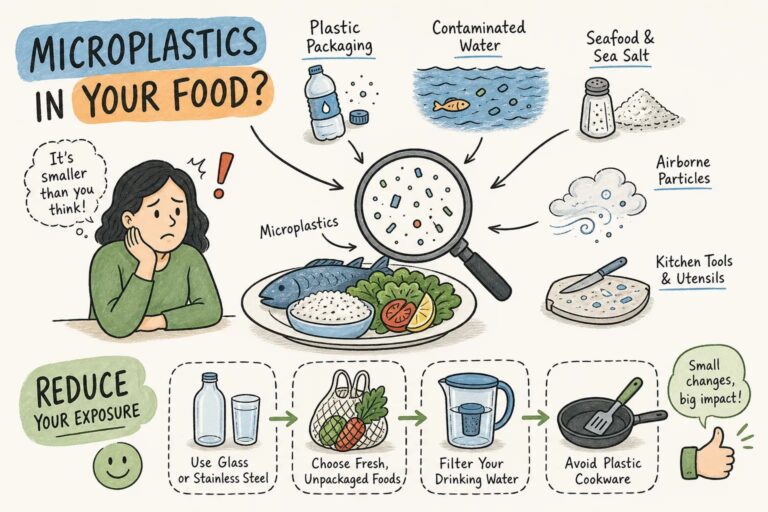
Microplastics and nanoplastics enter the body mainly through the food we eat, the water we drink, and the air we breathe, with skin contact as a less-understood third pathway. Understanding these pathways matters because it points directly at the swaps that actually reduce exposure, rather than ones that just sound good.
Through food and drink
Both particle types have been found in a wide range of foods and beverages, including bottled water, salt, seafood, and food packaged or heated in plastic containers. Heat is a particularly important factor here. Plastic that’s heated, whether that’s a to-go coffee cup lid, a nonstick pan on a hot burner, or a plastic container in the microwave, sheds particles far more readily than plastic at room temperature. This is one of the most consistent findings across food-safety research on the topic. Read our full article on how to reduce exposure through food and drink here.
Through the air we breathe
Household dust, synthetic carpet fibers, and fabric from clothes and furniture all shed tiny plastic particles into indoor air, where they can be inhaled. Because nanoplastics are so much smaller and lighter, they can stay suspended in the air longer than microplastics, which tend to settle out more quickly due to their larger size and weight.
Through the skin
This pathway is less studied and more debated among researchers, but it’s an active area of investigation, particularly for nanoplastics, given how effectively they can cross biological membranes compared to larger particles. Intact, healthy skin is a fairly effective barrier, but the question of whether nanoplastics can cross it under certain conditions hasn’t been fully settled either way.
None of these pathways are exotic or rare. They’re built into a lot of ordinary daily routines, which is exactly why the swaps that matter most (glass and steel instead of plastic for food storage, natural fibers instead of synthetic for things that touch your skin or get washed often, avoiding heating plastic) tend to reduce exposure across more than one pathway at once.
Are Microplastics and Nanoplastics Regulated?
There are currently no enforceable federal limits in the United States for how much microplastic or nanoplastic exposure is considered safe, though some state and international efforts are underway. It’s a fair question to ask whether anyone in a position of authority is setting real limits on this, and the honest answer is: not yet, in any comprehensive way, though that’s actively changing.
California, for example, has moved toward setting a health-based notification level for microplastics in drinking water, a first-of-its-kind step in the United States. International health bodies have published reviews acknowledging that current evidence doesn’t point to an established human health risk from the microplastic levels typically found in drinking water, while also calling for continued research given the gaps in what’s currently measurable.
This regulatory lag isn’t unusual for an emerging contaminant. It typically takes years, sometimes decades, between when a substance is first identified as a potential concern and when enforceable limits are established, largely because that process requires the kind of large-scale, replicated research that’s still being built for nanoplastics specifically. It’s a reasonable thing to keep an eye on rather than something to be alarmed about today.
| Microplastics | Nanoplastics | |
|---|---|---|
| Size range | 1 micrometer to 5 millimeters | Under 1 micrometer (some definitions use under 100 nanometers) |
| Visible to the eye | Sometimes, at the larger end of the range | No, requires specialized equipment to detect |
| Main source | Breakdown of larger plastic items over time | Further breakdown of microplastics, plus some direct industrial production |
| Ability to cross cell membranes | Limited | Significantly higher |
| How long it’s been studied | Longer, with established detection methods | Shorter, detection methods still developing |
| Current research focus | Measuring how much is present in food, water, and air | Understanding health effects and improving detection |
Looking for safer swaps?
We keep all of our favorite low-plastic kitchen, kids, and home products in one place, so you can skip the research and find what actually works.
See Our Non-Toxic Picks →Frequently Asked Questions
What is the actual size difference between microplastics and nanoplastics?
Microplastics range from 1 micrometer up to 5 millimeters, roughly the size of a grain of rice down to something barely visible to the naked eye. Nanoplastics are smaller than 1 micrometer, with some scientific definitions setting the cutoff even lower, at 100 nanometers. That puts nanoplastics in a similar size range to some viruses and bacteria.
Are nanoplastics more dangerous than microplastics?
Early research suggests nanoplastics may pose a higher risk per particle because their smaller size lets them cross biological barriers, like cell membranes, that microplastics typically cannot. Lab studies using human cells have found nanoplastics produce a stronger stress response than microplastics at similar doses. That said, this research is still developing, and scientists haven’t established a confirmed dose-response relationship for either particle type in humans.
Can nanoplastics cross the blood-brain barrier?
Researchers believe it’s possible, based on the fact that nanoplastics are small enough to cross other cell membranes and biological barriers that microplastics can’t. This is an active area of study rather than a fully settled question, and more research is needed to confirm exactly how often this happens and what the health implications are.
Where do nanoplastics come from if I’m not around microplastics?
Nanoplastics can form from the continued breakdown of microplastics over time, but they’re also sometimes created directly through industrial processes at the nanoscale. That means reducing your exposure to sources of microplastic fragmentation, like synthetic fabrics, plastic food storage, and nonstick cookware, likely helps reduce nanoplastic exposure too, even though the two aren’t identical sources.
Is there a safe level of exposure to microplastics or nanoplastics?
Not yet, at least not one that’s been officially established by regulatory agencies. Current federal guidance suggests the levels typically found in food and the environment aren’t believed to pose a significant risk, but this is based on the research available so far, and scientists continue to study long-term effects as detection technology improves.
The Bottom Line
Microplastics and nanoplastics aren’t two names for the same problem. They’re related, but the size difference between them changes how each one behaves once it’s in the environment and in the body. Microplastics are the part of the problem we can see and measure most reliably. Nanoplastics are the part scientists are racing to understand better, because early research suggests they may carry more risk per particle, not less.
None of this is a reason to panic. It’s a reason to keep making the small, sensible swaps that reduce exposure to both categories at once, since the same sources that shed microplastics are often the same sources that shed nanoplastics too. Small swap, real difference, even when the particle you’re avoiding is too small to see.
For a full walkthrough of where these particles show up in daily life and how to reduce exposure room by room, our complete room-by-room guide is the natural next read.