Glitter Is a Microplastic: The Christmas Sparkle Problem, Explained

As an Amazon Associate I earn from qualifying purchases. This post contains affiliate links, which means I may earn a commission if you buy through them, at no extra cost to you.
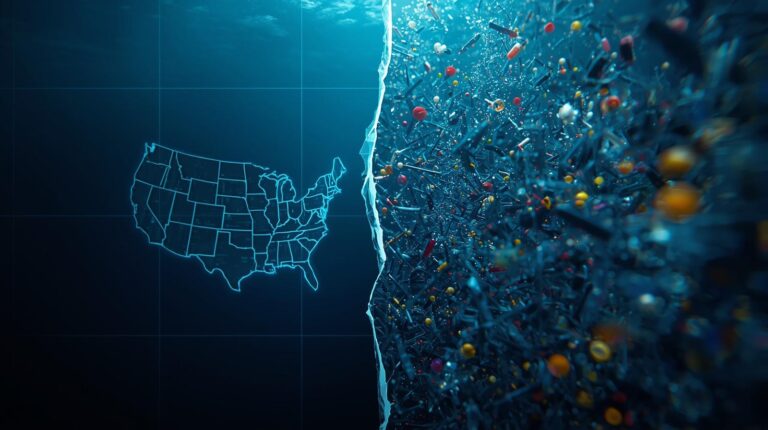
Here is a fun holiday party fact that is not actually fun: the sparkle on your Christmas cards, your wrapping paper, your ornaments and your New Year’s Eve eye makeup is plastic. Not plastic-adjacent, not plastic-coated. Plastic, cut into pieces so small that scientists file it under microplastics from the day it is made. December is when we spread more of it around our homes than any other month, mostly without knowing, so let’s fix the knowing part. The science here is more interesting than scary, and the swaps are genuinely easy.
The quick version: Yes, glitter is a microplastic. Traditional glitter is a sliver of PET polyester film (the Mylar family) coated with metal, and it is manufactured at microplastic size, roughly 50 micrometers to a few millimeters across. It sheds off cards, wrap and skin, goes down drains and into vacuums, and it makes otherwise recyclable Christmas cards and paper unrecyclable. The “biodegradable” eco-glitter swap sounds like the answer, but in the one head-to-head freshwater study we have, cellulose and mica glitters caused almost the same harm as the plastic kind. The real fix is boring and lovely: matte paper, plain wrap, and candlelight.
One proportion note before we start, because we keep it honest here: glitter is a small slice of the world’s microplastic problem by weight. It matters because it is one of the few sources that is 100% decorative, deliberately tiny, and completely within your control at the checkout.
What Is Glitter Actually Made Of?
Glitter starts as a sheet, not a powder. Most of the glitter sold for crafts, cards and cosmetics is made from BoPET, a stretched polyester film you may know by the trade name Mylar. The film is coated with a whisper-thin layer of aluminum to make it reflective, dyed or coated again for color, then precision-cut into tiny hexagons, squares and stars. Turkish researcher Meral Yurtsever, who wrote the first papers treating glitter as its own pollution category in 2019, puts commercial glitter sizes at about 50 to 6,350 micrometers. The small end of that range is finer than a grain of sand, and nearly all of it sits under the 5-millimeter line that defines a microplastic.
That last part is the key difference between glitter and most other microplastics you read about on this site. A plastic bottle becomes microplastics slowly, by breaking down over years. Glitter skips the queue. It is what researchers call a primary microplastic: plastic manufactured at micro size on purpose. Every jar of craft glitter is, by design, a jar of microplastics with a marketing department.
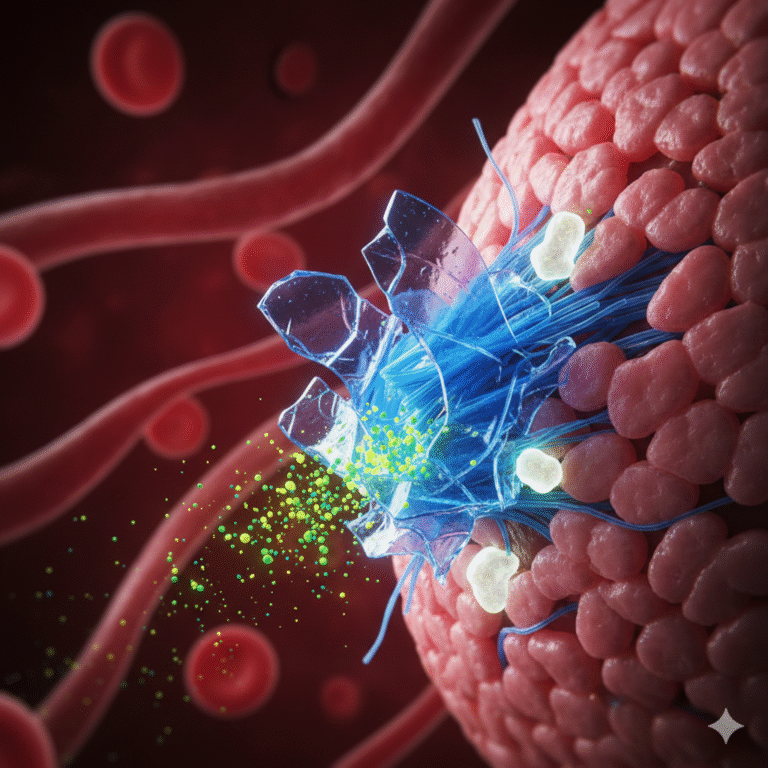
Yurtsever calls glitter a “stealth” pollutant, and the word fits. It is tasteless, odorless, nearly weightless, and it sticks to skin, carpet and clothing by static, which is exactly how it travels: rinsed off hands and faces into drains, brushed off tables into the trash, shaken out of cards onto the floor and into the vacuum. Wastewater treatment catches some particles, but the finest glitter can pass through with treated water, and what gets caught mostly ends up in sewage sludge, which is often spread on farmland. None of this requires a villain. It just requires December.
Get the Weekly Swaps
One short email a week: the newest microplastics studies in plain English, plus the swaps that are actually worth your money. Join free and we will send you our room-by-room microplastic checklist to get you started.
Get Our Free Room-by-Room Microplastic ChecklistJoin the newsletter and get the checklist free →
Where Christmas Piles It On
No other season concentrates glitter like this one. Walk through a normal December and count the sources:
Cards. Glitter is glued across a huge share of Christmas card designs, front and sometimes inside, where it sheds onto hands, tables and the envelope it arrived in. Wrapping paper and gift bags. The sparkly rolls shed as you cut, fold and tape, and again on Christmas morning when the paper gets torn and balled up. Ornaments, garlands and decor. Glitter-finished baubles and picks lose flakes every time they are handled, packed and unpacked; run a finger over an old glitter ornament and check your fingertip. Our guide to safer Christmas lights and ornaments covers what to buy instead. Stocking stuffers and novelty gifts. Glitter nail polish, glitter slime, glitter bath bombs and sparkly craft kits are stocking-season staples, which is why we steered the small gifts in our non-toxic stocking stuffers list toward wood, wool and beeswax instead. Party makeup. Face and body glitter comes off in the shower at the end of the night, which is the most direct drain-to-river route of the whole list. Kids’ crafts. December is peak glitter-glue season in classrooms and kitchens, and craft glitter is the loose, craft-store kind regulators worry about most.
Add it up and one household can easily bring home glitter on a dozen different products in a single month, each one shedding a little. Individually trivial; multiplied by every household on the street, every December, it is a real and largely uncounted stream of primary microplastics.
Why Glittery Cards and Wrap Cannot Be Recycled
This is the part of the story with an immediate, practical payoff, because glitter does not just shed into the environment. It sabotages recycling on its way out. Paper mills recycle cards and wrapping paper by pulping them back into fibers. A card coated in glued-on plastic flakes, foil stamping or a plastic laminate cannot be cleanly pulped: the glitter either contaminates the batch or the whole item gets rejected at sorting. That is why UK recycling guidance is blunt about it: cards and wrap with glitter on them do not go in the paper recycling. Full stop.
The retailers got there before most shoppers did. By Christmas 2020, John Lewis and Waitrose had made all of their own-brand cards, crackers, wrapping paper and gift bags 100% glitter-free, and Morrisons removed glitter from its entire own-brand Christmas range, cards, crackers, wrap, bags, flowers and wreaths included. When the people who sell Christmas for a living quietly delete an ingredient, it is worth asking why.
Two habits cover most of the damage at home. First, when you buy: if a card sheds sparkle onto your fingers in the shop, that is the product telling you what it will do in the recycling stream and on your table. Put it back and pick a matte design; you will not miss it by the time it is on the mantel. Second, for the glittery cards you receive (you will, and it is fine, this is not a purity test): tear off the glittered front panel and bin it, and recycle the plain back and the envelope as normal paper. Ten seconds, and most of the card still gets recycled. The same plain-paper thinking runs through our whole plastic-free gift wrapping guide, including the scrunch test for spotting plastic-coated wrap.
What the Science Actually Found
Glitter research is young, and we will tell you plainly what is proven, what is suggested, and what is still unknown. Start with the study Christmas shoppers most need to know about. In 2021, Dannielle Green and colleagues at Anglia Ruskin University published the first experiment to test glitter’s effects in freshwater, in the Journal of Hazardous Materials. They set up semi-natural stream mesocosms, basically controlled outdoor stream tanks with real sediment, plants and invertebrates, and added four kinds of glitter: conventional PET plastic glitter, a biodegradable glitter made from modified regenerated cellulose, natural mica glitter, and synthetic mica glitter. Then they watched for 36 days.
Every glitter type caused harm. Common duckweed, a floating plant that a lot of freshwater life depends on, grew roots roughly half as long in the glitter tanks as in clean water, and the phytoplankton chlorophyll in the water dropped sharply too, which means less of the microscopic algae growth that freshwater food webs run on. The biodegradable cellulose glitter and the mica glitters were not meaningfully gentler than the plastic one. The cellulose version did change the neighborhood in one extra way: New Zealand mud snails roughly doubled in abundance in its tanks, a reminder that “degrades eventually” and “harmless while it is here” are different claims. The authors’ own conclusion was that “both conventional and alternative glitters can cause ecological impacts in aquatic ecosystems.”
A year later, an Italian team led by Paolo Pastorino tested glitter on Mediterranean mussels, published in Environmental Toxicology and Pharmacology in 2022. Mussels are filter feeders, so they are a good stand-in for what happens when glitter reaches the sea. After seven days, the mussels’ digestive tracts held on to the smallest glitter particles the longest, those smaller particles triggered the strongest stress responses in the animals, and some glitter types physically crumbled during the test, breaking into even smaller pieces. In plain terms: the smaller the sparkle, the longer it stays in the animal, and glitter does not necessarily stay the size it started.
And the honest limits: these are mesocosm and lab studies, designed to show whether harm is possible and how it works, not to measure how much of the glitter in your local river came from Christmas cards. Researchers, including the Anglia Ruskin team, are upfront that glitter’s total share of microplastic pollution is not yet well quantified, and by weight it is certainly small next to tire dust and clothing fibers. The case against Christmas glitter is not that it is the biggest source. It is that it is a deliberate one: tiny plastic, bought for sparkle, shed by design, with good substitutes sitting on the same shelf.
The Eco-Glitter Question, Answered Honestly
So what about the jars and palettes labeled “biodegradable glitter,” “eco-glitter” or “plastic-free sparkle”? This is where the marketing runs well ahead of the evidence, and it deserves a careful answer rather than a slogan.
Most eco-glitter swaps the PET film for a film of modified regenerated cellulose, usually made from eucalyptus or other hardwood pulp, with a thin coating to make it shine. That is a genuinely better starting material: cellulose can biodegrade, and European regulators treat certified biodegradable glitter as outside the microplastics rules for exactly that reason. Under the EU’s microplastics restriction (Commission Regulation (EU) 2023/2055), loose plastic glitter was banned from sale in the EU from October 2023, one of the very first products the law touched, with glitter in cosmetics being phased out on longer timelines that run to 2035 for lip, nail and makeup products. Biodegradable and mineral glitters were left legal.
Legal, though, is not the same as impact-free, and this is where the Anglia Ruskin experiment earns its keep: it is the one study that put the alternatives in the same tanks as the plastic original, and the cellulose and mica versions still cut duckweed growth and water chlorophyll over 36 days. A particle that biodegrades over weeks or months is still a particle in the water in the meantime, still the size of food to the organisms at the bottom of the food web. Add the fine print on most biodegradability claims, which are earned in warm, microbe-rich test conditions that a cold December river does not promise, and the honest summary writes itself: eco-glitter is a better material wrapped around the same habit. If sparkle is loose, it sheds; if it sheds in December, some of it reaches water in January.
Our practical take: treat eco-glitter the way you would a “flushable” wipe. Better than the worst option, not a free pass, and not the thing to build a habit on. If you love the look, use sparkle that stays put: glitter sealed inside a durable, keep-forever object beats loose glitter every time, and matte color plus real candlelight beats both. Which brings us to the swaps.
Join Our Free Facebook GroupNon-Toxic Family Living: parents sharing swaps that work →
Sparkle Swaps That Actually Work
Nothing below asks you to give up the look of Christmas. It asks you to get the shine from surfaces and flame instead of flakes.
Cards: buy matte, letterpress or simply printed designs, and check with a fingertip before a handful goes in the basket. If it sheds in the shop, it sheds everywhere. Wrap: plain kraft paper with jute twine, a sprig of greenery or a dried orange slice reads more expensive than glitter wrap anyway, and it all recycles or composts; our plastic-free gift wrapping guide has the exact papers, paper tape and cloth wraps we recommend. Decor: glass, wood and metal ornaments shine by reflection, not by coating, and they do not leave a trail on the carpet; the lights and ornaments guide has the picks. Makeup: skip loose face and body glitter for the party circuit; the wash-off at midnight is the whole problem in miniature. Confetti, for New Year’s: paper confetti, dried petals or hole-punched leaves celebrate exactly as loud and then compost.
And the oldest sparkle of all: candlelight. A table of tea lights gives you the flicker and shimmer glitter is imitating, with zero flakes. Both of these are in our non-toxic Christmas gift guide too, because they earn their place twice.
The GoodLight Tea Lights are plant-based palm wax tea lights with cotton wicks and no paraffin, so the glow comes without the petroleum. Scatter them in glass holders down the table and the room does the sparkling for you.
For scent plus glow in one jar, the Slow North Orange + Clove Candle is a soy wax candle scented with essential oils instead of undisclosed fragrance blends. It smells like Christmas is supposed to smell, and the shine is all flame.
Browse Our Full Amazon StorefrontOur glitter-free Christmas picks in one place →
Glitter Questions, Answered
Is glitter really a microplastic? Yes. Most glitter is PET polyester film cut to between about 50 micrometers and a few millimeters, which puts it inside the under-5-millimeter definition of a microplastic. Unlike most microplastics, it is manufactured at that size on purpose, which is why researchers call it a primary microplastic.
Is biodegradable eco-glitter safe for the environment? It is a better material, but “safe” overpromises it. In the Anglia Ruskin University freshwater study (Journal of Hazardous Materials, 2021), cellulose and mica glitters reduced duckweed root growth and water chlorophyll much like conventional PET glitter over 36 days. It degrades eventually; it is not harmless while it is here.
Can I recycle Christmas cards with glitter on them? No. Glitter, foil and plastic coatings contaminate paper recycling, and glittery cards and wrap are rejected. Tear off the glittered front and recycle the plain back and envelope instead.
Is glitter banned? Partly. In the EU, loose plastic glitter has been banned from sale since October 2023 under the microplastics restriction in Commission Regulation (EU) 2023/2055, and glitter in cosmetics is being phased out on deadlines that run to 2035 for lip, nail and makeup products. There is no equivalent US federal ban yet, which is why the jars are still on American craft-store shelves.
What about the glitter ornaments I already own? Keep them. The shedding from ornaments you handle gently twice a year is a trickle next to loose craft glitter and wash-off cosmetics, and throwing out usable decor to buy new decor helps nobody. When one finally wears out, replace it with glass, wood or metal.
Sources
Green, D.S., Jefferson, M., Boots, B. and Stone, L. (2021). “All that glitters is litter? Ecological impacts of conventional versus biodegradable glitter in a freshwater habitat.” Journal of Hazardous Materials, 402, 124070. doi.org/10.1016/j.jhazmat.2020.124070
Yurtsever, M. (2019). “Tiny, shiny, and colorful microplastics: Are regular glitters a significant source of microplastics?” Marine Pollution Bulletin, 146, 678-682. doi.org/10.1016/j.marpolbul.2019.07.009
Yurtsever, M. (2019). “Glitters as a Source of Primary Microplastics: An Approach to Environmental Responsibility and Ethics.” Journal of Agricultural and Environmental Ethics, 32, 459-478. doi.org/10.1007/s10806-019-09785-0
Pastorino, P. and colleagues (2022). “Sparkling plastic: Effects of exposure to glitter on the Mediterranean mussel Mytilus galloprovincialis.” Environmental Toxicology and Pharmacology. doi.org/10.1016/j.etap.2022.103994
European Commission (2023). Commission Regulation (EU) 2023/2055, restricting synthetic polymer microparticles (microplastics) intentionally added to products, including the October 2023 prohibition on loose plastic glitter.
Add Us as a Preferred Source on GoogleOne tap, and our guides show up first in your Google results →