
Rockwell 6S Review: The Stainless Steel Safety Razor With Six Settings
As an Amazon Associate I earn from qualifying purchases. This post contains affiliate links, which means I may earn a commission if you buy through them, at no extra cost to you.
Most razors are designed to be thrown away. Not just the blade, the whole system: a plastic handle, a plastic cartridge with steel strips fused into it, a fresh one every week or two, forever. This Rockwell 6S review is about the opposite idea. The Rockwell 6S is a safety razor milled and moulded from solid 316L stainless steel, with no plastic anywhere in it, no plating to wear through, and a set of interchangeable base plates that give it six levels of aggressiveness in one handle. You buy it once, and after that the only thing you ever replace is a thin steel blade that costs a fraction of a cartridge and can be collected and recycled as scrap metal.
That is the pitch, and it is a good one. But a deep dive has to do more than repeat it. A stainless razor is a bigger upfront commitment than a chrome one, six settings can be a feature or a fiddle depending on the person holding it, and stainless steel, despite the name, can still show brown spots in a wet bathroom if you treat it badly. So this review works through the whole picture: what 316L steel actually is and why the grade matters, what each of the six blade gaps does, which blades pair well with which plates, how to look after the finish, how to dispose of used blades safely, and the honest cases where a cheaper or lighter razor on this page is the better buy. We have not shaved with every razor here and we will not pretend otherwise. What follows is built from the manufacturers’ published specifications, the standards behind the materials, and the patterns that show up again and again in owner reporting.
The quick version: The Rockwell 6S Matte Stainless Steel Safety Razor is the one we would buy if the goal is to stop buying razors. It is true 316L stainless steel from handle to cap, it carries a lifetime warranty against manufacturing defects, and its three reversible plates cover everything from a gentle first safety razor shave on plate 1 to a genuinely efficient shave on plate 6. It is heavy, it asks you to learn a short technique curve, and the five blades in the box are a starting sample, not a supply. Pair it with a proper blade sampler or a box of Astra Platinum Double Edge Blades once you know what suits your face, and the system is complete. If six settings sound like homework, the fixed-angle alternatives further down are not compromises, they are just different answers.
Get the Weekly Swaps
One short email a week: the newest microplastics studies in plain English, plus the swaps that are actually worth your money. Join free and we will send you our room-by-room microplastic checklist to get you started.
Get Our Free Room-by-Room Microplastic ChecklistJoin the newsletter and get the checklist free →
Why does the razor material matter so much?
It matters because the handle is the part you are supposed to keep, and most handles cannot be kept for long. A disposable razor is plastic by design. A cartridge system keeps a plastic handle a little longer, but the cartridge itself, steel blades embedded in a plastic frame with a polymer lubricating strip, is a mixed-material part that municipal recycling cannot separate, so every one of them goes to landfill. The scale figure usually quoted comes from a 1990 United States Environmental Protection Agency consumer handbook, reported by Design Development Today, which put American throwaway razors and blades at about 2 billion a year. Two honest caveats belong with that number. It dates from 1990, so as a count of units it is certainly out of date, and the EPA has since said it no longer tracks disposable razor waste at all. Treat it as a floor from a generation ago, not a current measurement.
A metal safety razor breaks the pattern at both ends. The handle is one durable object, and the consumable is a single piece of thin steel, with no plastic frame, no rubber strip and no fused materials. Used blades should never go loose into household recycling, where they are a hazard to the people sorting it. Collected in a blade bank, they become a sealed container of one clean metal that scrap recycling can actually take in many areas, and where it cannot, the sealed container is the safe way to bin them. The material of the handle then decides how long the whole arrangement lasts. Chrome-plated zinc alloy and chrome-plated brass, the build of most classic safety razors, work well for years, but the plating is a skin: chip it, wear it through at the threads, or drop the head hard enough to crack it, and the metal underneath corrodes from that spot. Solid stainless steel has no skin to lose. That is the entire case for the 6S, and it is why this deep dive exists. Our wider roundup, plastic-free safety razors, covers the full field from budget chrome to bamboo handles; this page takes the stainless pick apart properly.
The Rockwell 6S at a glance
Here is how the 6S compares with the three razors we would shortlist against it. The differences that matter are material, weight and how each one handles the question of aggressiveness.
| Razor | Material | Settings | Best for | Watch out for |
|---|---|---|---|---|
| Rockwell 6S | 316L stainless steel, matte | 6, from 3 reversible plates | Buying once, any beard type, shared households | Heavy at about 118 g, plates to keep track of |
| Henson AL13 | Aircraft grade aluminium, anodised | Fixed 30 degree angle | Razor burn, beginners who want zero decisions | Very light at about 37 g, easy to press too hard |
| Merkur 34C HD | Chrome plated brass | Fixed, mild closed comb | The classic first safety razor, decades of track record | Short handle, plating is the long term wear point |
| Leaf Razor | All metal, zinc alloy based | Pivoting head, loads 1 to 3 blades | Cartridge converts, legs, head and body shaving | Big head in tight spots, not stainless steel |
Browse Our Full Amazon StorefrontAll our safety razor picks in one place →
The Rockwell 6S in depth: what you are actually buying
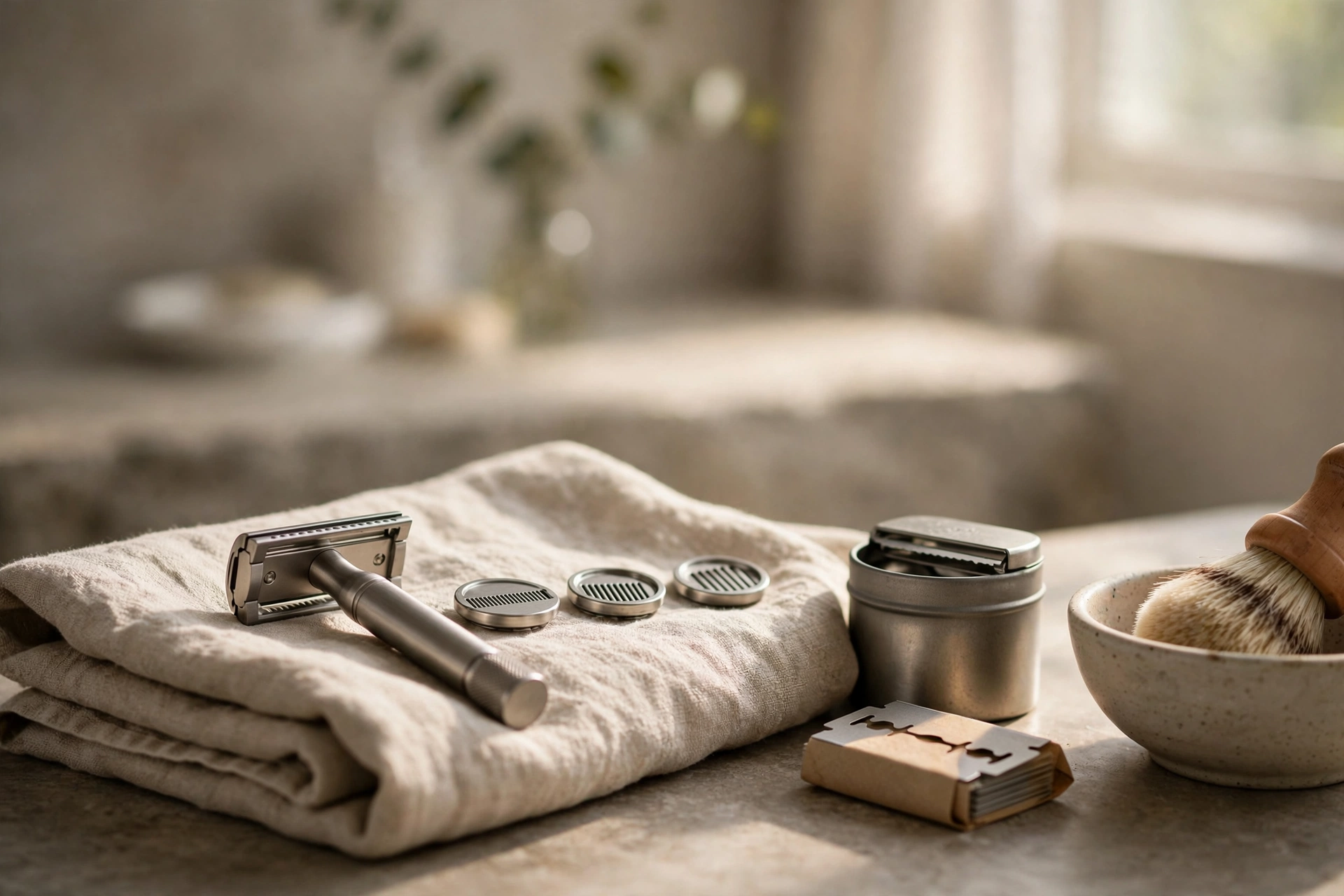
The Rockwell 6S is a three piece double edge safety razor. In the box you get the handle, a top cap, three reversible base plates, and a 5 pack of Rockwell’s own Swedish stainless steel blades. Each base plate carries two settings, one on each side, marked R1 through R6, so flipping a plate and reassembling the razor is how you change the shave. There is no dial and nothing to adjust mid shave. That sounds like a limitation until you understand what the settings are for: most people use them to find their setting once, over the first few weeks, and then rarely change plates again, except perhaps a step up for several days of growth or a step down for a sore neck. Judged that way, plate swapping is not a chore, it is a fitting system you use at the start of ownership.
The build is the headline. Every metal part is 316L stainless steel with a matte, bead blasted style finish, and the razor weighs about 118 g in the hand, roughly three times a Henson and noticeably more than a Merkur 34C. That weight is a working part of the design: a safety razor is meant to cut with its own mass while your hand simply guides it, and the 6S makes the no pressure rule easy to follow because pressing is obviously unnecessary. The matte finish hides fingerprints and water spots better than polished chrome and gives a little more grip with wet hands, though it is not a knurled grip and people who shave in the shower should keep a firm hold regardless. The razor is covered by a lifetime warranty against manufacturing defects, with free replacement for defects and free parts for accidental damage under Rockwell’s guarantee terms; note, as an honest detail, that Rockwell’s separate 100 day returns policy applies to purchases from Rockwell’s own store, and Amazon purchases go through the Amazon seller first.
On Amazon the 6S is rated 4.7 stars from roughly 650 ratings in the most recent secondary capture we could verify, which puts it at the top of the classic safety razor field on both score and on what owners praise: the same themes recur, versatility across beard types, the substantial feel, and an end to cartridge buying. The criticisms recur too, and they are in the cons section below in full.
What do the six settings actually change?
They change the blade gap: the distance between the blade edge and the safety bar, which controls how much blade the skin feels and how efficiently the razor clears longer growth. Rockwell publishes the gaps for the 6S, and they are worth printing because most razor marketing never gives you a number. Plate R1 has a gap of 0.20 mm, R2 is 0.35 mm, R3 is 0.48 mm, R4 is 0.61 mm, R5 is 0.69 mm, and R6 is 0.79 mm. As a rough translation, R1 and R2 are the mild, learn in safety settings, suited to fine hair, sensitive skin and daily shaving. R3 and R4 are the middle most owners settle on, efficient enough for a two pass shave on a normal beard. R5 and R6 are for coarse, dense growth, several days between shaves, or experienced users who want maximum efficiency in fewer passes.
Two things follow from the numbers. First, the steps are small and even, so the search for your setting is a gentle ramp, not a leap between razors. Second, blade gap is only half the story of how a shave feels. The blade itself is the other half, and a sharp blade on R2 can feel more assertive than a mild blade on R4. That pairing question gets its own section below, because it is where most new owners either find their shave or wrongly blame the razor. To find your plate, start on R2 or R3 with a mid sharpness blade, shave a week, then move one step in whichever direction your skin is asking for. Change one variable at a time. It is the same advice machinists give about any adjustable tool, and it works.
Why 316L stainless steel, and what does the grade mean?
Stainless steel is not one material, it is a family, and the grade stamped on a razor decides how it behaves in a wet, salty, soapy bathroom for the next few decades. The 6S uses 316L, the grade also used for surgical instruments and marine fittings. The 316 part signals a chromium nickel steel with molybdenum added, about 2 to 3 percent, and that molybdenum is the detail that matters here: it markedly improves resistance to pitting corrosion from chlorides, the salts in tap water, sweat and shaving products, compared with the more common 304 grade. The L means low carbon, at or under 0.03 percent, which preserves that corrosion resistance around worked and welded areas. One honest disclosure that belongs in any expert review: 316L contains nickel, so the small number of people with a serious nickel allergy should know it is there, even though the steel binds it tightly and reactions to solid 316L are uncommon.
Stainless works through a passive layer, a microscopically thin chromium oxide film that forms on the surface in air and repairs itself when scratched. That is why a solid stainless razor has no finish to protect: the protection is the surface chemistry of the metal itself, renewed constantly. Contrast the Rockwell 6C, the brand’s own cheaper sibling, which is a chrome plated zinc alloy razor with the same plate system. It shaves in the same family, but its working surface is a plating, and once plating wears at the threads or chips from a drop, the alloy underneath is exposed. The 6S removes that entire failure mode from your future. It is also worth being straight about how the 6S is made: it is produced by metal injection moulding, a process that forms complex steel parts precisely and is standard for high quality small components. Moulding is not a defect or a shortcut that weakens the razor, and Rockwell’s own history includes replacing early production razors for backers when the first runs fell short, which is part of why the current version carries the reputation it does.
How do you shave with it, and which blades pair with which plates?
The technique is the standard safety razor technique, and the 6S is forgiving to learn on because its mild plates exist. Prep matters more than the razor: shave after a shower or with a hot towel, build a real lather rather than a thin foam, and let the lather sit a minute to soften the hair. Hold the razor so the cap rides the skin at a shallow angle, use short strokes, rinse the head often, and let the 118 g do the work. Two passes handle most beards, one with the grain and one across it; a third, against the grain, is optional and is where sensitive necks should be cautious. The learning curve honest reviewers report is two to three weeks of slightly slower shaves, after which the routine is as fast as a cartridge, with less tugging, because a single sharp edge cuts hair at skin level instead of pulling and cutting below it the way multi blade cartridges are designed to do. That below skin cutting is the mechanism behind a lot of ingrown hairs on curly and coarse beards, which is why single blade shaving keeps its following among people prone to razor bumps.
Blade pairing is where the six settings earn their keep a second time. Double edge blades are a universal standard, every brand fits every razor here, but they differ in sharpness character. As a working map: the sharpest class of blades feels best on the mild plates, R1 to R3, where the small gap keeps them calm; mid sharpness blades, including the well known Astra Platinum type, are the all rounders that behave on R3 to R5 for most faces; and milder blades suit the higher plates, where the bigger gap supplies the efficiency and the gentler edge keeps it comfortable. Combinations that duplicate each other, a very sharp blade on R6, are where nicks come from, and combinations that cancel out, a mild blade on R1, are where people conclude wrongly that safety razors do not cut. The sensible start is a sampler pack across brands, two blades from each, on one plate, before buying any blade in bulk. The Rockwell blades in the box are a starting sample and, in owner reporting, the most criticised part of the package, so judge the razor with a second blade brand before you settle your opinion of it.
How do you look after it, and what are the brown spots?
Care is short, and the one scare story is worth defusing properly. Stainless means stain less, not stain proof. The brown marks owners sometimes find on a stainless razor, often called tea staining, are almost never the razor rusting. They are surface deposits, most commonly rust transferred from the blade itself, since many blades are carbon steel or coated steels that corrode far faster than 316L, left clamped wet in the head for days. The fix is simple and cheap: after shaving, loosen the head, rinse everything, shake dry, and store the razor where air reaches it. Remove the blade or leave the head loose if your water is hard and your bathroom stays steamy. A soft toothbrush and a mild citric acid soak lift existing marks without touching the steel. Do not use bleach, do not scrub the matte finish with abrasive pads, and do not leave a wet blade sealed in any razor for weeks, whatever the razor is made of.
The real failure modes are physical, not chemical. Drop 118 g of steel on tile and something can bend: check plate corners and cap threads after a hard drop, because a slightly bent plate changes the gap on one side. Lose a plate and you have halved the system, so the three plates need a home, a small tin or the box, rather than a life loose in a drawer. And the finish variants deserve a note: this review is of the matte stainless version, which has nothing to wear off. Coloured and coated versions of steel razors generally can show coating wear over years; the matte steel cannot, which is one more reason it is the version we would buy.
What do you do with used blades?
You put them in a blade bank, every time, and never loose in a bin or a recycling box. A blade bank is a small sealed metal container with a slot: blades go in, nothing comes out, and when it is full the whole sealed container goes to scrap metal recycling where facilities accept it, or into household waste as a sealed sharp object where they do not. One bank holds hundreds of blades, which at a typical pace of a blade a week is years of shaving in one small tin. The ZOMCHI Blade Bank is a simple black metal version rated for 300 or more blades, and it is the piece of kit that turns the waste argument of this whole article from a claim into a routine. For scale, without printing any prices: a daily or near daily shaver uses roughly 50 to 100 blades a year, against roughly 25 to 50 cartridges or a dozen or more whole disposable razors in the same year, each cartridge a fused plastic part headed to landfill. The arithmetic of the steel system is not subtle.
What are the honest cons of the Rockwell 6S?
It is heavy, and some hands, some travellers and some head shavers will simply prefer a lighter razor. It is the premium priced option in the classic field, a deliberate buy once decision rather than a casual purchase. The plate system means parts to store and a setting change that takes a minute of reassembly, not a twist. You may well settle on one plate and never use two thirds of the system you paid for; that is the standing argument for a good fixed razor, and it is a fair one. The included blades are a sample, not a supply, and are the most criticised element in owner reviews. The matte finish shows water spots more than polished chrome if you never rinse it. And like every safety razor, it cannot fly in cabin baggage with a blade fitted; blades travel in checked luggage or get bought at the destination, where the universal standard means they are easy to find. None of these is hidden, and for the buyer this razor is aimed at, none of them outweighs a handle that never needs replacing. But if two or three of them describe you, buy one of the alternatives below instead, with our blessing and for stated reasons.
The supporting picks: if not the 6S, then which?
Henson AL13: the fixed angle answer
The Henson AL13 is machined in Canada from aircraft grade aluminium to aerospace tolerances, and it removes the two decisions the 6S asks you to make. Its head holds the blade at a fixed 30 degree angle with unusually tight blade support, so the correct angle is built in and blade chatter is engineered out. For someone whose problem is razor burn rather than beard density, that design brief is arguably better aimed than adjustability. It is rated 4.6 stars on Amazon in the most recent secondary capture. The honest trade offs: at about 37 g it is startlingly light, and cartridge converts tend to press until they relearn; and aluminium, while corrosion proof in normal use, is a softer metal than stainless at the threads. Buy it if you want one decision, once. Skip it if you like heft or have a coarse, variable beard that benefits from settings.
Merkur 34C HD: the classic first razor
The Merkur 34C HD from Solingen, Germany, is the razor generations of wet shavers started on: a two piece, mild closed comb design in chrome plated brass, about 77 g, with a short heavy handle that tucks into the hand. It is rated 4.5 stars on Amazon across roughly 7,500 ratings in the most recent secondary capture, the deepest review pool on this page by a wide margin. It has no settings and needs none for a normal beard. Its limits are the ones in the table: the short handle is small for large hands and awkward for leg shaving, the two piece loading is slightly fiddly, and its chrome plating, not solid steel, is the long term wear surface. Buy it if you want the proven, lower commitment start. It is also the pair of shoes answer to the 6S question: many people own this class of razor happily for a decade and never feel a gap in their shaving.
Leaf Razor: the cartridge convert’s bridge
The Leaf Razor keeps the one cartridge feature people actually miss, a pivoting head, and removes the plastic. It is an all metal razor that loads one to three single edge blades, which can be snapped standard double edge blades, so the running system stays cheap and plastic free. For legs, heads and body shaving, where contours matter more than plate geometry, it is the easiest switch on this page, and the brand’s own guidance positions it there rather than as a precision face razor. Honest limits: the head is large for under the nose and other tight spots, the construction is a zinc alloy based metal rather than stainless steel, and it contains small magnets, which the listing flags with a hazard warning for households with small children. Buy it as the body razor or the gentle on ramp, not as the buy once face razor.
Astra Platinum blades: the running gear
Whichever handle you choose, the consumable decision is the same shape: a standard double edge blade you get on with, bought in a cardboard packed hundred. The Astra Platinum Double Edge Blades, 100 pack are stainless steel with a platinum coated edge, each blade wrapped in wax paper in cardboard tucks of five, with no plastic cartridge housing anywhere in the system. They sit in the mid sharpness class that pairs with the middle plates of the 6S and with fixed razors like the Merkur, which is why they are the default recommendation once a sampler has told you your preferences are mainstream. Two honest notes: blade feel is the most individual variable in this whole hobby, so sampler first is still the rule; and production of this line has moved to India in recent years, with some long time users reporting batch differences, which is one more reason to buy the hundred only after the sampler agrees with you.
Join Our Free Facebook GroupNon-Toxic Family Living: parents sharing swaps that work →
How to choose: a simple buying plan
If the goal is to stop buying razors entirely, buy the Rockwell 6S, a blade sampler, and a blade bank in the same order, and give yourself three weeks on R2 and R3 before judging anything. If razor burn is the problem you are solving, buy the Henson and its fixed angle instead. If you want the proven classic at a lower commitment, buy the Merkur 34C and revisit the question in a year, knowing its plating clock is ticking slowly. If the shaver in your house is mainly legs and body, buy the Leaf. What we would skip spending on: a second razor in the first month, bulk blades before a sampler, and any cartridge system bought as a backup, because a backup you keep feeding is not a backup, it is the old system surviving. For the rest of the bathroom side of this swap, our 7 bathroom swaps to reduce microplastics and our natural bar soap guide cover the shelves around the sink.
Frequently asked questions
Is the Rockwell 6S good for beginners?
Yes, with a condition. Start on plate R1 or R2, use a mid sharpness blade, and spend two to three weeks learning the no pressure technique. The mild plates make it one of the gentler ways in; the condition is patience, not skill.
What does 316L stainless steel mean?
It is a chromium nickel steel with molybdenum added for pitting resistance in salty, wet environments, in a low carbon variant. It is the grade used for surgical instruments and marine fittings, and it has no plating, so there is no surface layer to wear through.
Why is my stainless razor showing brown spots?
Almost always rust transferred from the blade, not the razor. Loosen the head after shaving, rinse and dry the parts, and do not store a wet blade clamped in the razor for days. A soft brush or a mild citric soak removes the marks.
How do I dispose of used blades safely?
Drop them through the slot of a blade bank and never loose in a bin or recycling box. A full, sealed bank goes to scrap metal recycling where accepted, or out as a sealed sharp object where it is not.
How long will the 6S actually last?
There is no plating to fail and the moving parts count is zero, so with basic drying care it is a decades item; that is an engineering judgement from the material, stated plainly, and the razor carries a lifetime warranty against manufacturing defects.
Which plate should a cartridge user start on?
R2 for most faces, R1 for fine hair or very sensitive skin, R3 if your beard is coarse. Change one step at a time, a week apart, and change nothing else while you are testing.
Does the blade brand really change the shave?
Yes. Blade sharpness character interacts with blade gap, so the same razor can feel mild or assertive with different blades. A sampler pack across brands is the cheapest experiment in the whole system.
Rockwell 6S or 6C: which should I buy?
They share the plate system. The 6C is chrome plated zinc alloy at a lower commitment; the 6S is solid 316L stainless with no plating to wear. If buying once is the point, the 6S is the answer; if you are testing whether safety razors suit you at all, the 6C or the Merkur is the cheaper test.
Can I fly with a safety razor?
The razor itself can travel in cabin baggage with no blade fitted. Blades go in checked luggage, or buy them at your destination; the double edge standard is sold worldwide.
Add Us as a Preferred Source on GoogleOne tap, and our guides show up first in your Google results →