Thursday Captain Boots Review: The Leather Boot That Outlasts the Plastic Ones
Thursday Captain Boots Review: The Leather Boot That Outlasts the Plastic Ones
Affiliate disclosure: this article contains affiliate links. If you buy through them, we may earn a commission at no extra cost to you. We never claim to have tested products we have not tested; this review is built from the maker’s specifications, the listing, and the published evidence, and we say plainly where the evidence runs out.
Here is a scene most men know. The boots by the door look fine from across the room. Up close, the toe is peeling, the sole has split away from the upper in a clean smile, and the whole thing is headed for the bin after about a year of wear. They were not cheap boots, exactly. They were just built the modern way: synthetic upper, foam inside, sole glued on. When a glued sole lets go, there is nothing to repair. The boot is done, and its mix of plastic, foam and fake leather goes where mixed plastic always goes.
That is the real question behind this review. Not “is this a handsome boot” (it is), but whether one resolable leather boot, worn for years, beats the cycle of disposable boots that shed, split and get landfilled. We put the Thursday Boot Company Captain under that question, because it was the highest-ticket pick in our men’s fall and winter clothing guide and it is built the old way: full-grain leather, stitched together, made to be resoled.
The short answer: is the Thursday Captain worth it?
Yes, for most men who want one everyday boot. The Thursday Captain is a cap-toe boot in full-grain leather with a Goodyear welt, which means a cobbler can strip off a worn sole and stitch on a new one instead of you throwing the boot away. It holds 4.4 stars across about 9,300 Amazon ratings, the strongest rating base of any boot we have covered. Buy it if you will actually wear leather boots weekly. Skip it if you need waterproofing, a safety toe, or sneaker comfort on day one. The honest catches, and there are several, get their own section next.
Get the Weekly Swaps
One short email a week: the newest microplastics studies in plain English, plus the swaps that are actually worth your money. Join free and we will send you our room-by-room microplastic checklist to get you started.
Get Our Free Room-by-Room Microplastic ChecklistJoin the newsletter and get the checklist free →
The case against it
Start with the objections, because a boot pitched as the sustainable choice has to survive them.
It is the most expensive boot most men will ever buy. The Captain sits in a different price class from the fashion boots it replaces, and we are not going to pretend otherwise. The defence is arithmetic, not vibes: a resolable boot spreads its cost over years and at least one resole, while a glued boot charges you full price again every time the sole splits. But that arithmetic only works if you wear them. A Captain that sits in a closet is the worst value on this page.
The sole is rubber, and rubber soles shed too. This is the objection our own readers should raise first. A 2025 study in the journal Microplastics measured shoe outsoles losing weight as walking distance rose, and showed particle counts climbing with abrasion contacts; goldfish in the same study ingested outsole particles. The Captain’s studded rubber and lug soles are synthetic rubber, so yes, they are part of that story. What the leather build changes is the rate of replacement: the upper does not become landfill when the sole wears down, because the sole is the part designed to be replaced. Fewer boots made, bought and binned is the claim. Zero shedding is not, and nobody should sell you that.
It is not waterproof, and it is not a work boot. No safety toe, no waterproof membrane. Rain and puddles, fine; standing water, slush and job sites, no. Reviewers who bought it as a winter or work boot are the ones leaving the angry reviews, and on that narrow point they are right.
Leather is not impact-free. The Captain’s uppers come from tanneries including Le Farc in Mexico and Horween in Chicago, and Thursday says its leather comes from Leather Working Group rated tanneries and US cattle. That is a better sourcing story than most, but leather is still chrome-tanned animal hide with a real footprint. Our case for it is narrower and more honest: durability. A material that lasts a decade and can be repaired beats a petroleum-based material that lasts a year, which is the same logic we apply to natural-fiber clothing over fleece.
Fit is the gamble. Thursday changed its sizing at the end of 2023, so older reviews give outdated advice, and owner feedback still splits between “runs large” and “too narrow.” The brand’s current guidance is half a size down from your sneaker size, or the same size as your other leather boots. Wide widths exist in every size, which helps, but a first pair is still a sizing bet, and the break-in is real: the stiffer Rugged and Resilient leathers have given reviewers blisters before they softened.
Quality control is not perfect. A small share of owners report dye-lot differences between the two boots, and a smaller share report soles separating, which should never happen on a stitched welt and is a warranty conversation when it does. With about 9,300 ratings, a 4.4 star average means most owners are happy and a vocal minority are not. Both things are true.
What is actually in this boot?
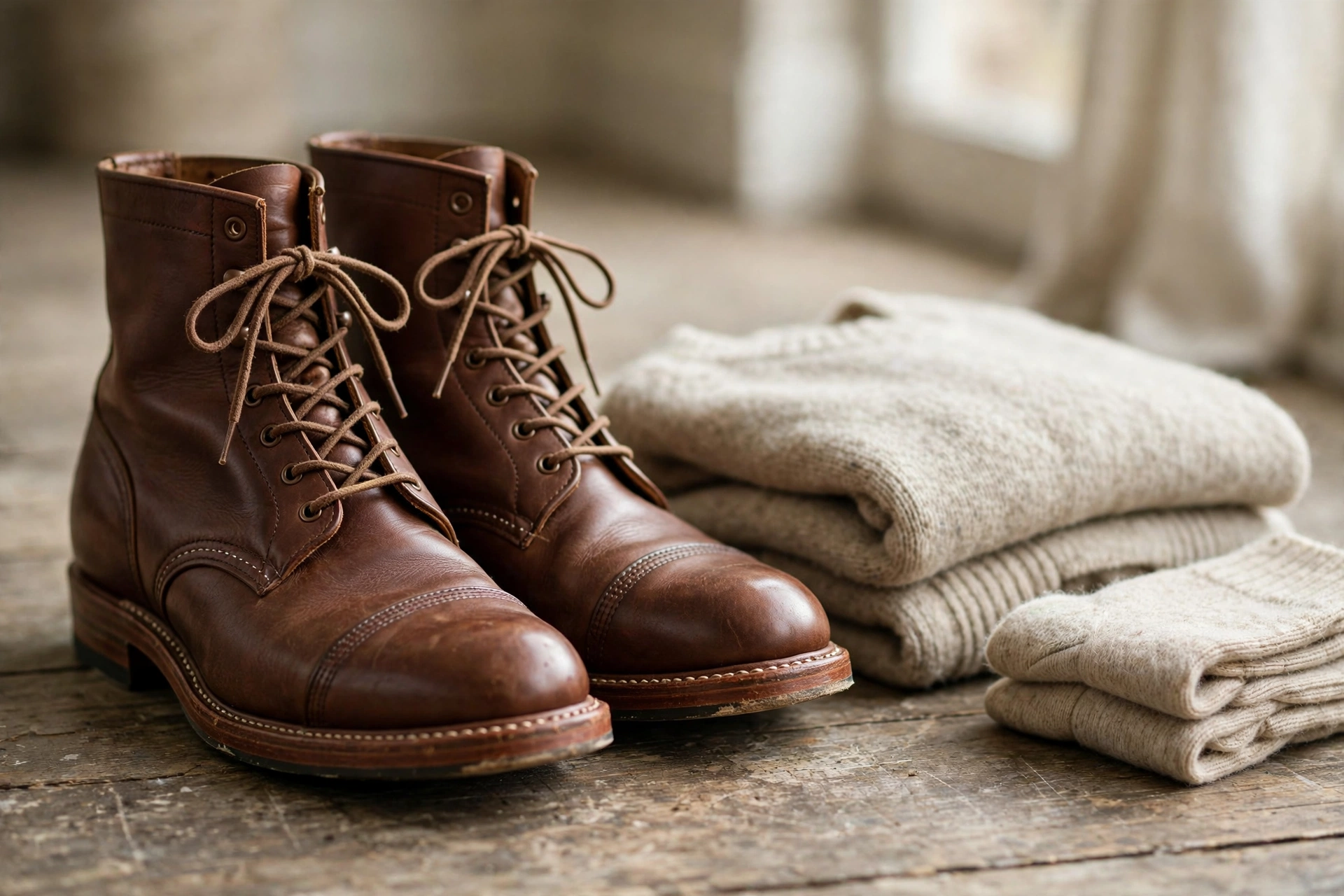
The build list is short, and that is the point. The upper is full-grain leather, about 1.8 to 2.0 millimetres thick in independent reviewers’ measurements. Full-grain means the top layer of the hide, with its tight fibre structure intact, rather than corrected grain (sanded and coated to hide flaws) or the bonded scraps sold as “genuine leather.” Tight fibres are why full-grain scuffs buff out instead of flaking, and why it ages into a patina instead of peeling. Under it sits a glove leather lining, a cork-bed midsole that compresses into the shape of your foot over the first weeks of wear, a steel shank for arch support, and a rubber outsole, either the lower-profile studded sole or the chunkier StormKing lug.
The leathers fall into two families. The Classic leathers, including the Brown that most buyers pick and the Natural made from Horween Chromexcel, are smoother, dressier and break in fast. The Rugged and Resilient line is thicker-feeling, more matte, more water resistant, and asks more of your heels in week one. Same boot, two personalities, and the listing does not always make the difference obvious. Check which family you are looking at before you check out, because variant confusion is the single most common complaint pattern in the reviews.
Why does the Goodyear welt matter so much?
Because it is the difference between a boot and a consumable. In a Goodyear welt, the upper is stitched to a strip of leather called the welt, and the sole is stitched to the welt. Nothing structural depends on glue. When the sole wears smooth, a cobbler unpicks the stitching, removes the dead sole and sews on a fresh one, and the upper, which is the expensive, broken-in, shaped-to-your-foot part, carries on. A typical Captain can take multiple resoles. Cemented construction, the glued kind on almost every fashion boot and sneaker, cannot be separated without destroying the shoe, so a worn sole means a whole new pair.
Run the waste maths on that. Figures widely reported from the US Department of the Interior put American shoe discards at about 300 million pairs a year, most of them mixed-material shoes that cannot be recycled in any practical stream and take decades to break down in landfill. Every year of extra life from a boot you already own is a year a replacement pair does not get made. That is not a heroic claim. It is just the largest lever a shoe buyer actually controls: how often you buy shoes.
And the plastic problem on your feet?
Two honest points. First, the upper: a synthetic boot upper is usually polyurethane coated fabric or microfibre, which sheds fragments as it flexes and cracks, and cannot be repaired when it does. Leather flexes for years without that failure mode. Second, the sole: the 2025 Microplastics study of shoe outsoles we cited above found outsole weight loss rising with distance walked, for walking and jogging alike. Every rubber soled shoe does this, including this one. The Captain does not solve sole abrasion; it slows the bigger cycle around it, the endless replacement of whole shoes. We would rather tell you that straight than dress a rubber sole up as plastic-free.
The wider wardrobe logic is the same one in our merino base layers guide: natural fibres and hides break down at end of life in ways synthetics do not. Zambrano and colleagues (Marine Pollution Bulletin, 2019) tracked cotton and rayon fibres biodegrading in aquatic conditions while polyester persisted, which is the textile version of the argument. Leather is not a textile and that study did not test it, so we cite it for the principle, not as proof about boots: materials from living sources rejoin the cycle; petroleum materials mostly wait it out.
How does the Captain actually fit?
Order half a size down from your sneaker size. That is Thursday’s current guidance, it matches most recent owner feedback, and it accounts for a last built longer than a sneaker’s. If you already wear leather boots or dress shoes, order that size instead. Between sizes or wide-footed, take the wide width rather than sizing up, because sizing up adds length you do not need and invites heel slip during break-in. The 2023 sizing change matters here: advice from reviews written before it, including some still ranking on Google, describes the old last. Trust the date on the review before you trust the review.
Break-in is one to two weeks of regular wear for the Classic leathers, longer and occasionally blistery for the Rugged line. The cork bed is doing quiet work in that period, compressing under your heel and forefoot until the boot stops feeling like a boot and starts feeling like yours. Thick socks help in week one; the Darn Tough Hiker Micro Crew socks from our men’s clothing guide are the pair we would pair with it, merino rich with the nylon content disclosed there, because a wool sock manages the moisture that makes new leather miserable.
Join Our Free Facebook GroupNon-Toxic Family Living: parents sharing swaps that work →
How long will a pair actually last, and how do you get there?
With rotation and basic care, the upper is a ten-year part. The sole is the consumable, and it is meant to be: expect the first resole somewhere in the two to four year range depending on mileage and surface, sooner on the studded sole if you walk mostly on concrete. Care is unglamorous and cheap. Rest the boots a day between wears with cedar trees in, because leather that never dries out rots from the inside. Brush after wear. Condition when the leather looks dry or after repeated wetting, not on a calendar, because over-conditioning softens the fibres you are paying for. Keep them away from direct heat when wet; a radiator will crack a wet upper faster than a winter will.
Know the failure modes so none of them surprise you. Heel counters soften and can collapse if you crush them forcing the boot on without a shoehorn. The welt stitching can wear at the toe if you kick steps and kerbs. Water will eventually darken and stiffen an unconditioned upper. And if a sole ever starts separating from the welt on a nearly new pair, that is a defect, not wear: stitched soles are not supposed to do that, and it is the brand’s problem to fix.
What does chrome tanning actually mean, and should it worry you?
Almost all modern leather, including the Captain’s, is chrome tanned: hides are treated with chromium salts that stabilise the collagen fibres quickly and produce the soft, even, colourfast leather boot buyers expect. The alternative, vegetable tanning with bark and plant extracts, takes far longer and produces a stiffer leather used mostly in belts, saddlery and some heritage boots. The fear version of this topic claims chrome tanning means toxic chromium on your skin. The chemistry is more specific than that. Tanning uses chromium(III), the stable form locked into the hide; the hazardous form is chromium(VI), which is not a tanning agent and appears only as a contamination failure that regulated tanneries test for. The European Union restricts chromium(VI) in leather goods to below 3 milligrams per kilogram for exactly this reason, and Leather Working Group auditing, which Thursday points to for its tanneries, includes chemical management and effluent treatment in its scoring. None of that makes tanning impact-free: it is an industrial chemical process with real water use, and a reader who avoids leather entirely will not be talked out of it here. It does mean the honest risk conversation is about tannery practice and sourcing, which is auditable, rather than about the word chromium, which is not.
Anatomy of the boot, part by part
Readers who have only worn sneakers are often surprised by how many separate parts a welted boot contains, so here is the stack from skin outward. Your foot sits on a leather insole over the cork-bed midsole; the cork is the comfort system, and unlike a foam insole it does not permanently crush in a season, it moulds and stays moulded. Beneath that runs the steel shank, a strip that keeps the arch from flexing into fatigue on hard floors. The upper wraps the foot in two layers, the outer full-grain hide and the glove leather lining, and the lining matters more than it sounds: a synthetic lining is where many otherwise decent boots start shedding and smelling first, while leather lining absorbs moisture and can be cleaned. At the back, a structured heel counter holds the heel in place during break-in; at the front, the cap toe is a second layer of leather over the toes, originally armour against wear, now mostly the Captain’s visual signature. The welt runs around the whole boot at sole level, and the outsole, studded rubber for grip on wet pavement or the deeper-lugged StormKing for softer ground and snow, is the only part designed to be consumed. That is the whole design philosophy in one sentence: everything above the stitching is permanent, everything below it is a service part.
Classic or Rugged, studded or lug: choosing your Captain
The Captain name covers more builds than most listings make clear, and picking the wrong one is the main avoidable mistake. The Classic leathers are the dressier choice: smoother surface, a slight sheen, faster break-in, and the better match for chinos, trousers and a sport coat. The Rugged and Resilient leathers are waxed and matte, shrug off rain and scuffs better, and suit jeans and rougher use, at the cost of a longer, sometimes blistery first fortnight. For soles, the studded rubber sole keeps the profile low and the look clean, and grips wet city pavement well; the StormKing lug adds height, weight and real traction, and is the one to pick if your winters involve snow covered sidewalks rather than office car parks. Width is the third decision and the easiest: standard if your shoes never pinch, wide if they sometimes do. Colour is the least important choice and the one buyers agonise over most; Brown in the Classic line is the most versatile single pair, because it carries both the office and the weekend without trying.
The resole maths, in years instead of prices
We do not print prices on this site, so do the longevity maths the way owners actually experience it, in pairs per decade. A glued fashion boot worn the same way lasts about a year before the sole or the coating fails, so a decade of that habit is roughly ten pairs bought, worn briefly at their best, and thrown away as mixed plastic and textile waste that no recycling stream wants. A Captain on the same feet is one upper, resoled perhaps three times in that decade, with each resole costing a fraction of a new pair and returning the boot to full function in a couple of weeks at a cobbler. Even if your mileage halves those numbers, the shape of the result does not change: the repairable boot wins on waste by an order of magnitude, and usually on money too, which is why cobblers, not marketers, are the loudest advocates of welted construction. The condition, and it is a real one, is that the owner has to actually send the boots in. A Captain thrown away at first sole wear because a resole felt like a hassle is just an expensive fashion boot, and the planet got nothing for the upgrade.
If not this one, then which?
Everything below is ranked, and the ranking logic is simple: fix the reason you are not buying the Captain, in the order most men actually hit it.
1. The Captain in a different leather family. If the verdict fits but the finish does not, stay in the model and change the leather: Classic Brown for the office, a Rugged and Resilient leather for a wetter, rougher life, accepting the harder break-in. Most “alternatives” people research are this decision in disguise.
2. Complete the kit instead: Darn Tough Hiker Micro Crew socks and a layer that matches. If the boot is right, the cheapest upgrade to the whole experience is what touches it. The Darn Tough socks are the boot sock from our men’s guide, and for cold months the Minus33 Chocorua merino crew is the 100 percent merino base layer we rate there. Neither sheds the way a synthetic sock or a plastic fleece does, and both outlast their cheap equivalents by years.
3. The outfit anchor: the Flint and Tinder Waxed Trucker Jacket. If you are rebuilding a wardrobe around buy-it-once natural materials, this is the jacket from the same men’s guide, waxed cotton sailcloth that shrugs off rain without a plastic membrane. It is the Captain’s logic applied above the ankle, and we reviewed the approach in depth in our clothing coverage.
The one we would skip: the fashion boot with a leather-look synthetic upper and a glued sole, whatever the brand. It photographs like the Captain, costs less today, and is landfill in a year when the coating cracks and the sole peels. It is the exact product this review exists to steer you off.
Browse Our Full Amazon StorefrontAll our Thursday Captain and natural-fiber picks in one place →
What happens at the very end?
Even a Captain dies eventually, usually when the upper cracks at the flex point after years of wetting and drying, or when a resole costs more than the remaining life justifies. That end is still different in kind from a synthetic boot’s end. A worn-out leather boot is mostly hide, cork, leather welt and a rubber sole: the hide and cork are biodegradable materials, the metal shank is recyclable scrap, and only the rubber sole persists the way plastic does. A worn-out synthetic boot is plastic in every layer, upper, lining, foam, sole and glue, and none of it separates. If a pair of Captains still has life when you are done with them, they are also genuinely resellable and donatable in a way cracked fashion boots are not, because a cobbler can return them to service. Longevity, repairability, resale and a cleaner end of life are not four separate virtues. They are one property, being made of repairable materials, showing up four times.
So what would we actually buy?
One pair of Thursday Captain boots in a Classic leather, half a size down from sneaker size, wide if you are between widths. Two or three pairs of good merino-rich socks so the boots can rest between wears. Cedar trees. One tin of conditioner, bought once and used rarely. Then stop. The buying plan for a longevity product is deliberately short, because the second pair, the matching care kit with six products, and the seasonal colour are how a sensible purchase turns back into consumption. Wear the one pair for years, resole it when the tread goes, and let the patina be the point. That is the entire strategy, and its boringness is exactly why it works for your wallet and for the waste stream at the same time.
Rapid-fire questions
Are Thursday Captain boots true to size? No. Order half a size down from your sneaker size, or match your leather boot and dress shoe size. Thursday changed its sizing at the end of 2023, so ignore size advice from older reviews.
Can the Captain be resoled? Yes. The Goodyear welt means a cobbler can remove the worn sole and stitch on a new one without harming the upper. That repairability is the main reason we recommend it.
Are they waterproof? No. The welted build resists rain and puddles well, but there is no waterproof membrane and the leather will wet through in standing water or heavy slush.
Is the Captain plastic-free? No, and we will not call it that. The outsole is synthetic rubber, which abrades like any rubber sole. The win is the leather upper and the repairable build cutting how often you replace the whole boot.
How long is the break-in? About one to two weeks of regular wear for Classic leathers. The Rugged and Resilient leathers take longer and can blister heels early on.
Do they work for wide feet? Better than most. Wide widths are offered across the size range, and wide is the right move for between-size feet rather than sizing up in length.
Are they heavy? Heavier than sneakers, lighter than old-school work boots. The weight comes from the leather stack, the shank and the rubber sole, and most owners stop noticing it within the first week. If you run for trains in your boots daily, pick the studded sole over the heavier StormKing lug, and expect your calves to file a brief complaint either way.
Is it a good work boot? No. There is no safety toe and no waterproofing. It is an everyday and dress-casual boot, and buying it for a job site is the fastest route to a one-star review.
Add Us as a Preferred Source on GoogleOne tap, and our guides show up first in your Google results →
Keep reading
More natural-fiber, buy-it-once guides from the site: our men’s fall and winter clothing guide, where the Captain first appeared; fleece alternatives for layers that do not shed plastic; the merino base layers guide; and our plastic-free safety razors roundup for the same replace-the-disposable logic in the bathroom.