Woolino Twin Wool Comforter Review: Is the Washable Wool Worth It?
As an Amazon Associate I earn from qualifying purchases. This post contains affiliate links, which means I may earn a commission if you buy through them, at no extra cost to you.
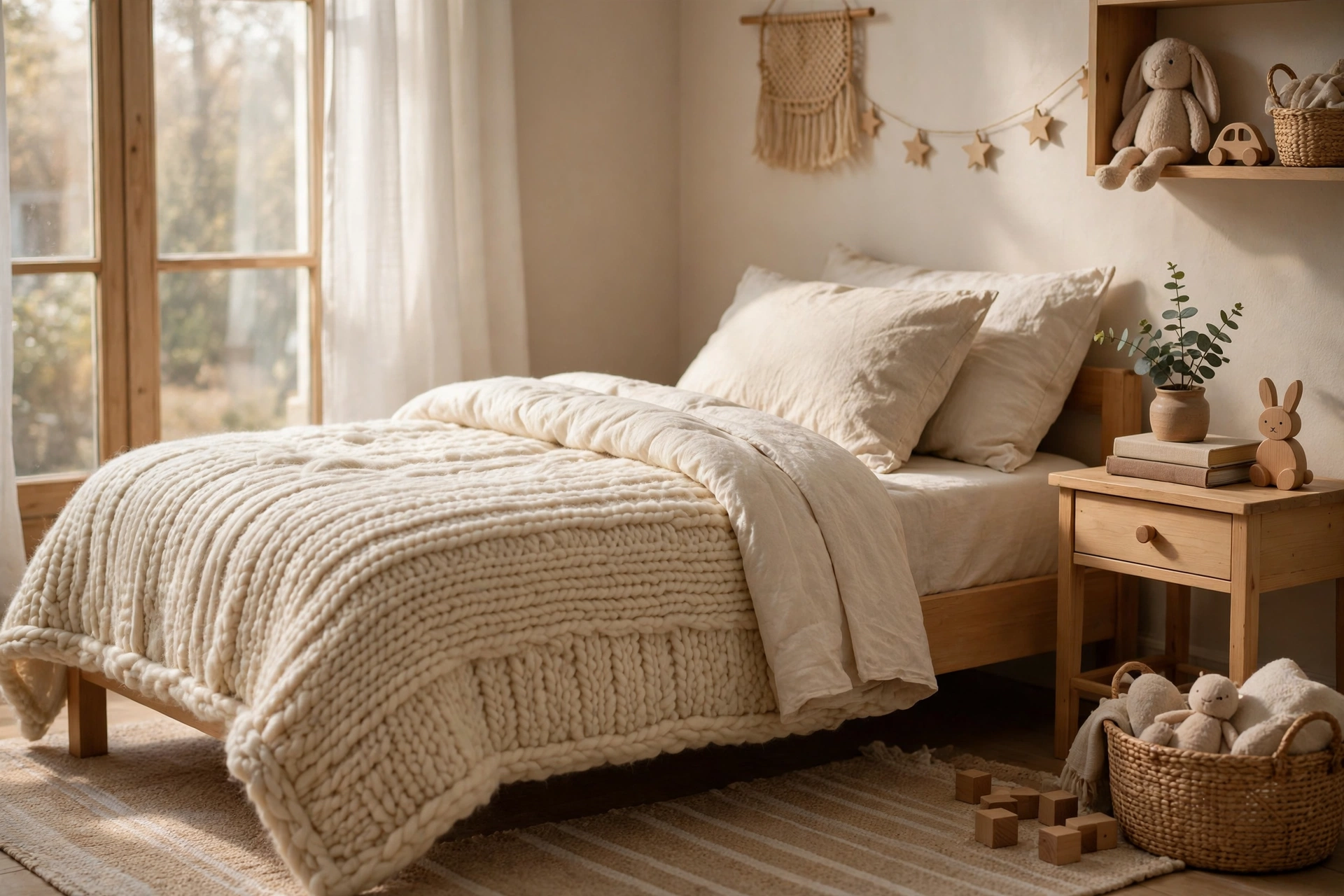
The quick version: The Woolino Twin Wool Comforter is the wool comforter we would buy first for a twin bed: 100 percent natural Australian wool fill at 400 grams per square metre, a 300 thread count GOTS-certified organic cotton sateen shell per Woolino, OEKO-TEX Standard 100 certification, and corner loops to keep it in place inside a duvet cover. On Amazon it carries 4.4 stars from 411 reviews in the listing data we could capture cleanly. The honest catch is care: washable here means occasional, cold, wool-cycle washing, not weekly hot washes and tumble drying.
It was the highest-ticket pick in our non-toxic kids bedding guide, which is why it gets its own deep dive. It works just as well on an adult twin, a daybed, or a guest bed as it does in a kids room.
Get the Weekly Swaps
One short email a week: the newest microplastics studies in plain English, plus the swaps that are actually worth your money. Join free and we will send you our room-by-room microplastic checklist to get you started.
Get Our Free Room-by-Room Microplastic ChecklistJoin the newsletter and get the checklist free →
Why does a wool comforter deserve a deep dive?
A comforter sits against a sleeper for seven to nine hours a night, every night. That is longer, closer contact than almost any other textile in the house. Most budget comforters are filled with polyester, which is plastic in fiber form, inside a polyester or polyester-blend shell. They are cheap, light, and easy to wash, and they are also the kind of product this site exists to question: what is it made of, what does it shed when you wash it, and how long will it actually last?
Wool answers those questions differently. It is a natural protein fiber, not a plastic, it regulates temperature in both directions, and a well made wool comforter can last for years with very little washing if you protect it with a duvet cover. The trade-off is real too: wool costs more up front, and it asks more of you on laundry day. This review walks through the materials, the certifications, the sleep science with its limits stated plainly, the sizing, the care rules in full, and the four supporting picks that make sense alongside it.
What is the Woolino Twin Wool Comforter made of?
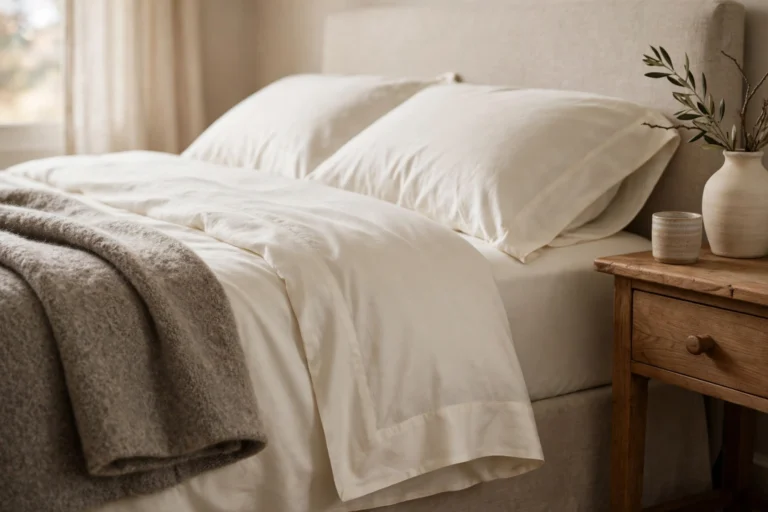
It is filled with 100 percent natural premium Australian wool and covered with a 300 thread count organic cotton sateen shell. That short answer is the whole reason it leads this guide.
Per Woolino and its Amazon listing, checked November 2026, the Twin is a mid-weight comforter at 400 grams per square metre of wool fill, measuring 68 by 86 inches. Woolino states the shell is 100 percent GOTS-certified organic cotton. The comforter also carries OEKO-TEX Standard 100 certification (certificate 15.HCN.66088) and Woolmark certification. Two naming points matter here, because bedding copy often blurs them. First, Woolino does not call this comforter fill merino. Merino is the fiber in its well known baby sleep bags. The comforter fill is described as Australian wool, and that is how we describe it too. Second, Woolino does not call the wool itself organic. The organic claim belongs to the cotton shell.
Inside, the design is simple on purpose. There is no synthetic fill to clump, no plastic shell to trap heat, and corner loops tie the comforter to a duvet cover so it does not bunch in a corner overnight. Woolino is based in Rocky River, Ohio, and was founded by Mimi Dzodzo, an architect and mother who designed the brand’s first merino sleep bag after she could not find one in the United States. The brand has sold its merino sleep bags in the US since 2010, and the comforters are the grown-up and sized-up extension of that same idea: wool where a person sleeps, instead of plastic.
How does wool regulate temperature while you sleep?
Wool keeps you warm when it is cold and cooler when it is warm because its hollow fibers breathe and manage moisture, instead of trapping it the way a sealed synthetic fill can. Woolino states wool can absorb up to 30 percent of its own weight in moisture without feeling wet. That is a brand and fiber claim we can explain, not a promise that every sleeper will feel the same result.
Think of a winter night in a house that cools down after midnight. A polyester comforter can feel warm at first and then clammy if you sweat, because the fill does not absorb much moisture. Wool takes up some of that moisture into the fiber itself, which helps the bed feel drier, and it releases heat slowly as conditions change. In summer, the same breathability is why a mid-weight wool comforter surprises people who assume wool means hot. It is not a thin summer blanket, and hot sleepers in a warm room may still prefer cotton alone, which is why the all-cotton supporting pick below exists. But for a three-season twin bed in a temperate house, mid-weight wool is a sensible middle: warm enough for winter with a cover, not stifling in spring and fall.
What does the research actually say about bedding, wool, and sleep?
The strongest reason to care about bedding materials is exposure time, and the most relevant recent study is about the sleeping microenvironment, not about this comforter. Vaezafshar and colleagues at the University of Toronto, in Environmental Science and Technology in 2025, tested 16 new children’s mattresses and detected 21 semivolatile organic compounds, including phthalates and flame retardants. Emissions rose with heat and weight: 12 compounds were emitted at room temperature, 20 at body temperature, and 21 at body temperature plus body weight. That study did not test Woolino, and it did not test comforters. What it shows is why the layers closest to a sleeping child deserve the same scrutiny as the mattress itself.
On wool and sleep onset, honesty matters. Shin and colleagues at the University of Sydney, in Nature and Science of Sleep in 2016, found that wool sleepwear shortened the time it took young adults to fall asleep compared with cotton, clearest at a cool 17 degrees Celsius. The same study found no bedding effect on sleep. So we will not claim a wool comforter has been proven to make anyone fall asleep faster. The sleepwear result supports wool worn next to skin. For bedding, the case rests on temperature and moisture behavior, material composition, and wash shedding, not on a proven sleep-onset claim.
Washing is the third piece. De Falco and colleagues, in Scientific Reports in 2019, measured 124 to 308 milligrams of microfibers released per kilogram of synthetic fabric washed, roughly 640,000 to 1,500,000 microfibers per wash on that basis. Zambrano and colleagues, in Marine Pollution Bulletin in 2019, found cotton and rayon microfibers biodegraded in aquatic tests while polyester persisted. Zambrano did not test wool, so we do not claim that study proved anything about wool specifically. The fair takeaway is narrower: polyester fibers are plastic and persist, natural fibers are not plastic, and a comforter that needs washing only occasionally, protected by a washable cotton duvet cover, cuts the total number of wash loads either way.
How does the Woolino compare with the alternatives?
The table below puts the hero next to the two closest comforter alternatives in this review. All three skip polyester fill. They differ on fiber, care, and how much certification you get.
| Comforter | Fill and shell | Care | Best for |
|---|---|---|---|
| Woolino Twin Wool Comforter | Australian wool, organic cotton sateen shell, 400 gsm | Occasional cold wool-cycle wash, no tumble dry, duvet cover recommended | Temperature regulation on a twin bed, kids or adults |
| YOUR MOON Wool Comforter (Queen) | Australian wool, cotton shell, OEKO-TEX | Not machine washable per roundup guidance, cover recommended | A larger bed, if you accept dry or professional cleaning |
| Whisper Organics Cotton Comforter | Organic cotton fill and shell, GOTS and Fairtrade, 240 gsm | Fully machine washable | Wool-free homes, easier laundry, lighter warmth |
Browse Our Full Amazon StorefrontAll our wool comforter picks in one place →
Which size should you buy, and how does the Twin fit?
Buy the size that matches the bed, with a little drape over each side. The Twin at 68 by 86 inches is made for a standard twin mattress, and it also works on a twin XL dorm bed with a slightly shorter drape at the sides, on a daybed, and as a generous throw layer on a larger bed for one sleeper.
Woolino also makes this comforter in Crib at 37 by 51 inches, Queen at 88 by 88 inches, and King at 90 by 104 inches. If you are buying for a child moving up from a crib, the safe-sleep rule still comes first: loose comforters are for older toddlers and children who are out of a crib and sleeping in a bed, not for unsupervised infant sleep in a crib. Our Burt’s Bees Baby crib sheet review covers the bare-crib approach for the youngest sleepers. For a pillow to match on a toddler bed, the Woolino Toddler Pillow below uses the same wool and cotton pairing at a low loft.
Fit inside the duvet cover matters as much as bed size. Use the corner loops. A wool comforter that slides and bunches feels lumpy even if the fill itself is even, and most complaints about natural-fill comforters trace back to a missing or loose cover, not to the fill.
Is the Woolino comforter really washable?
Yes, but only in the limited way wool allows, and Woolino’s own care page is stricter than the word washable suggests. The direct answer is: spot clean first, air it out regularly, and wash only occasionally on a cold wool cycle if you must.
Per the official Woolino wash and care guidance, checked November 2026, you should use a duvet cover so the cover takes the washing, spot clean small marks, and freshen the comforter in sunlight and fresh air for a couple of hours every few months. When you do wash, use low temperature water at about 80 degrees Fahrenheit, a wool or mild detergent with no enzymes and no bleach, and do not tumble dry. It is also dry-cleanable. Skip fabric softener. That routine is very different from a polyester comforter you can throw in a hot wash every week, and for some families that difference will be the deciding factor. If weekly washing is non-negotiable in your house, choose the Whisper Organics cotton comforter below and accept lighter warmth.
What are the honest trade-offs?
Every pick on this site gets its cons in the open, and a premium comforter gets more scrutiny, not less. First, price class: wool with an organic cotton shell costs substantially more than a polyester comforter, and you still need a duvet cover on top of that. Second, care: no tumble drying, no hot water, no enzyme detergents, and a duvet cover is required in practice, not optional. Third, weight and warmth: mid-weight wool has real heft and warmth, which most sleepers like in winter and some hot sleepers will not like in a warm bedroom in July. Fourth, wool is not for everyone: families avoiding animal fibers for ethical reasons should choose the cotton pick, and anyone with a confirmed wool sensitivity should test a smaller wool item first. None of those are reasons to dismiss it. They are the reasons to buy it with your eyes open, for the right bed.
What should you buy alongside it?
The four supporting picks below complete the bed without reintroducing polyester fill. Each one was re-verified on Amazon for this review. Ratings are quoted only where we could capture them cleanly.
YOUR MOON Wool Comforter, for a larger bed
The YOUR MOON Luxurious All Season Wool Comforter in Queen is the closest wool alternative: 100 percent Australian wool fill in a cotton shell, with OEKO-TEX certification. We do not quote an Amazon star figure for it because we could not capture one cleanly this run. Its main trade-off against Woolino is care: guidance for this line says not to machine wash it, so Woolino’s limited washability is a real advantage if both are on your list.
Whisper Organics Cotton Comforter, the wool-free option
The Whisper Organics 100% Organic Cotton Comforter is filled and covered with GOTS and Fairtrade certified organic cotton at 240 grams per square metre, with diamond stitching to stop the fill clumping. It carries 4.3 stars from 37 reviews, a small pool we flag plainly. It is lighter than the wool picks and fully machine washable, which makes it the easiest-care natural comforter here.
Woolino Toddler Pillow, the matching low-loft pillow
The Woolino Toddler Pillow at 14 by 19 inches pairs 100 percent wool fill with a cotton cover at a low loft under 2 inches, sized for a first pillow on a toddler bed. It carries 4.4 stars from 408 reviews in the listing data we captured. The pillowcase is sold separately, and care is gentler than a synthetic pillow, so buy it for the materials, not for toss-in-the-wash ease.
Naturepedic Mattress Protector, the layer underneath
The Naturepedic Organic Waterproof Mattress Protector Pad, Twin puts two layers of organic cotton jersey around an ultra-thin waterproof barrier, with no vinyl, PVC, phthalates, or latex per the listing. Honest framing: that barrier is a GOTS-approved polyurethane layer, so this protector is not plastic-free. It is the pragmatic compromise most families choose under a good comforter, because one unprotected accident can ruin a mattress. We do not quote a rating for this exact size because we could not capture one cleanly. Check our non-toxic bedding guide for the adult-bed version of this layering approach.
Join Our Free Facebook GroupNon-Toxic Family Living: parents sharing swaps that work →
Who should buy the Woolino Twin, and who should skip it?
Buy it if you are replacing a polyester comforter on a twin bed, you sleep hot and cold in the same night, you are willing to use a duvet cover and wash the comforter itself only occasionally, and you want certifications you can check instead of vague eco language. It is an especially good fit for a child’s first real bed, a teen twin, a dorm-adjacent twin XL where one good comforter has to do every season, and a guest twin that sits made up for weeks and needs to air out well between visitors.
Skip it if you need to hot-wash bedding weekly, if you will not buy a duvet cover, if anyone in the bed avoids wool, or if your bedroom runs warm all summer and a lighter cotton comforter would get more use. In those cases the Whisper Organics pick above is not a consolation prize. It is the better buy for your house, and saying so is the point of a deep dive.
Frequently asked questions
Is the Woolino Twin Wool Comforter good for hot sleepers?
It is better than a polyester comforter of the same warmth, because wool absorbs moisture and breathes. It is still a mid-weight comforter, so in a warm room in summer many hot sleepers will prefer cotton alone.
Can you machine wash the Woolino wool comforter?
Occasionally, on a cold wool cycle at about 80 degrees Fahrenheit with wool detergent, no enzymes or bleach, and no tumble drying. Day to day, use a duvet cover, spot clean, and air it in sunlight every few months per Woolino.
Is the Woolino comforter merino wool?
No. Woolino describes the comforter fill as 100 percent natural Australian wool. Merino is the fiber in its baby sleep bags, and the brand keeps the two descriptions separate.
What size is the Woolino Twin comforter?
68 by 86 inches, a standard twin size. The same comforter also comes in Crib, Queen, and King sizes.
Does a wool comforter shed microplastics?
No. Wool is a natural protein fiber, not a plastic, so it does not shed microplastics. Like all textiles it can shed natural fibers, which are a different material class from the persistent polyester microfibers measured in the 2019 washing studies cited above.
How long should a wool comforter last?
Years, if it is protected by a duvet cover, aired regularly, and washed rarely and gently. Wool fill does not break down the way cheap polyester batting clumps after repeated hot washes, but rough care will shorten its life faster than anything else.
Add Us as a Preferred Source on GoogleOne tap, and our guides show up first in your Google results →
Keep reading
- Non-Toxic Kids Bedding: sheets, pillows and comforters, the roundup this deep dive came from.
- Boll and Branch Signature Sheet Set Review, for the organic cotton sheets to pair with it.
- Non-Toxic Bedding, our adult bedding guide.
- Burt’s Bees Baby Crib Sheet Review, for the youngest sleepers.