
The Best Non-Toxic Lunch Boxes for Kids (2026 Guide)
Disclosure: We earn a small commission on purchases made through our links at no extra cost to you. Read our full affiliate disclosure.
Finding the best non-toxic lunch boxes for kids is one of the most practical swaps a parent can make. Most kids carry lunch to school every day. And for years, the default has been a plastic box, a plastic bag, or a compartmentalized plastic tray with a lid that snaps satisfyingly shut. It works. But it also means your child is eating out of a container that can leach chemicals into their food, especially when it gets warm, scratched, or run through the dishwasher a few hundred times.
We looked into this so you don’t have to. The research on plastic containers and food is not great. A 2025 study published in Nature Medicine found microplastic particles accumulating in human brain tissue at levels roughly 10 times higher than a decade ago. Lunch containers are not the only source, but they are one of the most direct points of contact between plastics and your child’s food, every single school day.
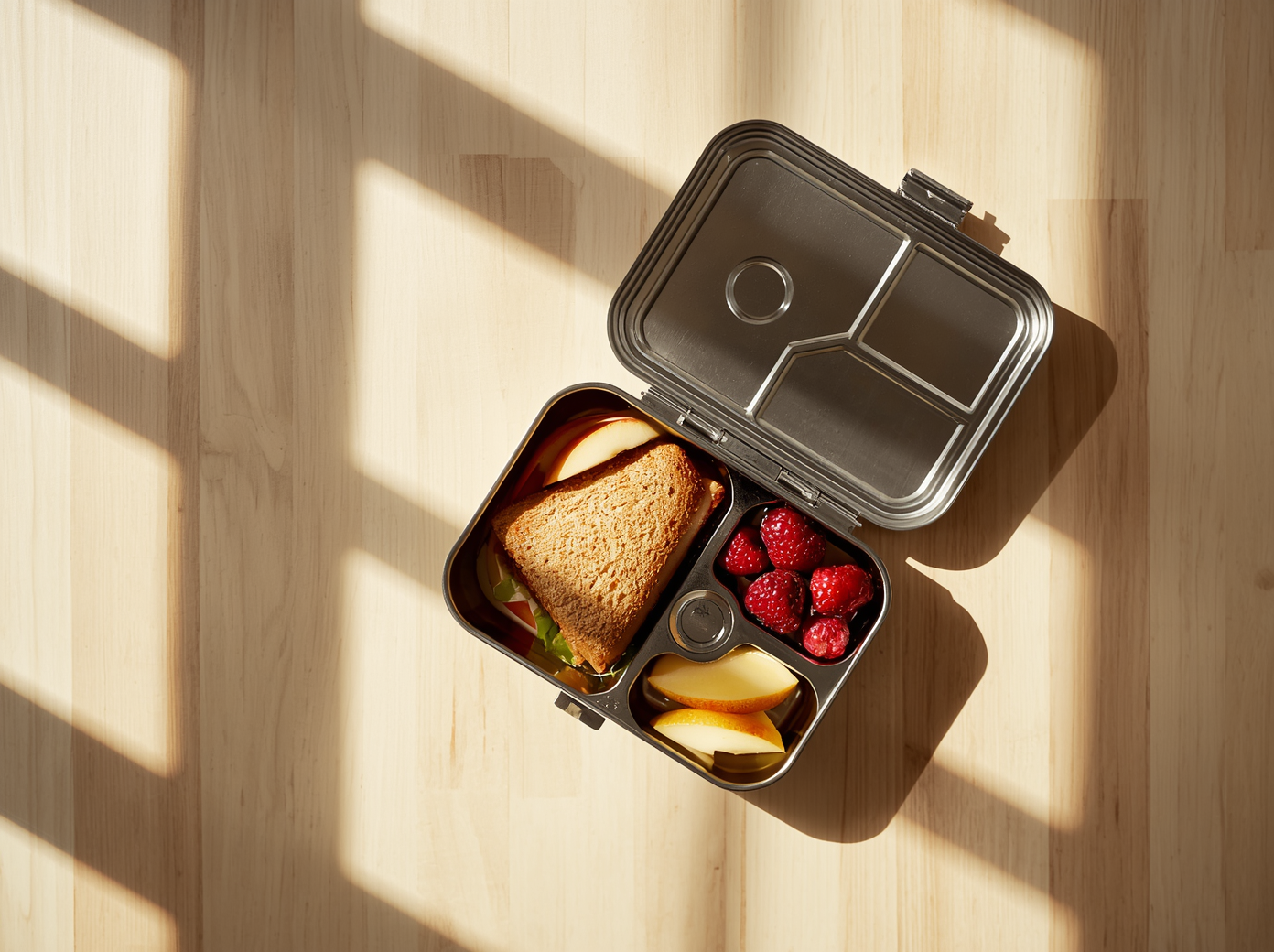
The good news is that the swap is easier than it sounds. Stainless steel lunch boxes are durable, dishwasher-safe, and genuinely better than what most kids are using right now. Our top pick for most families is the PlanetBox Rover, a single-piece stainless tray with five compartments that fits most school lunch bag setups and lasts for years. We break down exactly why below, along with every other option worth considering.
For storing food at home before it goes in the lunch box, our glass food storage container guide covers the best options.
Quick Answer: The Best Non-Toxic Lunch Boxes for Kids
If you are looking for the best non-toxic lunch boxes for kids, here is the short version of what we recommend
- Best overall: PlanetBox Rover — stainless steel, five compartments, durable enough to last through elementary school
- Best for younger kids: PlanetBox Launch — same quality, three compartments, better for smaller appetites
- Best budget pick: LunchBots Large Cinco — five compartments, solid stainless construction, lower price point
- Best for simple lunches: LunchBots Trio II — three compartments, leak-resistant lid, good for older kids
- Best for warm food: Thermos Funtainer Food Jar — stainless interior, keeps food warm for hours
- Most familiar format: Bentgo Kids Stainless — stainless compartments, leak-proof outer shell, classic lunch box feel
- Best for versatility: ECOlunchbox Three-in-One Classic — three nested stainless containers, completely plastic-free
Every product on this list has stainless steel food-contact surfaces. No plastic touching your child’s food.
Why the Lunch Box Material Actually Matters
Plastic lunch containers are not uniformly dangerous. But they are not neutral, either. The concern is not that plastic will poison your child overnight. The concern is cumulative exposure over time, across many sources, starting early in life.
Plastic food containers, especially those made from polycarbonate or lower-grade plastics, can release bisphenol A (BPA) and related compounds into food. The National Institute of Environmental Health Sciences classifies BPA as an endocrine-disrupting compound, meaning it interferes with hormone signaling. Even containers labeled BPA-free can contain substitute bisphenols with similar properties.
Heat, scratching, and repeated washing accelerate the leaching process. A lunch box that gets warm in a backpack, tossed in a dishwasher, and scratched with a metal fork is exactly the kind of container that releases the most. Kids eat lunch at school 180 days a year. That adds up.
We cover the broader exposure picture in our guide to how to avoid microplastics in your food, water, and home. The short version: lunch is one of the most controllable exposure points in your child’s day. Switching to non-toxic lunch boxes for kids is one of the most straightforward swaps available
What to Look for in a Non-Toxic Kids Lunch Box
Not every stainless steel lunch box is created equal. Here is what we check before recommending anything.
Food-contact surfaces
The inside of the box, every compartment and divider, should be stainless steel. That is the part touching your child’s food. Nothing else matters if this surface is plastic.
Lids and seals
Most stainless lunch boxes use a stainless lid, a silicone seal, or both. Food-grade silicone is considered safe and does not leach chemicals the way plastic does. Avoid boxes with plastic lids that clip directly over the food compartments.
Compartment design
Multi-compartment designs fit a sandwich, fruit, and snacks in one place without mixing. Single-compartment boxes require separate containers for every item, which means more packing and more pieces to wash.
Durability
Stainless boxes dent. They do not crack, shatter, or stain, but they dent when dropped on a cafeteria floor. The best brands are built to absorb that and keep going. PlanetBox in particular has a strong reputation for longevity.
Weight
Stainless is heavier than plastic. For a kindergartener with a small backpack, weight matters. The PlanetBox Rover runs around 1.1 pounds empty. The ECOlunchbox nested containers are lighter but require more assembly.
Lunch Boxes are just one piece of the puzzle. See our full guide to reducing your child’s microplastic exposure for nine more simple swaps
The Best Non-Toxic Lunch Boxes for Kids
PlanetBox Rover — Best Overall
PlanetBox Rover — check current price on Amazon
The Rover is a single flat tray with five compartments, a stainless lid, and a magnetic closure that kids can open themselves. No separate containers to lose, no lids left behind at school, no plastic anywhere near the food.
A main compartment fits a full sandwich. Two medium compartments fit fruit and carrot sticks. Two small compartments fit dips, crackers, or a treat. That is most lunches, organized in one box.
Check current price on Amazon →
Best for: Families who want one complete system that does not require additional containers.
Honest limitation: It is not leak-proof. Wet items like cut fruit or yogurt should go in a small silicone cup inside the compartment. It costs more upfront than plastic alternatives, but it genuinely lasts.
PlanetBox Launch — Best for Younger Kids
PlanetBox Launch — check current price on Amazon
The Launch is the Rover’s smaller sibling. Three compartments, slightly smaller overall dimensions, and a lower price point. The same all-stainless construction and magnetic closure.
For kids in preschool through first grade who eat less and carry smaller bags, the Launch is the better fit. The Rover can feel oversized for a four-year-old’s portion sizes.
Check current price on Amazon →
Best for: Younger kids and smaller appetites.
Honest limitation: Three compartments fill up quickly for older kids who need more variety. Most families graduate to the Rover by second or third grade.
LunchBots Large Cinco — Best Budget Pick
LunchBots Large Cinco — check current price on Amazon
LunchBots is one of the original stainless steel lunch container brands. The Cinco is their five-compartment tray with 18/8 stainless steel food-contact surfaces and a lid that snaps on with four clips.
It costs meaningfully less than the PlanetBox and performs well. The main differences are the clip closure instead of magnets, and a thinner lid.
Check current price on Amazon →
Best for: Families who want a stainless bento-style box at a lower price point.
Honest limitation: The clip closure can be harder for small kids to manage independently. The lid is not leak-proof.
LunchBots Trio II — Best for Simple Lunches
LunchBots Trio II — check current price on Amazon
Three compartments, a leak-resistant silicone-sealed lid, and 18/8 stainless steel throughout. A good option for older kids who pack a simpler lunch and do not need the full five-compartment layout.
The silicone seal makes it meaningfully more leak-resistant than open tray designs, which is useful for cut fruit or anything with moisture.
Check current price on Amazon →
Best for: Older kids and middle schoolers who pack a three-item lunch and want something compact.
Honest limitation: Fewer compartments means less organizational flexibility.
Thermos Funtainer Food Jar — Best for Warm Food
Thermos Funtainer Food Jar — check current price on Amazon
A wide-mouth insulated jar designed for soups, pasta, rice, or any warm lunch that kids will not eat cold. The interior is stainless steel and keeps food warm for around five hours, which covers most school lunch schedules.
Thermos includes a fold-up spoon under the lid, which kids genuinely appreciate. It pairs well with a separate snack container for a complete lunch.
Check current price on Amazon →
Best for: Families who pack warm lunches regularly, or kids who refuse to eat cold food.
Honest limitation: This is for warm food only. You would still need a separate system for sandwiches and snacks.
Bentgo Kids Stainless — Most Familiar Format
Bentgo Kids Stainless — check current price on Amazon
A stainless inner tray with five compartments inside a plastic outer shell with a leak-proof seal. The food-contact surface is stainless. The outer shell, which is plastic, does not touch the food.
The latch system is easy for kids to operate. It closes and carries like a traditional lunch box, which makes the transition from plastic feel familiar.
Check current price on Amazon →
Best for: Families transitioning from plastic who want the familiar lunch box format with stainless food-contact surfaces.
Honest limitation: The outer shell is plastic. It does not touch the food, but it is there. If your goal is completely plastic-free, the PlanetBox or LunchBots options are cleaner.
ECOlunchbox Three-in-One Classic — Best for Versatility
ECOlunchbox Three-in-One Classic — check current price on Amazon
Three nested stainless steel containers that stack inside each other for storage and unpack as separate pieces at lunch. No plastic, no silicone seals, just stainless lids that press on.
Each container can go in the fridge independently. You can mix sizes based on what you are packing. A good option for families who pack varied lunches or want to use the containers beyond school.
Check current price on Amazon →
Best for: Families who want a flexible, modular, completely plastic-free system.
Honest limitation: Three separate pieces to keep track of. Press-on lids are not leak-proof. Slightly more setup than an all-in-one tray.
Side-by-Side Comparison
| Lunch Box | Compartments | Leak-Proof | Plastic-Free | Best For | Price |
|---|---|---|---|---|---|
| PlanetBox Rover | 5 | No | Yes | Best overall | $$ |
| PlanetBox Launch | 3 | No | Yes | Younger kids | $ |
| LunchBots Large Cinco | 5 | No | Yes | Budget pick | $ |
| LunchBots Trio II | 3 | Partial | Yes | Simple lunches | $ |
| Thermos Funtainer | 1 (jar) | Yes | Yes | Warm food | $ |
| Bentgo Kids Stainless | 5 | Yes | Partial* | Familiar format | $ |
| ECOlunchbox 3-in-1 | 3 (nested) | No | Yes | Versatility | $ |
*Bentgo Kids Stainless has a plastic outer shell that does not contact food.
Accessories Worth Adding
A stainless box gets you most of the way there. A few small additions fill the gaps.
- Stasher bags — platinum silicone, dishwasher-safe, and hold up well in a school bag. Our go-to for anything that would otherwise go in a Ziploc.
- Lunchskins paper bags — FSC-certified paper with a light coating, compostable, and feel just like a traditional sandwich bag. Good for parents who want the familiar format without the plastic.
- Silicone snack cups — small food-grade silicone cups drop into tray compartments and hold yogurt, dips, or anything wet. Look for 100% food-grade silicone with no fillers.
- Stainless ice pack — standard gel ice packs contain plastic that can leak over time. A small stainless freezer pack avoids all of that.
- Kids stainless cutlery — a small fork and spoon in stainless steel adds about 10 seconds to the packing routine and replaces dozens of plastic forks per year.
If you have already made the switch to stainless at lunch, the table at home is the next logical step. We cover the full picture in our guide to the best non-toxic kids plates and bowls, including bamboo, stainless, and glass options with honest trade-offs.
Frequently Asked Questions
Are stainless steel lunch boxes safe for kids?
Yes. Food-grade stainless steel, specifically 18/8 (304) stainless, is non-reactive and does not leach chemicals into food. It has been used in food service and medical settings for decades. It does not degrade with heat, washing, or scratching the way plastic does.
What is the best non-toxic lunch box for a kindergartener?
For kindergarteners, we recommend the PlanetBox Launch or the LunchBots Large Cinco. Both are all-stainless, sized appropriately for smaller portions, and durable enough to handle how five-year-olds treat their belongings. The Launch has a magnetic closure that small hands manage more easily.
Are BPA-free plastic lunch boxes safe?
Not necessarily. BPA-free means the product does not contain bisphenol A, but many BPA-free plastics contain similar compounds like bisphenol S or bisphenol F that research suggests may have similar endocrine-disrupting effects. The National Institute of Environmental Health Sciences notes that BPA’s health effects are still being studied. Stainless steel sidesteps this entirely.
Can stainless steel lunch boxes go in the dishwasher?
Most stainless steel lunch boxes are dishwasher-safe. Check the manufacturer’s instructions for your specific box, but in general stainless holds up well. One exception is insulated containers like the Thermos Funtainer Food Jar, which recommends hand washing to preserve the vacuum seal.
Is silicone safe for kids’ food containers?
Food-grade silicone is generally considered safe for food contact. It does not leach chemicals the way plastic does, it is heat-stable, and it is inert in normal use. Look for 100% food-grade silicone, not lower-quality blends.
What is the most leak-proof stainless lunch box for kids?
The Bentgo Kids Stainless is the most leak-proof option on this list, thanks to its outer shell design and locking latch. The LunchBots Trio II is the most leak-resistant of the open-tray designs, with a silicone-sealed lid. The PlanetBox Rover and Cinco are not leak-proof and work best with silicone cups for wet foods.
The Bottom Line
Switching to non-toxic lunch boxes for kids is one of the most direct swaps a parent can make to reduce their child’s plastic exposure. Your child eats lunch from it 180 days a year. The material it is made of matters.
For most families, the PlanetBox Rover is the right call. It handles most lunches without extra containers or complicated packing. The LunchBots Large Cinco is the best option if the PlanetBox price point does not work right now. Both are genuinely good. Both will outlast any plastic lunch box you have bought.
Small swap, real difference. And if you are thinking about reducing plastic exposure more broadly, our guide to how to avoid microplastics in your food, water, and home is a good next read.


2 Comments
Comments are closed.