Naturepedic Organic Classic Crib Mattress Review: The 144-Coil 2-Stage, Examined Closely
Disclosure: this article contains affiliate links. If you buy through them, we may earn a commission at no extra cost to you. That is how this site stays free and independent.
The short answer first
The Naturepedic Organic Classic 2-Stage Crib Mattress is the crib mattress we would buy first for a newborn, and this review explains exactly why, and exactly where its limits are. It is a 144-coil innerspring mattress wrapped in GOTS-certified organic cotton, with a waterproof surface made from sugarcane-derived polyethylene that meets food-contact standards, and no polyurethane foam, no vinyl, no flame retardants and no phthalate plasticisers anywhere in the build. One side is extra firm for infants, the other is medium-firm for toddlers, so the same mattress carries a child from the first night home through the toddler bed years.
Two honest caveats belong right up front, because you will not find them stated this plainly in most reviews. First, that waterproof surface is still a plastic. Sugarcane polyethylene is chemically polyethylene; it is renewable in origin and free of the plasticiser and PFAS concerns that come with vinyl, but calling this mattress plastic-free would be wrong, and we do not. Second, the Classic is not the breathable model. If a washable, breathable surface layer is your top priority, the Naturepedic Organic 2-Stage Ultra Breathable is the sibling to look at, and we compare the two properly below. Everything else in this review is the long version: the materials science, the dated studies on what babies actually breathe and absorb from mattresses, the federal firmness rule, the sizing edge cases that trip people up, and the failure modes that only show up in year two.
The overview box: Naturepedic Organic Classic 2-Stage at a glance
- Construction: 144-coil innerspring with reinforced border rods, organic cotton fabric and fill
- Two stages: extra-firm infant side, medium-firm toddler side, flip at around one year
- Waterproofing: sugarcane-derived polyethylene surface, heat-sealed seams, meets food-contact standards
- Not in it: polyurethane foam, vinyl or PVC, flame retardants or barriers, phthalates, fibreglass
- Certifications: GOTS-certified organic cotton, MADE SAFE certified, GREENGUARD Gold line certification
- Size and weight: about 51.6 x 27.25 x 6 inches, about 19 to 20 pounds, fits standard full-size cribs
- Best for: parents who want the cleanest conventional build and a mattress that lasts two children
- Skip it if: you need a lightweight mattress for frequent sheet changes, or breathability is your first priority
The plain answer: for a standard crib, buy the Naturepedic Organic Classic 2-Stage. If you want the breathable surface instead, buy the Ultra Breathable version from the same line.
Get the Weekly Swaps
One short email a week: the newest microplastics studies in plain English, plus the swaps that are actually worth your money. Join free and we will send you our room-by-room microplastic checklist to get you started.
Get Our Free Room-by-Room Microplastic ChecklistJoin the newsletter and get the checklist free →
Our recommendations, all of them, up front
Here is the whole buying decision on one screen. The Classic is the hero of this review; the other four are the mattresses and the step-up we would genuinely consider alongside it, each with its trade-off stated in one line. The detailed sections after this one explain the evidence, the sizing, the care and the failure modes behind every line here.
Naturepedic Organic Classic 2-Stage Crib Mattress
The hero pick. Organic cotton over a 144-coil innerspring, built-in waterproof surface, no foam and no vinyl. Best for most families with a standard crib.
Naturepedic Organic 2-Stage Ultra Breathable
The upgrade pick. A lightweight WaveSupport core with a removable, washable breathable pad over the waterproof layer. Best if breathability and easier lifting matter more than an innerspring feel.

- Organic Construction: 100% GOTS certified organic crib mattress meets flammability standards without flame retardants; UL/GREENGUARD Gold certified for low emissions; breathable for healthier sleep.
- Dual-Sided Design: 2-stage support system offers a firmer side specifically engineered for infants and a medium-firm side for toddlers; this dual-sided crib mattress grows with your child from newborn to toddler years for extended use
- Enhanced Breathability: Breathable mattress cover features a 3-dimensional structure allowing air to flow through the fabric and under Baby; improved airflow reduces suffocation risks; best crib mattress for temperature regulation
- Naturally Waterproof: Organic cotton fabric includes patented waterproof coating derived from sugarcane; surface cleans easily with soap and water; no plastic covers needed; maintains breathability while protecting the breathable baby mattress
- LIGHTWEIGHT: Our patented wavesupport core is strong yet incredibly lightweight when comparing to traditional coil mattresses; weighs 14 lbs
Babyletto x Avocado Organic Crib Mattress
The latex alternative. Pocketed coils with coconut fibre, natural latex and wool, and the longest certification list here. Best if you want latex and wool in the build and accept that it is not waterproof, so a protector is part of the real cost.
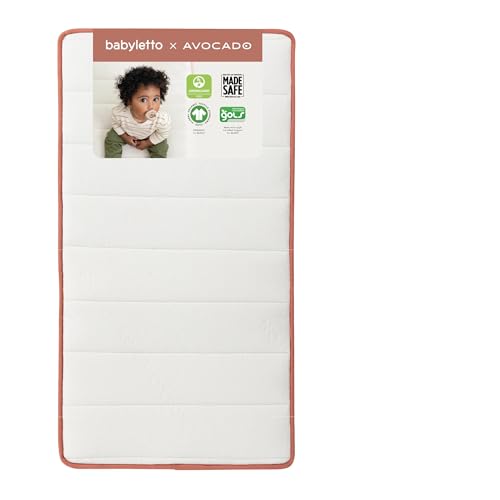
- GREENGUARD GOLD CERTIFIED: Tested by UL Environment to meet some of the world's most rigorous emissions standards for chemical exposure and pollutants.
- 2-STAGE: This is a 2-stage dual-sided mattress that has a firm supportive side for infants that can be flipped to a softer side for toddlers. The toddler side features our signature terracotta color piping.
- NONTOXIC MATERIALS: A soft, organic cotton mattress cover and wool batting is gentle on baby's sensitive skin while firm and breathable coconut husk fibers and individually wrapped coil springs provide ample support.
- ORGANIC: Rest assured that the mattress is certified by the Global Organic Textile Standard, and the latex used meets the Global Organic Latex Standard. Organic latex is used as a bonding material for the coconut fiber support.
- STANDARD CRIB SIZE: Universally designed to fit a standard size crib.

Lullaby Earth Breathe Safe 2-Stage Crib Mattress
The lighter, simpler pick from Naturepedic’s sister line, rated 4.5 stars on Amazon. A food-grade polyethylene core with a removable washable breathable protector. Best if weight and washability lead and you accept a plastic-based, non-organic core.
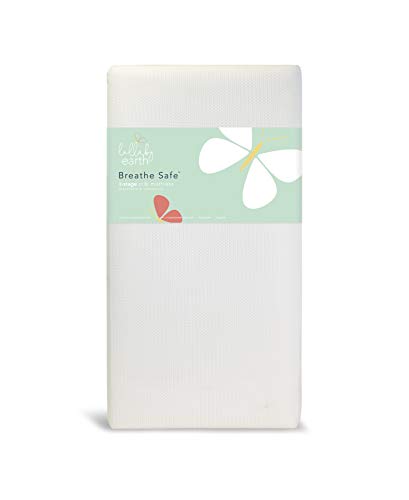
- Material: Premium polyester; Safer construction: Our baby crib mattresses pass all government flammability requirements without flame retardants or barriers; Safer, healthier crib mattress for your little one's sleep environment
- Breathable Design: Removable mattress cover features 3-dimensional structure with waterproof layer; Allows air to flow through fabric and under baby; Breathable crib mattress promotes better air circulation for comfortable sleep
- Two-Stage Support System: 2-stage design offers firmer infant side for babies and medium-firm toddler side; Perfect mattress for baby crib that grows with your child from newborn to toddler bed stages; Standard size fits most cribs
- Lightweight Construction: Patented wavesupport core provides exceptional strength while remaining incredibly lightweight; Easier to change sheets compared to traditional coil mattresses; Makes handling your baby mattress simple
- Standard Size Crib: These natural crib mattresses measure approximately 27 1/4" x 51 5/8" x 6" for a snug fit in most standard cribs and nursery furniture
Newton Baby Kids Twin Mattress
The step-up pick for the first real bed. A fully washable Wovenaire core for the twin years. Best when your child is leaving the crib and washability is the whole point.
Browse Our Full Amazon StorefrontAll our crib and kids mattress picks in one place →
What is actually inside this mattress, layer by layer?
A crib mattress is the surface a baby breathes against for roughly half of every day in the first year, so the materials list matters more here than in almost any other product we review. The Classic’s build is unusually simple to describe, which is itself a good sign. The core is a continuous innerspring unit of 144 coils with heavier border rods around the edge, the same basic architecture adult innerspring mattresses have used for decades. There is no polyurethane foam slab to off-gas, crumble or yellow, and no foam comfort layer that needs flame retardants blended into it. Steel and cotton do not burn the way foam does, which is how this mattress passes federal flammability rules without added flame retardant chemicals or fibreglass barriers.
Above the coils sits organic cotton fabric and fill, certified to the Global Organic Textile Standard (GOTS). The toddler side carries a plant-derived PLA fibre comfort layer for a little more give once a child is old enough not to need the firmest surface. The waterproof surface is the layer that deserves the closest look. It is organic cotton coated with a polyethylene made from non-GMO sugarcane rather than petroleum, applied to food-contact standards and heat-sealed at the seams so liquids cannot wick into the interior. That is a genuinely better waterproofing chemistry than the vinyl (PVC) covers still common on budget crib mattresses, because vinyl needs phthalate plasticisers to stay flexible, and those plasticisers are exactly the compounds researchers keep finding in nursery dust and in children’s sleep environments.
Now the honesty paragraph. Polyethylene from sugarcane is still polyethylene. It does not shed the way a fleece blanket sheds, and a smooth, intact, food-contact surface is about as inert as a plastic gets, but it is a plastic layer on the mattress, and at end of life it behaves like one. If your goal is a mattress with no plastic layer at all, that product exists in this roundup: it is the Babyletto x Avocado, and the trade is that it is not waterproof, so you will be managing leaks with a separate protector instead. Neither answer is wrong. They are two different ways of handling the same unavoidable problem, which is that babies leak, and whatever catches the leak has to be made of something.
What does the research actually find in children’s mattresses?
The evidence base here is newer and more specific than most mattress marketing suggests, and it is worth reading carefully rather than fearfully. Start with the most direct study. Vaezafshar et al. (2025), from the University of Toronto’s Diamond lab and published in Environmental Science and Technology, measured plasticisers, flame retardants and UV filters coming off children’s mattresses. At room temperature they detected 12 semi-volatile compounds; at body temperature, 20; and with body weight pressing on the mattress, 21. Heat and pressure, in other words, are not minor details. They are the mechanism. A sleeping child supplies both, for hours at a time, with their face close to the surface.
The companion in-home study tells the same story from the bedroom side. In Vaezafshar et al. (2025), the in-home companion paper in Environmental Science and Technology Letters, researchers sampled 25 bedrooms of children aged 6 months to 4 years in Toronto and Ottawa and found 28 to 31 compounds across the room air, the sleep microenvironment and the mattresses themselves. The mattresses were confirmed as a source, not just a bystander, and older mattresses carried higher levels of the phthalates DEHP and BzBP. That last detail is one reason the second-hand question, which we cover below, is not as simple as it looks.
The crib-specific work goes back further. Boor et al. (2014), from the University of Texas at Austin and published in Environmental Science and Technology, tested 20 new and used crib mattresses and found that all of them emitted volatile organic compounds. The mean total VOC emission rate roughly doubled and more with warmth, from 56 micrograms per square metre per hour at 23 degrees Celsius to 139 at 36 degrees, close to body temperature, and concentrations in the infant breathing zone ran 1.8 to 2.4 times higher than in the bulk room air. A baby does not breathe the room’s average air. A baby breathes the thin layer of air directly above the mattress.
The follow-up, Boor et al. (2015) in Environmental Science and Technology Letters, took the covers and foams apart chemically. Seventeen of 20 covers contained at least one plasticiser, at 1 to more than 35 percent by weight, and 9 covers contained DEHP or DINP. The polyurethane foam models also held flame retardants and unreacted isocyanates. Read those two papers together and the buying rule writes itself: the risk concentrates in vinyl covers and polyurethane foam, so a mattress built without either removes most of what the researchers were measuring. That is the entire case for the Classic’s steel-and-cotton build, stated in the literature’s own terms rather than in marketing terms.
The broadest check on the industry is a report rather than a journal paper. The Ecology Center and Clean and Healthy New York’s 2020 report, The Mattress Still Matters, reviewed 227 product pages from 37 brands and lab-tested 13 mattresses bought in 2018 and 2019. All 6 PVC covers tested contained plasticisers, 3 covers showed total fluorine suggesting PFAS waterproofing, antimony turned up in 5 products, and only 4 of the 13 mattresses fully matched what their makers disclosed. Naturepedic was the standout for disclosure accuracy in that testing, which is one reason we keep returning to the brand in this category: in a market where most labels understate the chemistry, a brand whose claims survive lab checking has earned something.
None of this proves that a conventional crib mattress will harm a particular child, and we will not pretend otherwise. These are exposure studies. They show what comes off mattresses and into the air and dust around sleeping children, at levels that rise with heat and weight. Reducing that exposure where it is cheap and easy to do, by choosing a build without the two materials the studies keep flagging, is a proportionate response. That is the standard this review applies.
How firm does a crib mattress have to be? The federal rule, in plain English
Firmness is not a preference in a crib. It is the main safety variable, and since 2022 it has been a regulated one. The Consumer Product Safety Commission’s crib mattress standard, 16 CFR Part 1241, incorporates ASTM F2933 with CPSC amendments and has been mandatory since August 2022. Its centrepiece is a firmness test that uses a 5,200-gram feeler-arm fixture: if the mattress is so soft that the fixture sinks far enough for the arm to contact the sleep surface, the mattress fails. The standard also sets minimum full-size crib mattress dimensions of 27 and a quarter by 51 and five-eighths inches, and caps the corner gap at 3.15 inches, because a gap at the corner is where a small face can wedge.
The practical translation for a buyer is the two-finger fit test. A crib mattress should fit its crib with no more than two fingers of space between the mattress edge and the crib side. More than that, and the mattress is the wrong size for that crib, whatever the listing says. The Classic’s listed dimensions sit right on the federal minimum footprint, which is deliberate: it is made to fill a standard full-size crib snugly. Press the centre of the infant side with your palm when it arrives. It should feel closer to a firm floor pad than to a bed. If a crib mattress feels comfortable to an adult, it is too soft for an infant. That single sentence will save you more regret than any other in this review.
The 2-stage design exists because the firmness a newborn needs is not the firmness a two-year-old sleeps best on. The Classic’s infant side is the extra-firm one; the toddler side adds the PLA comfort layer for a medium-firm feel. Flip it at around twelve months, or when your child moves to a toddler bed, whichever comes first. There is no alarm that goes off at the one-year mark, but there is also no benefit in leaving a heavier toddler on the infant side once they are standing, climbing and sleeping in every position except the one you put them down in.
Classic, Breathable or Lightweight? Decoding the Naturepedic line
The most common mistake with this brand is buying the wrong sibling. Naturepedic sells several crib mattresses with near-identical names, and the differences are real. The Classic 2-Stage, this review’s subject, is the innerspring model: 144 coils, about 19 to 20 pounds, the firmest and most traditional build, and the one with the longest track record. One small confusion to clear up: some older reviews and the brand’s own current page describe a 150-coil version. The Amazon listing for this mattress says 144 coils, and 144 is the figure to use for the mattress you are actually buying here.
The Ultra Breathable 2-Stage swaps the innerspring for a WaveSupport core made of food-grade polyethylene, which drops the weight considerably, and adds a removable breathable pad that sits over the waterproof layer and can be taken off and washed. That pad is the real difference. It gives air a path under the baby while the waterproof protection stays underneath it. If you have read the breathability debate and landed on wanting that feature from a certified-organic brand, this is the model, and it is the only upgrade we would call genuinely worth considering over the Classic.
The Lightweight Classic models use the same WaveSupport core without the breathable pad. They exist for one honest reason: sheet changes. A crib mattress gets lifted, tilted and wrestled at 3 a.m. more often than any product photo admits, and the Classic innerspring’s 19 to 20 pounds is its single most-cited drawback in owner feedback. If you have a smaller frame, a bad back, or a crib whose side does not drop, the weight difference is not a trivial spec. It is the difference between a thirty-second sheet change and a small workout. Our order: Classic innerspring for the firmest, longest-lasting build; Ultra Breathable if breathability leads; Lightweight if lifting leads. Do not pay for the breathable pad if what you actually needed was the lighter core, and do not buy the innerspring if you already know you will dread lifting it.
Certifications, decoded: what each label does and does not prove
Certification logos are where crib mattress marketing gets loudest and least precise, so here is the plain decoder. GOTS, the Global Organic Textile Standard, certifies the organic status and the processing rules for the cotton in this mattress. It is a real, audited standard with chain-of-custody checks, and it restricts a long list of chemicals in processing. What it does not do is test the finished mattress in your child’s bedroom for emissions. It certifies inputs and processes, not outcomes.
GREENGUARD Gold is the opposite kind of check: it tests finished products for VOC emissions against limits set with sensitive populations in mind, which is exactly the exposure route the Boor studies measured. MADE SAFE screens ingredients against a hazard list and certifies that known harmful chemicals are not in the product, which covers the plasticiser and flame retardant questions. No single one of these proves a mattress is safe in some absolute sense, and any brand that talks as if one logo does should lose credibility with you. What the stack proves, together, is that the inputs are certified, the ingredient list has been screened, and the finished product’s emissions have been measured. That is about as much verification as this product category offers, and the Classic carries the full stack.
The labels to treat with suspicion are the unregulated ones. “Non-toxic,” “chemical-free,” “natural” and “eco” on a mattress listing are marketing words with no standard behind them; chemical-free is not even a coherent claim for a physical object. CertiPUR-US, which you will see on foam mattresses including two picks in our wider child mattresses guide, is a foam-industry programme that limits certain substances in polyurethane foam. It is better than nothing on a foam mattress, but it is a standard for the material this review is steering you away from, written by that material’s industry. Compare like with like: a foam certification is not a substitute for not having the foam.
Sizing and fit: the edge cases that actually catch people
The Classic fits standard full-size cribs. That sentence covers most buyers and quietly excludes several situations worth checking before you order. Mini cribs take a much smaller mattress, roughly 24 by 38 inches, and this mattress will not fit one. Oval cribs, including the popular convertible oval designs, need their own shaped mattresses. Play yards are not cribs: their manufacturers require the specific pad made for the model, and adding a crib mattress to a play yard is a genuine safety hazard, not a comfort upgrade. Bassinets likewise take their own thin pads, and a newborn’s first weeks in a bassinet do not need, and must not use, a six-inch crib mattress.
Convertible cribs are the friendlier case. A crib that converts to a toddler bed uses the same mattress in both forms, which is precisely what the 2-stage design is built for, and a crib that later converts to a full-size bed leaves this mattress behind at that stage, ready to hand down or store. One more check that owners forget: measure the inside of your crib, not the outside, and measure it at the mattress support level, because some cribs taper slightly. If your crib is an older or European model, its inside dimensions may differ from the US standard by enough to matter. The two-finger test after delivery is the final word, and a mattress that fails it in your crib should go back, however good its materials are.
When the crib years end, the step up is a twin. Our full reasoning on that stage is in the Newton Baby Kids Twin pick above and in our deep dive on the Naturepedic 2-in-1 Organic Kids Mattress, the Classic’s closest twin-size relative. On the twin, a protector earns its keep through the potty-training years: the Naturepedic Organic Waterproof Twin Protector is the twin-size fitted pad from the same line, with two layers of organic cotton jersey over a thin waterproof barrier. Note the size in that name. It is a twin protector, not a crib pad, and the Classic crib mattress does not need one in any case, because its waterproof surface is already built in.
Care, longevity and the failure modes nobody puts in the listing
Day to day, the Classic is one of the easier crib mattresses to live with. The surface wipes clean, which is the entire routine for most incidents: warm water, a mild soap if needed, dry fully before the sheet goes back on. Never use harsh solvents or bleach on the waterproof coating, and never put any part of this mattress in a washing machine. The heat-sealed seams are the feature to protect. They are what stop liquid reaching the cotton fill and the coils, and they are also the first place to inspect as the mattress ages. Run a finger along them every few months. A seam that is lifting or a coating that is cracking or peeling is the mattress telling you its waterproof life is over, even if it still feels firm.
The realistic failure list is short, which is a point in this design’s favour. Foam mattresses fail by softening, dipping and crumbling at the edges; an innerspring fails more honestly and more slowly. Expect, over years: possible coil noise as the unit ages, gradual edge wear where an adult repeatedly sits on the side of a toddler bed, and surface coating wear in the centre where the child actually sleeps. What you should not accept at any age is a persistent dip, a broken-feeling spot, or a smell that airing does not clear. A new Classic may carry a faint natural materials smell at first; air it in a ventilated room for a few days before first use, as you should with any new mattress, and expect it to fade. The studies above are one more reason that airing-out habit is worth keeping.
On lifespan, plan on the Classic outlasting the crib it starts in. A realistic service life is the full crib and toddler run for one child, roughly four years, and then a second child’s run if it has been stored dry, flat and clean and still passes the firmness press test and the seam inspection. That second-child maths is where a premium innerspring earns its price back: cost per year falls below the budget foam mattresses that need replacing, and the emissions evidence cuts the other way from what most people assume, since the in-home research found older foam-era mattresses carrying higher phthalate levels, not lower. Storage rules are simple: flat, never folded, never with weight stacked on it, in a dry place. A mattress stored damp in a garage for three years is not a hand-me-down; it is a mould risk with a familiar logo.
The second-hand question deserves a straight answer, because crib mattresses are handed down constantly. Within your own family, with known history, stored dry, still firm, seams intact and surface uncracked, reuse is reasonable. From a stranger, with unknown storage, unknown spills and no way to check what the surface has been through, we would not, at any price. The savings are small next to the years a baby spends breathing against it. For the sleep surface itself, our Burt’s Bees Baby crib sheet deep dive covers the organic cotton layer that sits on top of this mattress, and our guide to non-toxic mattress pads and protectors covers the protector question for every bed size after the crib.
Join Our Free Facebook GroupNon-Toxic Family Living: parents sharing swaps that work →
Who should skip the Classic, honestly?
Three buyers should walk past this mattress without guilt. If your crib is a mini, oval or non-standard size, it does not fit, and fit outranks materials every time. If lifting weight is a real constraint in your house, the Lightweight models exist precisely for you, and choosing them is not settling. And if your firmest belief is that the sleep surface should contain no plastic layer of any kind, the Babyletto x Avocado, with its latex, coconut fibre and wool build and a separate protector handling the waterproofing, is the more coherent purchase for your values, even though it is the heaviest pick in this review at about 23 pounds. What we would skip entirely is the middle muddle: a budget vinyl-covered foam mattress bought to save money in the one product category where the exposure research is clearest and the years of use are longest.
Frequently asked questions
Is the Naturepedic Organic Classic actually plastic-free?
No, and any review that says so is wrong. Its waterproof surface is polyethylene made from sugarcane. That is a cleaner plastic than vinyl: no phthalate plasticisers, food-contact grade, and not a PFAS-based coating. But it is plastic. The rest of the build, coils and organic cotton, contains no foam and no vinyl.
When do I flip it to the toddler side?
At around twelve months, or when your child moves into a toddler bed. The infant side is extra firm for safe newborn sleep; the toddler side is medium-firm with a PLA comfort layer. There is no harm in flipping slightly late, and no benefit in flipping early.
Is it 144 coils or 150 coils?
The Amazon listing for this mattress says 144 coils. Some older reviews and current brand pages describe a 150-coil version. For the mattress sold at the link in this review, use 144. The practical difference between the two counts is negligible next to fit and firmness.
Do I need a separate waterproof protector for it?
No. The waterproof surface is built in and heat-sealed at the seams, which is one of the design’s main advantages. A thin cotton pad for comfort is fine if you want one, but do not add anything thick or padded, and never add a topper to an infant sleep surface.
Will it fit my mini crib or oval crib?
No. It is made for standard full-size cribs at about 51.6 by 27.25 inches. Mini cribs, oval cribs, bassinets and play yards each need their own correctly sized sleep surface. Measure the inside of your crib and use the two-finger fit test when it arrives.
What does “breathable” mean here, and does the Classic have it?
The Classic is not the breathable model. Breathable versions add a removable, washable pad with a three-dimensional surface that lets air move under the baby, over the top of the waterproof layer. If that feature matters to you, choose the Ultra Breathable model instead. Note that breathable is a comfort and design claim, not a substitute for back-sleeping and a bare crib.
How long will it last?
Plan on a full crib and toddler run for one child, about four years, and a second child’s run if it is stored flat, dry and clean and still passes a firmness press and a seam inspection. Check the waterproof seams every few months; a lifting seam or cracking coating ends its waterproof life.
Can I use a second-hand crib mattress?
Within your own family, with known dry storage, firm feel and an intact surface, yes. From an unknown source, we would not. You cannot verify storage, spills or surface wear, and the savings are small against years of nightly use.
Is the Lullaby Earth version the same mattress for less?
No. Lullaby Earth is Naturepedic’s sister line, and its Breathe Safe model uses a food-grade polyethylene core rather than coils and organic cotton. It is lighter and washable-cover friendly, and it is a fair pick, but it is a plastic-based, non-organic build with a shorter certification stack. Different product, different buyer.
What should go on top of it?
A fitted organic cotton crib sheet, snug, and nothing else in the crib. No topper, no padding, no loose blankets for infants. Our non-toxic kids bedding guide covers the sheet and blanket layers in full.
Add Us as a Preferred Source on GoogleOne tap, and our guides show up first in your Google results →