Burt’s Bees Baby Crib Sheet Review: Is the Organic Cotton Worth It?
Burt’s Bees Baby Crib Sheet Review: Is the Organic Cotton Worth It?
Disclosure: this post contains affiliate links. If you buy through them, we may earn a commission at no extra cost to you. We never claim to have tested products in our own home unless we say so plainly, and we have not tested this sheet. What follows is a close read of the listing, the certifications, and the research.
Here is the scene most crib sheet guides skip. It is 2 a.m. The sheet is soaked, you are changing it one-handed in the dark, and the replacement you grab is the one your baby will press a cheek against for the rest of the night. That sheet sits against your child’s skin and in their breathing zone for more hours than almost anything else they own. So the real question is not which sheet is cutest. It is: what is it actually made of, and can the brand prove it?
Most crib sheets on Amazon cannot answer that well. The listings are a fog of “ultra-soft” and “premium,” and a good share of the best sellers are microfiber, which is polyester under a friendlier name. We went looking for the opposite: a plain sheet, from a brand you have heard of, with a certification you can actually check. Then we tried to argue ourselves out of it. Here is how that went.
The short answer: the Burt’s Bees Baby Essential Organic Cotton Fitted Crib Sheet is the one we would buy first. It is 100 percent organic cotton jersey with a GOTS organic content claim of 95 to 100 percent, a traceable certification number, and no water-resistant or stain-resistant finish. It is not perfect, and the next section is us saying exactly how. But on the thing that matters most here, what touches the baby, it is the cleanest verified answer we found.
What are you actually buying?
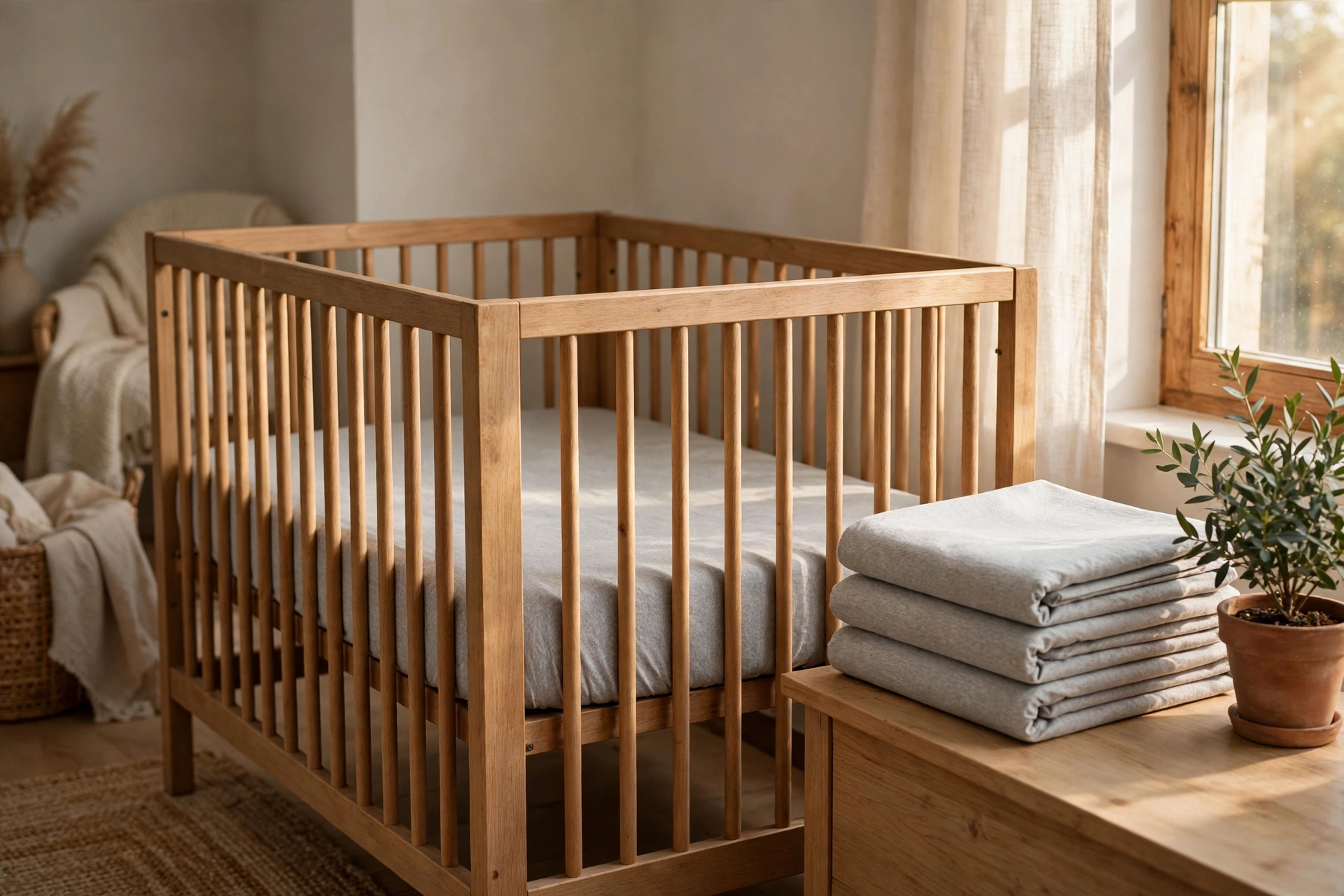
A single fitted sheet, 52 inches by 28 inches, sized for a standard crib or toddler mattress, with a pocket about 5.5 inches deep and elastic that runs all the way around. Burt’s Bees Baby calls that elastic BeeSnug 360, and the all-around part matters more than the name: corner-only elastic is the kind that pops off at 2 a.m. The fabric is combed, ring-spun organic cotton in a jersey knit, the same knit as a soft t-shirt. The listing for this ASIN, B00NZK5G2E, is the Heather Grey colour. Other colours exist in the same line, each under its own listing.
The certification is the part we checked hardest. The listing states the sheet is certified by CU 831717, and the line’s Amazon data carries a GOTS certification showing 95 to 100 percent organic content, plus an OEKO-TEX Standard 100 certification, number 11-47542. That traceability separates this listing from sheets that simply print the word organic in the title. One more honest signal: Amazon’s page for this sheet showed steady recent buying when we checked in November 2026. This is not a dusty listing. It is a working staple that parents replace and rebuy, which is exactly what a crib sheet should be.
The case against it
Before the evidence, the objections. If this sheet cannot survive its own weaknesses stated plainly, the verdict above is worth nothing. Here are the five strongest, with our honest answers.
“It is a t-shirt pretending to be a sheet.” Partly true. Jersey knit is thinner and stretchier than woven cotton, it can pill if it is washed hard and dried hot, and parents who love the crisp, hotel-sheet feel of percale will find it casual. Our answer: thin is not the same as flimsy, and jersey’s stretch is why it stays put on the mattress. But if the woven feel is what you want, we mean this: buy the Naturepedic in the alternatives section instead. We would rather lose the click than have you disappointed in the knit.
“One sheet is not a system.” True, and it is the objection we agree with most. A single sheet fails the 2 a.m. test the moment it is in the wash. Our answer is not to defend the one-pack, it is to plan around it. The buying plan below assumes three. Any review that recommends this sheet without telling you to buy more than one is setting you up.
“The pocket is too shallow for a thick mattress.” True, in one specific case. The pocket is about 5.5 inches. On a standard 4 or 5 inch mattress, plenty. On the thickest mattress the law allows, a full 6 inches, it is the tight squeeze, and the Naturepedic’s 6 inch pocket wins. The federal numbers are in the evidence below; if your mattress is a thick one, this objection should actually decide your purchase.
“Organic is a marketing word.” Often true, and the right default suspicion. Plenty of sheets print organic in the title with nothing behind it. Our answer is the certification chain, and it is checkable rather than vibes-based: a certifier name, CU 831717, a GOTS licence you can look up in the public database, and a content grade of 95 to 100 percent, which is the top of GOTS’s two grades. The labels section below separates what each of those labels does and does not prove, including the uncomfortable limits.
“It does nothing to protect the mattress.” True, deliberately. This sheet has no waterproof barrier, because a waterproof barrier is a plastic-family layer, usually polyurethane, and putting one against the baby’s skin all night is the trade this whole category exists to avoid. Our answer: protection, if you need it, belongs under the sheet, not in it. The buying plan covers when that trade is worth making.
And one more, the objection from our own side of the argument: cotton sheds fibers too. Anyone who tells you a natural fiber sheet is a zero-shed product is overselling. The washing evidence below gives you the real numbers, including the part that surprised us.
Does the sheet material actually matter, or is this overthinking?
It matters more than most nursery purchases, and the reason is exposure time, not panic. A 2025 University of Toronto study by Vaezafshar and colleagues, in Environmental Science and Technology Letters, measured the bedrooms of 25 children aged 6 months to 4 years. They detected 31 compounds in the air right around the sleeping child, more than in the wider bedroom air, and concluded bedding items were a likely source of at least one of them, a phosphate compound called TBOEP. The mattress got most of the coverage. The bedding finding is the part that applies to a sheet.
Then there is the finish question. In a 2022 study in Environmental Science and Technology, Rodgers and colleagues at the Silent Spring Institute tested 93 children’s products. They found detectable fluorine, a marker for PFAS, in 54 of them. But when they tested for 36 specific PFAS chemicals, those chemicals turned up only in products labelled water-resistant or stain-resistant, including products marketed as green. Read that second part again, because it is the practical takeaway: a plain sheet with no resistant finish is a different category from a treated one. The Burt’s Bees Baby sheet makes no water or stain resistance claim at all. That absence is a feature.
None of this proves a polyester sheet harms a baby, and we will not pretend it does. It says the sleep surface is a real, measured exposure route, and the lowest-effort way to shrink it is simple, washable, natural fiber bedding with no chemical finishes you never needed.
Will it actually fit? Crib sizes are regulated more tightly than you would guess
Crib fit is not a style preference, it is a federal standard. Under the US Consumer Product Safety Commission rules, a full-size crib measures 52 and three-eighths inches by 28 inches inside, give or take five-eighths of an inch, and a full-size crib mattress must be at least 27 and a quarter inches wide by 51 and five-eighths long, and no more than 6 inches thick. Those numbers leave almost no slack, which is the point: a snug mattress and a properly fitted sheet are part of the tested sleep setup, not decoration.
Run the hero sheet against them. Its 52 by 28 footprint matches the standard exactly. Its 5.5 inch pocket clears a typical 4 or 5 inch mattress with room for the all-around elastic to grip, and it is only on the thickest legal mattress, the full 6 inches, that the pocket becomes the tight squeeze we flagged in the case against it. One more fit note: cotton jersey relaxes and shrinks a little in its first washes, mostly lengthwise. The brand’s care instructions, wash cold on a gentle cycle and tumble dry low, are not filler text. Following them is how the sheet keeps the fit it started with.
What do most crib sheet guides get wrong?
Two things. The first is treating the word organic as the finish line. Organic describes how the cotton was grown. GOTS goes further: it certifies the fiber content and restricts chemical inputs through processing, manufacturing, and labelling, with independent certification of the whole supply chain. A sheet can be made from organic cotton and still be blended, finished, or sewn in ways a GOTS-certified product cannot. When you shop this category, look for the certification body and licence number, not just the adjective.
The second mistake is assuming a familiar natural brand is natural all the way through a product line. Example, from this very brand: the Burt’s Bees Baby reversible quilt blanket has an organic jersey cotton shell, and its listing states plainly that the fill inside is polyester. We are not linking it as a pick, because it fails the test this article is built on. If you are buying to keep plastic fill off the bed, the shell is not the whole story. Read the fill line on every quilt and comforter you consider.
GOTS and OEKO-TEX: what do those two labels actually promise?
They answer different questions, and shoppers mix them up constantly. GOTS answers: was this fiber certified organic, and was the whole supply chain, processing, manufacturing, packaging, and labelling, held to environmental and social rules, checked by an independent certifier? Its two label grades are “organic,” at least 95 percent certified organic fibers, and “made with organic,” at least 70 percent. This sheet sits at the top grade. OEKO-TEX Standard 100 answers a narrower question: was this finished product lab-tested against a list of more than 1,000 harmful substances and found harmless for its intended use? Its strictest limits, Product Class 1, apply to products for babies and children up to age 3, which is the class a crib sheet falls under.
Notice what OEKO-TEX does not say. It says nothing about organic fiber, how the cotton was grown, or how the product was made. A conventional cotton sheet, even a synthetic one, can pass it, and an organic sheet is not automatically certified. This Burt’s Bees Baby sheet carries both labels, GOTS at the top grade and OEKO-TEX number 11-47542, which is the strongest combination we found in this category. One honest limit applies to both: neither label tells you anything about fiber shedding. For that, you need the next section.
How you wash it matters as much as what it is made of
Let us correct something our own FAQ below could leave you believing. A cotton sheet does shed fibers in the wash. In accelerated laundering tests at North Carolina State University, Zambrano and colleagues reported in Marine Pollution Bulletin in 2019 that cellulose fabrics actually released more fiber mass than polyester did. And in real household loads, a 2020 study by Lant and colleagues in PLoS ONE found 96 percent of the fibers released came from natural fabrics like cotton and wool. Cotton is not a zero-shed fabric.
The difference is what happens next. In the same NC State research program, cotton microfibers biodegraded about 76 percent over 243 days in aquatic testing, while polyester degraded less than 5 percent. A cotton fiber that escapes is a short-lived natural material. A polyester microfiber is plastic, and it persists. That, not zero shedding, is the honest case for natural fiber bedding.
You can also shed less of either kind. The 2020 PLoS ONE study found that switching from a warm, long cycle to a cold, short one cut fiber release by about 30 percent. Fuller loads shed less per item, because what drives release is the water-to-fabric ratio, per Kelly and colleagues in Environmental Science and Technology in 2019. That same finding has a counterintuitive edge: a delicate cycle that uses a lot of water for a few items can shed more, not less. Shedding is heaviest in a fabric’s first washes, so washing on a real soil schedule instead of after every use removes the highest-shed events. Liquid versus powder detergent? The studies genuinely disagree, so we will not crown one. The good news: the brand’s own care label for this sheet, machine wash cold, gentle cycle, tumble dry low, already points the low-shed direction.
Join Our Free Facebook GroupNon-Toxic Family Living: parents sharing swaps that work →
If not this one, then which?
Four situations change the answer, in the order we would act on them. This is the whole alternatives list, ranked by how likely each is to apply to you.
If your mattress is thick, or you want a woven sheet: the Naturepedic Organic Crib Mattress Sheet. It is 100 percent organic cotton in a sateen weave at 250 thread count, 52 by 28 inches, with a deeper 6 inch pocket, in ivory. Sateen feels smoother than jersey and drapes rather than stretches, so the fit reads more tailored, and that pocket settles the thick-mattress objection outright. Naturepedic is a GOTS certified organic bedding manufacturer, and this sheet meets GREENGUARD certification standards per its description. The trade-off: the colour choice is basically ivory.
If you want the simplest thing on the bed: the American Baby Company Knit Fitted Crib Sheet Made with Organic Cotton, in its natural undyed colour. A standard 52 by 28 inch fitted knit sheet in organic cotton, elastic all around, a deep fit that suits mattresses up to about 6 inches thick. Undyed fabric skips the dye step entirely, which some parents prefer for a newborn. One caution we want on the record: this brand sells several near-identical sheets, and some are labelled natural cotton rather than organic. Check that the listing you are on is the organic one, ASIN B0014HQITA, before you check out. Brand lines blur; individual listings are what you are actually buying.
If your baby sleeps in a mini crib or a playard: the Burt’s Bees Baby Fitted Mini Crib Sheet. Same 100 percent organic cotton jersey line, sized 38 by 24 inches, same all-around elastic. The ASIN above is the Blossom colour. A standard sheet bunched into a mini crib is not a harmless shortcut: loose, ill-fitting bedding is exactly what safe sleep guidance tells you to avoid. Match the sheet to the mattress size you actually own.
If your baby is now a toddler asking for a blanket: the Woolino Premium Australian Wool Comforter, Crib Size. Nothing goes on top in a crib with an infant; bare is the rule. Once your child is in a toddler bed, this is the natural fiber option we keep coming back to, and a pick in our non-toxic kids bedding guide. The fill is 100 percent Australian wool, the shell is 100 percent organic cotton, and it is machine washable, which most wool bedding is not. Wool regulates temperature in both directions, so it works across seasons. A toddler bed layer, not a crib accessory.
And the one we would skip: the Burt’s Bees Baby reversible quilt, named above. Organic shell, polyester fill. It is the most likely wrong purchase in this whole category precisely because the brand earned your trust with the sheet. That trust does not transfer to the fill line.
Browse Our Full Amazon StorefrontAll our crib sheet and nursery picks in one place →
What we would actually buy
Concrete, in order. Three of the hero sheet. One on the mattress, one in the wash, one folded for the middle of the night. That rotation, not any single product feature, is what makes a crib sheet system work, and it is why the one-pack objection above does not change our verdict, it just changes the quantity.
Skip the matching quilt. Polyester fill, and an infant should not have it in the crib anyway. Skip the waterproof protector for now, too. Truly waterproof requires a barrier layer, a plastic-family material like polyurethane sandwiched between cotton layers, and any guide that calls a waterproof protector plastic-free is skipping a layer. If leaks turn out to be constant in your house, buy one knowingly, put it under the fitted sheet rather than against the skin, and wash the sheet often. Most families never need to make that trade.
Spend the difference on the second setup instead. If a woven feel matters to you, swap one of the three hero sheets for the Naturepedic and compare them in your own laundry rotation. And if your crib is a mini, ignore everything above and buy the mini sheet in the same quantity. Fit beats fiber, every time, because fit is the safety feature.
Get the Weekly Swaps
One short email a week: the newest microplastics studies in plain English, plus the swaps that are actually worth your money. Join free and we will send you our room-by-room microplastic checklist to get you started.
Get Our Free Room-by-Room Microplastic ChecklistJoin the newsletter and get the checklist free →
Rapid-fire: the questions everyone asks
Is the Burt’s Bees Baby crib sheet really organic?
Yes, by the checkable definition. 100 percent organic cotton, certified by CU 831717, GOTS content at 95 to 100 percent, the top label grade. Verify the licence in the GOTS public database if you want to see it yourself.
Will it fit my crib mattress?
Standard crib or toddler mattress, 52 by 28 inches, up to about 5.5 inches thick: yes. A full 6 inch mattress: it is the tight squeeze, buy the Naturepedic. Mini crib: no, buy the mini sheet. Forcing a loose fit is the one mistake that actually matters here.
How many should I buy?
Three. One on, one in the wash, one folded. Two is the bare minimum and you will feel the gap on laundry day.
Jersey or sateen?
Feel, not safety; both are cotton. Jersey is soft, stretchy, forgiving on fit. Sateen is woven, smoother, more tailored. If you cannot decide, the buying plan above splits the difference.
Does an organic sheet shed microplastics?
No. It sheds natural cotton fibers, which biodegrade; microplastics are plastic. Cotton sheds more fiber than most people expect, though. The washing section has the honest numbers.
How should I wash it so it sheds less and lasts longer?
The brand’s label: cold, gentle cycle, tumble dry low. Cold short cycles measurably cut fiber release, fuller loads shed less per item, and low heat is kinder to the knit and the elastic. Wash when it is soiled, not on a schedule.
Is OEKO-TEX the same as organic?
No. OEKO-TEX Standard 100 means the finished product passed harmful-substance testing, strictest for baby products. It says nothing about organic fiber or how the product was made. GOTS covers organic content and the supply chain. This sheet carries both.
Add Us as a Preferred Source on GoogleOne tap, and our guides show up first in your Google results →
Keep reading
Building the rest of the sleep setup? Start with our non-toxic kids bedding guide, which covers twin sheets, wool pillows, and comforters for older kids. For the grown-up bed, our non-toxic bedding guide applies the same material rules. For the changing table end of the nursery, see our non-toxic baby wipes guide, and for feeding, our guide to glass baby bottles.
Our verdict survived its own case against it, which is the only kind of verdict worth printing. Buy the Burt’s Bees Baby organic cotton sheet, buy three, and spend the money you saved on hype somewhere it counts.