The 3 Best Non-Toxic Air Fryers Without Teflon or PFAS (2026 Guide)
This post contains affiliate links. If you buy through them, we may earn a small commission at no extra cost to you. Read our full affiliate disclosure.
Flip over most air fryer baskets and you will find the same thing. A dark nonstick coating, usually PTFE, the material most of us know as Teflon.
PTFE belongs to the PFAS family of chemicals, the same group often called forever chemicals. The box may say PFOA-free in big letters, but that only means one specific chemical was removed. The nonstick coating itself is still there. If you have been searching for a non-toxic air fryer, this is the gap the labels do not explain.
The good news is that genuinely coating-free options exist now. After going through manufacturer disclosures and independent lab findings, our top pick is the Ninja Crispi Pro, which cooks in borosilicate glass containers instead of a coated basket. Every food-contact surface is made without PFAS and PTFE. Check the current price on Amazon.
Below, we break down what those labels really mean, which materials hold up, and the three models we would actually buy for our own kitchens.
The Short Version
The best non-toxic air fryers of 2026 are:
- Best overall: Ninja Crispi Pro. Glass cooking containers, PFAS-free and PTFE-free on all food-contact surfaces, around $230 to $280.
- Best ceramic nonstick: Typhur Dome 2. A verified PFAS-free ceramic basket with a stainless steel interior, around $400 to $500.
- Best oven style: Our Place Wonder Oven. Stainless steel interior with a ceramic-coated bake pan, around $185.
All three brands confirm their food-contact surfaces are made without PFAS, including PTFE. Most standard air fryers cannot say that.
Every Product We Recommend, In One Place
We keep our full list of researched, family-tested swaps in our Amazon storefront, organized by room so you can find what you need fast.
Visit Our Amazon StorefrontWhy Your Air Fryer Coating Matters
In a test run by the Danish Consumer Council and seven European consumer groups, all six air fryer models they examined contained PFAS in the nonstick coating. Not some of them. All six.
Here is the honest part, because we promised you honesty over hype. The same testers noted that air fryers at normal settings do not reach the temperatures needed to release PFAS from an intact coating. A brand-new basket, used carefully, carries a low risk during everyday cooking.
The problem is that baskets do not stay new. PTFE is a plastic. When the coating gets scratched by utensils, worn by scrubbing, or stressed by dishwasher cycles, it can flake, and those plastic particles go straight into your food. That is the exposure we can actually do something about, and it is why the material your air fryer is made from matters more than any setting on the dial.
Where the Exposure Actually Comes From
With air fryers, the concern is not the hot air itself. It comes down to three things:
- Worn coatings. A scratched or peeling PTFE surface sheds particles into food at any temperature. This is the most common real-world failure, and it happens gradually enough that many of us keep using a basket long after it should be replaced.
- Maximum heat settings. PTFE coatings begin to break down at very high temperatures. Most air fryers max out around 400 to 450 degrees Fahrenheit, which sits near the edge of the comfortable range, especially during long preheats.
- Hidden coated parts. Some models advertise a PFAS-free basket while the crisper plate or drip tray still carries a standard nonstick coating. Every surface your food touches counts.
If you want the bigger picture on how cooking surfaces fit into your kitchen overall, our guide to microplastics in the kitchen walks through every major exposure point, from cutting boards to storage.
What Makes an Air Fryer Non-Toxic: Reading the Labels
Air fryer marketing follows a hierarchy, and knowing it puts you ahead of most shoppers:
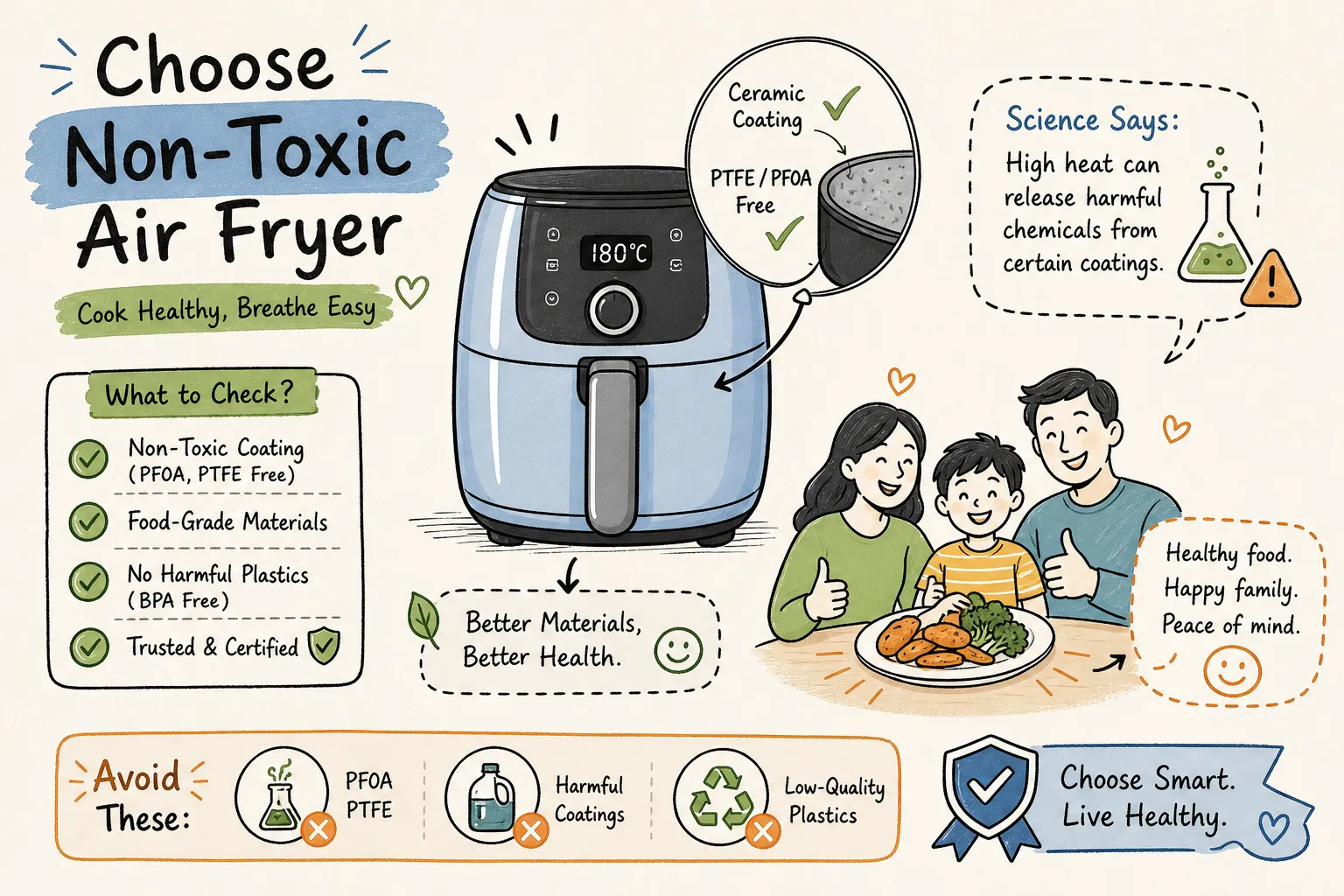
- PFOA-free is the weakest claim. PFOA is one chemical that was phased out years ago industry-wide. A PFOA-free basket can still be coated in PTFE.
- PTFE-free is a real step up. It confirms there is no Teflon-style fluoropolymer coating on that surface.
- PFAS-free on all food-contact surfaces is the gold standard. This is the claim you want, and it should cover the basket, crisper plates, trays, and racks.
One thing worth knowing: PFAS-free is not a regulated claim in the US. There is no federal definition yet. The closest thing to a verified standard is NSF Certification Guideline 537, which requires no intentionally added PFAS, total organic fluorine under 50 parts per million, and annual retesting. Very few consumer appliances carry it so far, so for now, clear brand disclosure is the practical bar.
On materials, the ranking is simple. Uncoated stainless steel and glass are the most stable choices, with nothing to wear off. PFAS-free ceramic coatings are a genuine step up from PTFE, though they are more brittle and typically last one to three years with careful use. Standard PTFE nonstick sits at the bottom of the list.
You Don't Have to Figure This Out Alone
Join our free Facebook community of parents making small, realistic swaps to cut microplastics at home. Real questions, honest answers, zero judgment.
Join the GroupThe 3 Best Non-Toxic Air Fryers of 2026
Ninja Crispi Pro: Best Overall
Best for: Most families, and anyone who wants zero coating on the primary cooking surface without giving up convenience.
The Crispi Pro flips the usual design. Instead of a coated metal basket, your food cooks in CleanCrisp borosilicate glass containers, a 6-quart and a 2.5-quart, that double as storage with snap-on lids. Ninja confirms all food-contact surfaces are made without PFAS and PTFE. The 1800-watt unit reaches 450 degrees and fits a 7.5-pound chicken in the large container, so this is not a compromise appliance.
We also like a quiet bonus here. Because the containers go from air fryer to fridge, you can skip a round of plastic storage containers entirely.
- Pros: Glass primary cooking surface with nothing to wear off. Containers double as meal-prep storage. Real family capacity and full temperature control.
- Cons: The included crisper plates are ceramic-coated aluminum, so treat them gently and skip metal utensils. Glass also adds weight, and it costs more than a basic basket fryer.
Typhur Dome 2: Best Ceramic Nonstick
Best for: Anyone who wants true nonstick convenience without PTFE, and cooks in big batches.
Typhur is one of the most transparent brands we have found in this category. The extra-wide basket uses a ceramic coating the company confirms is free of PFAS, PTFE, and PFOA, over a 304 stainless steel interior. It fits a 12-inch pizza or about 32 wings in a single layer, heats from top and bottom so there is less flipping, and includes a self-cleaning mode that helps protect the coating. The three-year warranty is one of the longest in the category.
The honest downside is price. This is a premium appliance, and at around 20 pounds it is not one you tuck away between uses. Ceramic coatings also wear faster than PTFE in general, though owner reports on this one have been unusually good.
- Pros: Verified PFAS-free ceramic with unusually full disclosure. Excellent cooking performance and capacity. Three-year warranty.
- Cons: Expensive, heavy, and takes up serious counter space.
Our Place Wonder Oven: Best Oven Style
Best for: Small kitchens, and anyone replacing a toaster oven and air fryer with one appliance.
The Wonder Oven is a compact 12.7-quart countertop oven with a stainless steel interior. It air fries, bakes, toasts, roasts, broils, and reheats, plus a steam-infusion trick that revives leftovers better than any microwave. Our Place confirms the interior and all included accessories are made without PFAS, including PTFE. The bake pan uses the brand’s ceramic nonstick coating, and the air fry basket is stainless wire mesh.
It will not match a basket-style fryer for maximum crunch, and the accessories are hand-wash only. But as one appliance that keeps every food-contact surface clean while replacing two or three others, it earns its counter space.
- Pros: Stainless steel interior. Six functions plus steam in a small footprint. The most affordable pick on this list.
- Cons: Less crisp than basket-style fryers, and the interior is too small for a 9 by 13 pan.
| Model | Cooking Surface | Capacity | Price Range | Best For |
|---|---|---|---|---|
| Ninja Crispi Pro Check price on Amazon |
Borosilicate glass containers, nano-ceramic crisper plates | 2.5 qt and 6 qt | $230 to $280 | Most families, meal prep |
| Typhur Dome 2 See availability on Amazon |
PFAS-free ceramic basket, stainless steel interior | 5.6 qt (extra wide) | $400 to $500 | Nonstick convenience, big batches |
| Our Place Wonder Oven Check price on Amazon |
Stainless steel interior, ceramic-coated bake pan | 12.7 qt oven style | $165 to $195 | Small kitchens, replacing a toaster oven |
Prices are approximate and change often. Check current listings for today's price.
The trade-off is straightforward. The Crispi Pro gives you a coating-free primary surface at a mid-range price. The Typhur Dome 2 buys nonstick convenience and top-tier performance at a premium. The Wonder Oven trades some crispiness for versatility and the lowest cost of entry.
Frequently Asked Questions
Do air fryers contain PFAS?
Most standard air fryers do. The typical nonstick basket is coated with PTFE, which is a PFAS chemical. European consumer testing found PFAS in every one of the six conventional models examined. Air fryers with glass, stainless steel, or verified PFAS-free ceramic surfaces avoid this.
Does PFOA-free mean an air fryer is PFAS-free?
No. PFOA-free means one specific chemical was removed from manufacturing, which happened industry-wide years ago. The PTFE coating itself can still be present. Look for models that state all food-contact surfaces are free of PFAS and PTFE.
Is a scratched air fryer basket safe to use?
We would replace it. A scratched PTFE coating can shed particles into food at any temperature, and the damage only spreads with use. If your current basket is peeling or flaking, that is the clearest sign it is time for a swap.
What is the safest air fryer material?
Uncoated stainless steel and glass are the most stable choices because there is no coating to wear off. Both stay the same on day one and day one thousand. PFAS-free ceramic is a solid second choice as long as the coating stays intact.
Are ceramic air fryers non-toxic?
PFAS-free ceramic coatings contain no fluorinated chemicals and are a genuine step up from PTFE. The catch is durability. Ceramic is brittle, so use silicone or wooden utensils and expect one to three years of life from the coating with careful use.
The Bottom Line
For most families, the Ninja Crispi Pro is the easiest answer. Glass where it counts, honest disclosure, and no coating to babysit. Whichever model fits your kitchen, swapping a worn nonstick basket for a non-toxic air fryer is exactly the kind of small change we talk about all the time. Small swap, real difference.
If you are working through your kitchen one item at a time, our 12 simple kitchen swaps guide is the natural next step. And you can find every product we recommend in one place in our Amazon storefront.