Your Washing Machine Is One of the Biggest Microplastic Sources in Your Home: 5 Laundry Swaps That Actually Help
This site is reader-supported. When you buy through links on this page, I may earn a small commission. It keeps the lights on and never changes what I recommend.
I never thought twice about laundry. Not once. I was too busy stressing about plastic water bottles and food containers, you know, the obvious stuff, while my washing machine was quietly being one of the biggest plastic polluters in my house. The irony is almost funny. Almost.
Here’s what stopped me in my tracks: a single load of laundry can release hundreds of thousands of tiny plastic fibers. From your clothes. The cozy fleece, the workout leggings, the kids’ polyester everything. Every wash breaks off microscopic pieces and they all go straight down the drain. I thought about my own laundry pile and honestly wished I hadn’t.
But here’s the good news, and it’s actually good. This is one of the few plastic problems with fixes that are genuinely easy. A thirty-dollar bag you toss in the wash. A filter on a hose. I fell down this rabbit hole so you don’t have to. Here’s what actually works, what kind of works, and what’s just marketing.
Short on time? Here’s the gist:
Your washing machine sheds hundreds of thousands of microfibers per load, mostly from synthetic fabrics. The easiest fix I found is washing synthetics in a GUPPYFRIEND Washing Bag. Independent testing showed around 70% fewer fibers escaping. If sorting every load sounds like a fantasy (it does to me too), a drain-hose filter like the PlanetCare Microfiber Filter catches fibers from everything. Honest drawbacks and the free habits that help most are below.
Why your washing machine is a bigger deal than you’d think
Every synthetic thing you own is slowly falling apart. Polyester, nylon, acrylic, all those cotton-poly blends. Each wash snaps tiny fibers loose and they ride the drain water straight out. Now, wastewater treatment does catch a lot of it. Somewhere around 70 to 99 percent ends up trapped in the sludge. But billions of fibers still slip through, and the captured stuff mostly gets spread on farmland as fertilizer. There is no version of this where the fibers just disappear. Fun, right?
If you want the full deep dive, this peer-reviewed review of the laundering research is worth a skim: Plastic microfibre pollution: how important is clothes’ laundering?
Two things from the research changed how I do laundry:
- Fabric matters a LOT. One study washed 6kg loads of different fabrics and counted the fibers. Acrylic: about 729,000 per load. Polyester: around 496,000. Polyester-cotton blend: about 138,000. Fleece is the worst offender by a mile, so if you live in fleece like I did, sorry.
- Your machine matters too. In one study, a fleece garment shed roughly eight times more fibers in a top-loader than a front-loader. If you’ve got a front-loader, you’re already winning.
I’m not telling you this to ruin laundry day. I’m telling you because once you see the scale, the fixes feel worth doing.
What actually helps (ranked honestly)
1. Wash synthetics in a microfiber bag: the single best easy swap
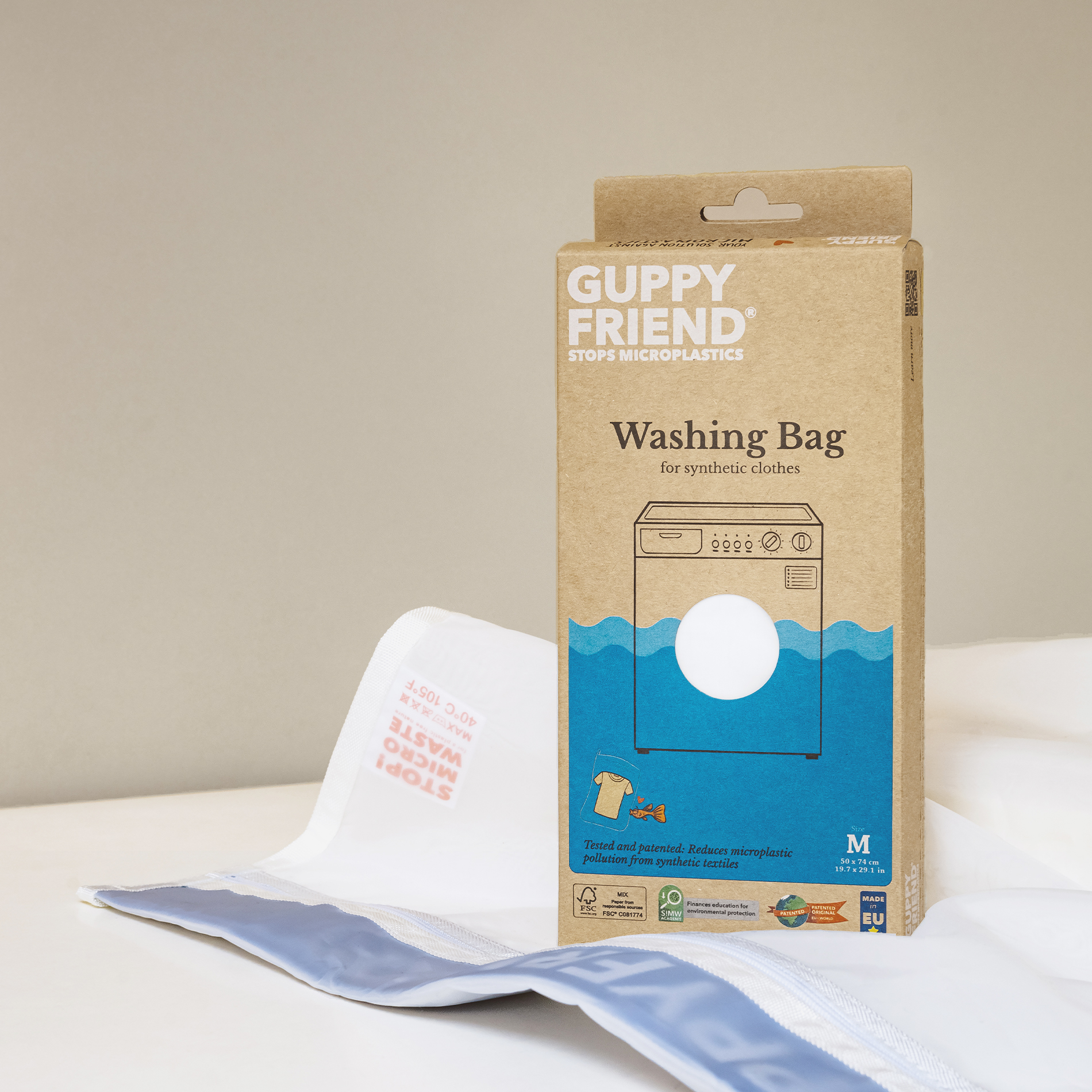
GUPPYFRIEND Washing Bag (around $35)
This is the one I’d buy first. You toss your synthetic stuff in the bag, zip it, and wash like normal. The weave is tight enough to keep broken fibers in but still lets water and detergent through. Bonus: less friction between your clothes means fewer fibers break off in the first place, so your stuff lasts longer too.
The evidence is better than most eco products get. A European consumer organization tested it head to head with the Cora Ball and measured roughly 70% fewer fibers escaping with the Guppyfriend. The brand’s own testing claims higher. Either way, it’s the best-tested thing you can just throw in the drum.
Drawbacks, because there are always drawbacks. One bag holds maybe three or four garments, so a family doing real laundry volume probably needs two or three, and that adds up fast. The bag itself is polyamide, which is plastic, yes. Its weave is designed not to shed, but I get the irony. And the fuzz you collect doesn’t vanish. You pull it out and throw it away. Harm reduction, not magic.
2. Filter the drain hose: protection for the whole load
PlanetCare Microfiber Filter (around $60 to $70 plus replacement cartridges)
Filtrol 160 Washing Machine Lint Filter (around $139, no cartridges)
If bagging every synthetic thing you own sounds like an organizing project you will absolutely not maintain, no judgment, I know myself too. A filter on the drain hose catches fibers from everything, bagged or not. This is the closest thing to a set-it-and-forget-it fix.
PlanetCare is the sleeker, newer option, with the company claiming around 90% capture. I’d love to see more independent testing before I treat that number as gospel. The catch is the cartridges. It’s basically a subscription, and if you stop replacing them you’ve got a seventy-dollar paperweight.
The Filtrol 160 is the buy-once alternative. Reusable stainless steel mesh, no disposables. Owners seem to like it. It’s bulkier, pricier upfront, and you’ll be rinsing out a lint-filled mesh on the regular, which is exactly as glamorous as it sounds.
Either one beats nothing. If you’ll keep up with maintenance, PlanetCare. If you hate subscriptions like I do, Filtrol.
3. Toss in a Cora Ball: modest help, zero effort
Cora Ball Microfiber Catching Laundry Ball (around $30)
This is the lowest-effort thing on the list. A spiky recycled-plastic ball you throw in with every load. The little stalks snag fibers while the drum turns. I like it for people who won’t do anything else, because something beats nothing.
But I have to be straight with you. The independent testing here is not great. One test put capture around 26%, and a European consumer group tested it and basically said don’t bother. It also needs regular cleaning since the stalks get matted, and it can thump around noisily.
My take: fine as a sidekick to a bag or filter, not a replacement. Don’t buy it expecting miracles.
4. Swap dryer sheets for wool dryer balls
Smart Sheep Wool Dryer Balls, XL 6-Pack (around $18)
Okay, full disclosure, this one doesn’t catch microfibers. I don’t want to oversell it. But it earns its spot for two reasons. One, regular dryer sheets are coated in plastics and fragrance chemicals, so ditching them removes a source. Two, the dryer sheds fibers on its own (one study counted around 40,000 per drying cycle), and wool balls cut drying time, which means less tumbling, less energy, and less wear on your clothes.
They last something like a thousand loads, so eighteen bucks pays for itself fast compared to buying dryer sheets forever. Downsides: they smell faintly like a sheep at first (it fades, I promise), they thump, and you’ll replace them about once a year.
5. The free habits that might beat everything above
Honestly? These might outperform all the gadgets. And they’re free.
- Wash cold, wash full, wash less. Hot water, half-empty drums, and overwashing all make shedding worse. Most everyday clothes do not need hot water.
- Front-loader beats top-loader. If you’re ever replacing your machine, this is the single biggest variable. Up to eight times less shedding for fleece.
- Buy fewer synthetics, especially fleece. The best filter is a closet with less plastic in it. When you do buy synthetic, tighter weaves shed less than loose knits.
- Skip the “eco” wash bags that are just loose mesh. A regular delicates bag saves your bras. It does nothing for microfibers. The weave has to be genuinely tight.
What I’d skip
- “Microplastic-catching” laundry sheets or pods with zero published test data. If a brand can’t show you a number, the number is marketing.
- Replacing a perfectly good washing machine just for this. Use what you have. Add a thirty-five-dollar bag or a hose filter. The greenest machine is the one already in your basement.
- Anything promising 100% capture. Nobody has this. Run from perfect claims.
The bottom line
Laundry is one of the biggest microplastic sources in a normal home, and it’s also one of the most fixable. A thirty-five-dollar wash bag plus colder, fuller loads gets you most of the way there. A drain filter gets you further. None of it is perfect. All of it beats the 700,000-fibers-per-load status quo.
Start with one thing. The bag, if you’ll actually use it. The filter, if you won’t sort. That’s plenty for this week.
Keep reading:
- What Clothing Sheds the Most Microplastics? Synthetics vs. Wool vs. Cotton: which fabrics in your closet are the worst offenders
- Non-Toxic Laundry Soap: What Actually Works: pair your fiber fix with a cleaner detergent
- The Reduce-Microplastics Home Guide: the room-by-room version of all of this