
5 Kitchen Swaps to Reduce Microplastics in Your Kitchen
This site is reader-supported. When you buy through links on this page, I may earn a small commission. It keeps the lights on and never changes what I recommend.
Your kitchen is where microplastics get the most direct route into your body. Not floating in the air or shedding off your sweater, but landing right on your food and in your glass. That sounds grim, but here is the part I actually find encouraging: the kitchen is also where the fixes are the simplest. Most of the worst offenders are single objects you can replace once and then forget about. No new habits, no subscriptions, no daily rituals. Just better versions of things you already own. These are the simplest ways to reduce microplastics in your kitchen.
I went through the research and ranked these by impact, so if you only do one or two, start at the top. If you want to reduce microplastics in your kitchen, these are the five changes that matter most.
Short on time? Here’s the gist:
Your cutting board, your plastic containers, and your non-stick pan are the three biggest microplastic sources in most kitchens. The two swaps I would make first are a wood cutting board like the Teakhaus teak cutting board and a set of glass containers like the 18-piece Pyrex Simply Store set. The science, the honest drawbacks, and the one swap that costs nothing are all below.
How to reduce microplastics in your kitchen
1. Trade the plastic cutting board for wood
This is the swap I would make first, because the exposure is so direct. Every slice drags the knife across plastic, and the particles land straight on your food. Researchers finally measured this properly in 2026: in a study published in Communications Materials, ten minutes of chopping on a plastic board released between 2,750 and 7,242 microplastics, plus 23 to 112 million nanoparticles. Boards that had aged in light and heat shed up to 963% more nanoplastics. You can read the full study here.
Wood boards sidestep the whole problem. No plastic, nothing to shed. My pick is the Teakhaus Medium Teak Cutting Board. It is 18 by 14 inches and an inch thick, so it is substantial enough for real cooking without being a backbreaker. The teak is FSC-certified, it comes pre-finished with mineral oil and beeswax, and teak’s natural oils make it more resistant to moisture and odors than most woods.
The honest drawbacks: you have to hand wash it and let it dry, no dishwasher, and it wants a rub of mineral oil now and then. It costs more than a plastic board. And if you are wondering about bacteria, the research generally favors wood over scarred plastic as long as you wash and dry it properly, but I will not pretend a wood board is maintenance free. It is not. It is just a much better trade.
2. Get food out of plastic containers, especially before heating
Heat is the great accelerator of plastic shedding, and nothing in the kitchen combines heat and food contact like a plastic container in the microwave. Researchers at the University of Nebraska-Lincoln tested this in 2023 and the numbers are hard to forget: three minutes of microwaving released up to 4.22 million microplastics and 2.11 billion nanoplastics per square centimeter of plastic container. Even refrigeration released millions over time. The paper is here if you want the details.
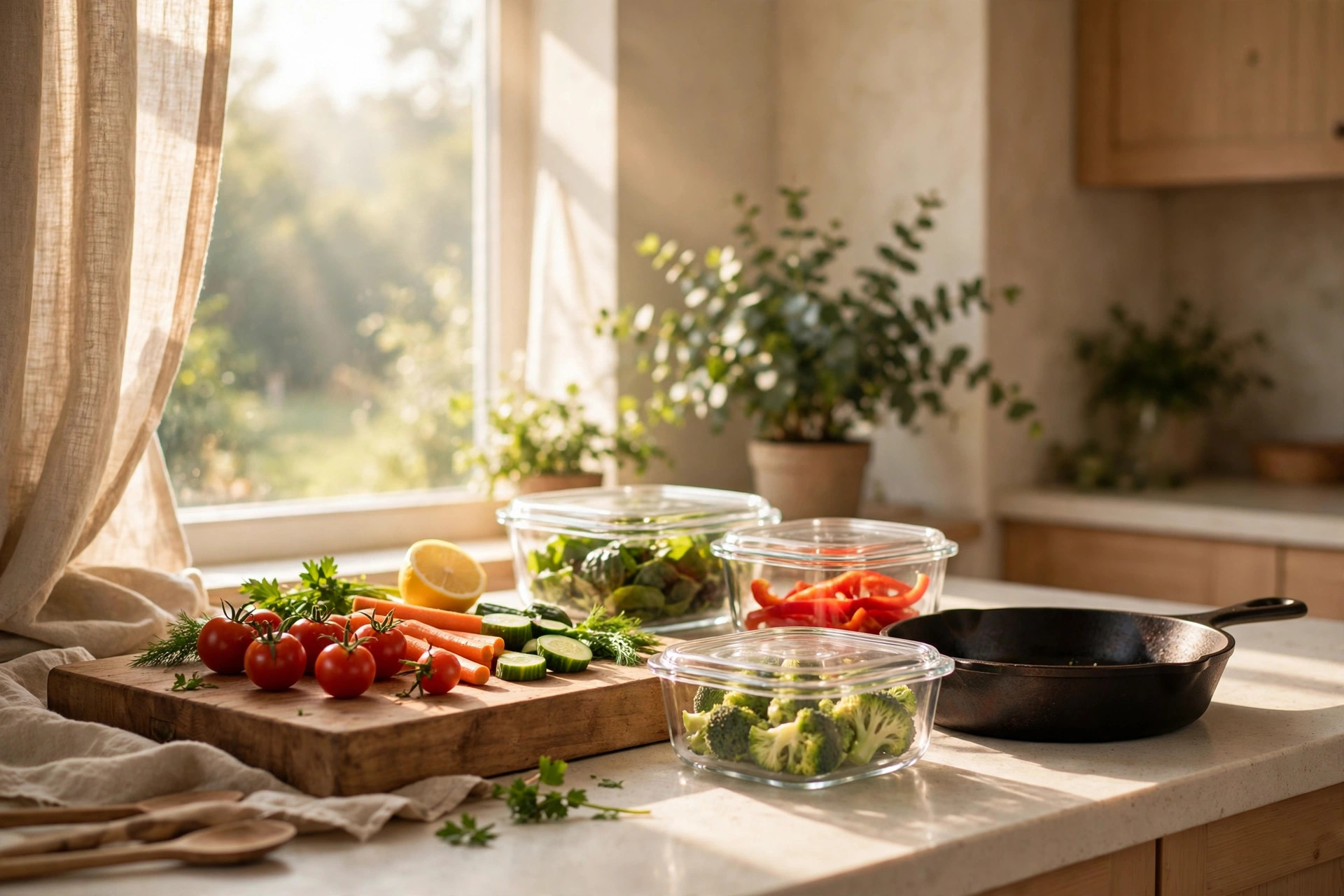
The fix is glass. The Pyrex Simply Store 18-piece set covers the sizes you actually use, from a 1-cup round up to a 7-cup round and a 6-cup rectangle, and the glass goes from fridge to microwave to oven without any shedding question at all. It has over 25,000 ratings averaging 4.7 stars, which tells you this is not some niche product. It is just what a lot of kitchens already run on.
Two honest notes. First, the lids are BPA-free plastic, so this is not a zero-plastic product. The glass is what touches your food during heating, which is where it counts, but if plastic lids bother you, glass-lid sets exist and they cost more and seal worse. Second, the free version of this swap is a behavior change: stop microwaving food in plastic, even plastic labeled microwave-safe. Transfer leftovers to a plate or a glass container first. That one habit costs nothing and matters more than which brand you buy.
3. Retire scratched non-stick pans
A non-stick pan in good condition is not the villain here. A scratched one is. Researchers at Flinders University in Australia found that a single small crack in a Teflon coating can release up to 9,100 microplastic particles, and a badly damaged coating can release up to 2.3 million tiny particles during just 30 seconds of cooking. Since Teflon is in the PFAS family, those particles carry extra baggage. ScienceAlert’s summary of the study is a good read.
So here is my rule: if your non-stick pan is scratched, flaking, or the coating looks tired, replace it, and replace it with something that has no coating to lose. The Lodge 12-inch cast iron skillet is the obvious answer. It is pre-seasoned with vegetable oil, made without PFOA or PTFE, made in the USA, and it has a 4.7-star average across more than 160,000 ratings. Once it is seasoned well, it cooks eggs and fish with barely any sticking. I wrote a full Lodge cast iron review if you want the longer version.
The trade-offs are real though. It weighs about eight pounds, so if you have wrist issues or you like tossing a pan one-handed, this is not your pan. It needs basic care: dry it right after washing and rub in a little oil now and then. And go easy on long-simmered tomato sauce until the seasoning is well built up. If cast iron sounds like too much commitment, plain stainless steel is the other no-coating answer and it is lighter.
4. Filter your tap water instead of buying bottled
Bottled water is one of the most consistent microplastic exposures in the research. A 2024 study in the Proceedings of the National Academy of Sciences found roughly 240,000 plastic particles in a typical liter of bottled water, and about 90% of them were nanoplastics, the tiny ones that worry researchers most. Some of that plastic likely sheds from the bottle itself and even from filters used in bottling. NPR’s coverage lays it out clearly.
Well-filtered tap water sidesteps the bottle entirely. For a simple countertop or fridge option, the ZeroWater 10-cup pitcher is a solid pick. Its 5-stage filter is independently certified to reduce lead, chromium, mercury, and PFOA/PFOS, and it comes with a TDS meter so you know when the filter is spent instead of guessing. The 10-cup size fits a fridge door, which is the sweet spot for most households.
Honest drawbacks: replacement filters are an ongoing cost, and the pitcher body is plastic, albeit BPA-free. If that bugs you, the upgrade path is a stainless or glass dispenser or an under-sink system. I compare the bigger options in my guide to the best water filters for microplastics.
5. Swap paper towels and plastic scrubbers for Swedish dishcloths
This one is lower impact than the four above, but it is cheap, easy, and it cuts two waste streams at once. Plastic scrubby sponges shed microplastics straight down your drain, and paper towels are a constant stream of trash. Swedish dishcloths like this 10-pack from MoLKENE are made of 70% cellulose and 30% cotton, so there is no plastic to shed. One cloth does the work of about 15 paper towels, you toss it in the washing machine when it needs refreshing, and the manufacturer says they are 100% biodegradable and compost in about 90 days.
The cons: they feel strange the first time you use one, stiff when dry and oddly flat. And the grey ones show stains fast, which is cosmetic but worth knowing. Still, for a few dollars, this is one of the easiest wins on the list.
What I would not stress about
You do not need to do all five this weekend. If I had to pick two, it would be the cutting board and the containers, because those put plastic in direct contact with your food every single day. The pan matters most if yours is already scratched. The water filter matters most if you drink a lot of bottled water. And the dishcloths are just a nice, cheap upgrade whenever.
Perfection is not the goal here. Every swap removes a source, and the sources you remove first are the ones touching your food.
What is the biggest source of microplastics in the kitchen?
Plastic cutting boards and heated plastic food containers. A 2026 study found 10 minutes of chopping on a plastic board released thousands of microplastics and millions of nanoplastics, and 3 minutes of microwaving a plastic container released billions of particles.
Is it safe to microwave food in plastic containers?
Even plastic labeled microwave-safe sheds microplastics and nanoplastics when heated. Transfer food to glass or a ceramic plate before microwaving.
Are wood cutting boards better than plastic for microplastics?
Yes. Wood boards shed no plastic particles. Hand wash and dry them, and rub in mineral oil occasionally to keep them in good shape.
Do water filters remove microplastics?
Certified filters reduce microplastics and other contaminants, and filtered tap water avoids the roughly 240,000 plastic particles found per liter of bottled water in a 2024 study.
Keep reading
- Your Washing Machine Is One of the Biggest Microplastic Sources in Your Home: 5 Laundry Swaps That Actually Help
- Reduce Microplastics in Your Home: A Room-by-Room Guide to 25+ Simple Swaps
- The Best Non-Toxic Cutting Boards of 2026
- Best Glass Food Storage Containers
- Best Water Filters for Microplastics in Water