The ‘Safer’ Plastic Chemical Linked to Smaller Babies: What the New DINCH Study Actually Found
As an Amazon Associate, we earn from qualifying purchases. If you buy through our links, we may earn a commission at no extra cost to you.
Quick overview: A new NYU Langone-led study of 6,617 pregnancies found that higher levels of DINCH, the plasticizer sold as a safer replacement for phthalates, were linked to lighter, smaller newborns. Every tenfold increase in exposure was tied to about 27 grams lower birth weight, and 50 to 70 percent of the women had measurable DINCH by-products in their urine. The study shows an association, not proof of cause, and we walk through the caveats honestly below. The practical takeaway is the one we keep coming back to: less plastic touching your food. Our plastic-free food storage guide and our guide to glass baby bottles are good places to start. Every product we recommend across the site also lives in one place, our Amazon storefront:
If you have spent any time reading labels in the baby aisle, you have probably seen the phrase “phthalate-free” and felt a small wave of relief. Phthalates, the chemicals long used to make plastic soft and flexible, have been tied to preterm birth, fertility problems, and other health concerns for years. So manufacturers swapped them out for newer plasticizers and told us the replacements were safer.
A study out this week suggests we should be careful about taking that promise at face value. The research, led by scientists at NYU Langone Health as part of a large national pregnancy research program, looked at one of the most common phthalate replacements, a chemical called DINCH. What this DINCH pregnancy study found is worth understanding properly, neither hyped up nor waved away. So let us go through it together: what DINCH is, what the researchers did, what they found, and just as importantly, what the study does not prove.
What Is DINCH, and Where Does It Hide?
DINCH stands for diisononyl cyclohexane-1,2-dicarboxylate, which is a mouthful, so DINCH it is. It is a plasticizer, meaning it is added to hard plastic, usually PVC, to make it soft and bendable. It was introduced as a safer alternative to phthalates like DEHP, and it has quietly become one of the main plasticizers used around the world.
You will not see DINCH on an ingredient label, because plasticizers are not listed that way. But it shows up in a lot of everyday places:
- Food packaging and plastic wrap, especially anything designed to cling or flex
- Medical devices and tubing, where soft PVC is common
- Children’s toys and childcare products made from flexible plastic
- Vinyl flooring, wallpaper, and coated fabrics
- Food-processing equipment and gloves used in food handling
Plasticizers like DINCH are not chemically locked into the plastic. They slowly migrate out over time, into food, dust, and the surfaces the plastic touches. That is how a packaging chemical ends up measurable in people’s bodies, and why food contact is the exposure route researchers worry about most.
How This DINCH Pregnancy Study Worked
The analysis was led by researchers at NYU Langone Health, with Dr. Leonardo Trasande of NYU Grossman School of Medicine as lead author. It was funded through the National Institutes of Health’s Environmental Influences on Child Health Outcomes program, known as ECHO, which pools pregnancy and child-health data from cohorts across the US.
The team analyzed 6,617 pregnancies. During pregnancy, the women gave urine samples, which the researchers tested for by-products of DINCH. The body breaks DINCH down into metabolites that leave in urine, so those metabolites act like a receipt for recent exposure. The researchers then compared those levels with the babies’ birth weight, birth length, and whether each baby was small for gestational age, a clinical term for a newborn whose weight falls below the 10th percentile for babies born at the same stage of pregnancy.
This is a big sample by environmental-health standards, and birth size matters: babies who grow more slowly in the womb face higher risks of problems that can follow them for years, including heart disease, learning difficulties, and obesity. You can read the full NYU Langone announcement, released via PR Newswire, here.
What the Researchers Found
Three findings stand out.
First, exposure was nearly everywhere. Between 50 and 70 percent of the pregnant women in the study had measurable levels of a DINCH by-product in their urine. DINCH is not some rare industrial chemical a few people encounter at work. It is already in most of us, including most pregnant women.
Second, higher exposure tracked with smaller babies. Every tenfold increase in DINCH exposure was associated with a 27-gram reduction in newborn birth weight. Babies whose mothers had higher levels were also more likely to be classified as small for gestational age. There were differences by sex, too: boys showed greater differences in birth length, while girls were more likely to be small for their gestational age.
Third, timing mattered. DINCH exposure during the third trimester was more strongly tied to lower birth weight for gestational age than exposure earlier in pregnancy. That fits with how fetal growth works, since babies gain much of their weight late in pregnancy.
The researchers also flagged a fairness issue: mothers who were Hispanic or had lower levels of education were more likely to have children affected. Exposure is not evenly shared, and families with the fewest resources usually have the least control over the packaging and products around them.
Dr. Trasande puts it plainly: the findings suggest that a chemical promoted as a safer replacement for phthalates may itself affect how babies grow in the womb, and even small differences in birth size can matter because fetal growth problems can raise risks that echo into adolescence and adulthood.
What This Study Does Not Prove
Here is where we slow down, because the honest version of this story matters more than the scary version.
This study shows an association, not causation. The authors say so themselves: the analysis cannot prove that DINCH exposure directly causes smaller birth size. Women with higher DINCH levels may differ from women with lower levels in other ways, diet, income, neighborhood, other chemical exposures, that also affect birth weight. Researchers adjust for as much of that as they can, but never everything.
27 grams needs context. A typical newborn weighs around 3,300 grams, so 27 grams is roughly the weight of five or six sheets of paper. For one baby, that difference is tiny and well within normal variation. No parent should lose sleep over 27 grams. The reason researchers pay attention anyway is the population effect: when an exposure is this widespread and it nudges the whole curve of birth weights slightly downward, the babies at the fragile low end of the curve are the ones who get pushed into riskier territory. Small shift, many families.
Urine levels are a snapshot. DINCH leaves the body relatively quickly, so a urine test reflects recent exposure, not a lifetime total, and a single measurement can miss the full picture. One more reason to read the findings as a signal worth following up, not a final verdict.
None of this makes the study weak. It makes it what good science usually is: a careful analysis raising a question regulators should have asked before DINCH was everywhere.
The “Safer Replacement” Problem
If this story sounds familiar, it is because we have watched it play out before. BPA was pulled from baby bottles and receipts, and in many products it was replaced by BPS, a chemical cousin that later research found behaves in similar ways in the body. Phthalates came under pressure, and the replacements, DINCH among them, were adopted at scale before anyone had studied what they do during pregnancy at these exposure levels.
Researchers have a name for this pattern: regrettable substitution. A chemical with known problems gets swapped for a less-studied relative, the labels get a reassuring new claim, and the safety homework gets done afterward, if at all, usually by independent scientists working years behind the market.
That is exactly the gap Dr. Trasande is pointing at. His argument is that chemicals used in food packaging and household products should be tested before they are introduced, not after they are connected to health concerns. You do not have to be anti-plastic to find that reasonable. It is the standard we already expect for medicines and, ironically, for a lot of food additives. Plastic chemicals just have not been held to it.
What You Can Actually Do
You cannot avoid DINCH entirely, and trying to live in a bubble would be miserable. Nobody’s goal here is a perfect, plastic-free pregnancy, because that does not exist. The goal is to cut the biggest, easiest exposure routes, which mostly run through food.
One housekeeping note before the tips: this article is a study explainer, so there are no product sections to scroll through. Every swap we recommend on this site, the glass containers, the bottles, the kitchen gear, is gathered in one spot, our Amazon storefront, if you want to browse it all in one place:
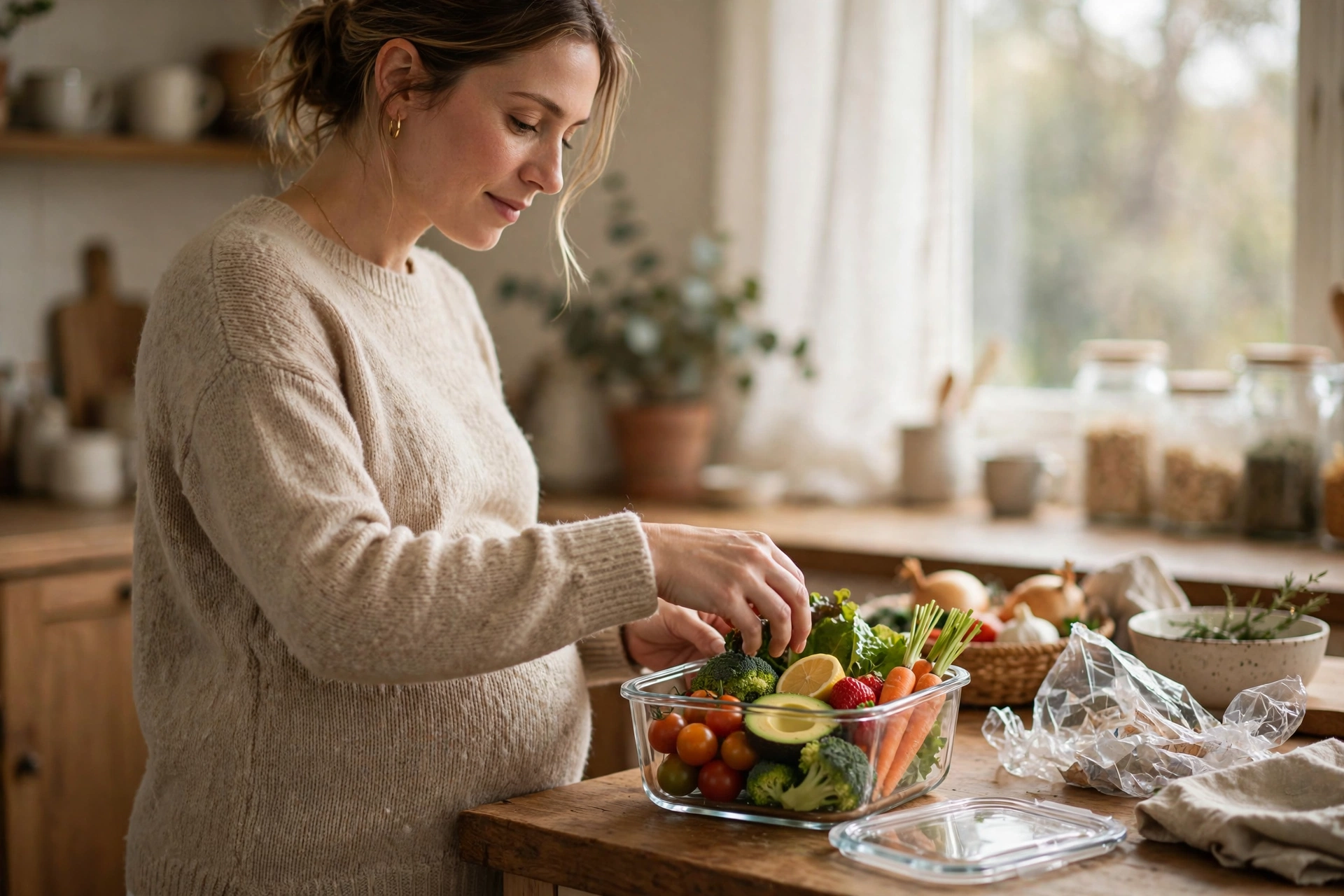
Store food in glass instead of plastic. Plasticizers migrate more readily into fatty and acidic foods, and they migrate faster with heat and time. Moving leftovers and pantry staples into glass is the single highest-value swap. We have a full walkthrough in our plastic-free food storage guide and a product roundup of the best glass food storage containers.
Do not heat food in plastic. Microwaving in plastic and pouring hot food into plastic containers are the habits to retire first. Transfer food to glass or ceramic before reheating. It takes ten seconds and removes the highest-migration scenario entirely.
Go easy on heavily packaged and processed foods. The more plastic touches food along the supply chain, the more chances plasticizers have to move into it. Fresh and minimally packaged food is not just a nutrition upgrade; it is an exposure downgrade too.
Think ahead to bottles and baby gear. If you are expecting, this is the moment when swapping gets easier, because you are choosing things for the first time. Our guide to glass baby bottles covers the plastic-free options, and when your baby gets older, our guides to non-toxic sippy cups and kids’ plates and bowls do the same for the toddler years.
Do not panic about medical care. DINCH is used in medical tubing and devices, and if you or your baby needs medical care, the benefit of that care vastly outweighs a theoretical plasticizer exposure. Save your energy for the everyday, optional exposures you can trim without cost or stress.
Frequently Asked Questions
What is DINCH?
DINCH is a plasticizer, a chemical added to PVC plastic to make it soft and flexible. It was introduced as a safer replacement for phthalates and is used in food packaging, medical devices, toys, vinyl flooring, and other flexible plastic products. It is not printed on labels, which is part of why it has spread so quietly.
What did the DINCH pregnancy study find?
The NYU Langone-led analysis of 6,617 pregnancies found that higher DINCH levels in pregnant women’s urine were associated with lighter, smaller newborns. Every tenfold increase in exposure corresponded to about 27 grams lower birth weight, and babies of higher-exposure mothers were more likely to be small for gestational age. Between 50 and 70 percent of the women had measurable DINCH by-products in their urine.
Does DINCH cause low birth weight?
That has not been proven. The study is observational, meaning it found an association that could partly reflect other differences between higher-exposure and lower-exposure families. The authors themselves caution that the analysis cannot prove DINCH directly causes smaller birth size. It is best read as a strong signal that the chemical deserves proper safety testing and follow-up research.
How can I reduce DINCH exposure during pregnancy?
Focus on food contact, the biggest everyday route. Store food in glass, avoid heating or microwaving food in plastic, choose fresh and minimally packaged foods when you can, and cut back on plastic wrap for fatty foods. You cannot eliminate exposure; trimming the biggest sources is the goal.
Is “phthalate-free” plastic safe?
Not automatically. “Phthalate-free” tells you one family of chemicals is absent; it does not tell you what replaced them. This study is a reminder that replacements like DINCH can carry their own risks. Where it counts most, food and baby products, choosing glass, stainless steel, or silicone over any flexible plastic sidesteps the whole guessing game. We go deeper on that in our explainer on whether silicone is actually safe.
The Bottom Line
The DINCH story is not really about one chemical. It is about a system that keeps introducing replacements first and asking safety questions later, and about pregnant women ending up as the test population without ever agreeing to it. This study does not prove DINCH harms babies, and anyone who tells you it does is getting ahead of the science. But a careful look at 6,617 pregnancies found a consistent association between a “safer” plastic chemical and smaller newborns, and that is more than enough reason to ask why the testing did not happen first.
Until the rules change, the practical response is the unglamorous one: less plastic touching your food, especially when you are pregnant, and especially when heat is involved. If you want to keep going, our guide to avoiding microplastics in food, water, and your home lays out the whole picture, and our guide to reducing microplastics for kids picks up where this one leaves off.