Non-Toxic Salt and Spices: Tested Salts and Organic Spices Worth Buying
This article contains affiliate links. If you buy through our links, we may earn a small commission at no extra cost to you. We never claim to have tested products we have not used, and we check materials, listings and the published research before we link anything.
Salt and spices are the two ingredients you use every single day without thinking about them, which is exactly why they deserve a closer look. The research picture is genuinely two-sided. Sea salt is evaporated from modern ocean water, and modern ocean water carries microplastics. Ground spices, meanwhile, are one of the few pantry categories with repeated heavy metal findings in independent testing, including lead in cinnamon serious enough to trigger federal alerts. Neither fact is a reason to panic over dinner. Both are reasons to buy these staples a little more deliberately than most of us do.
This guide to non-toxic salt and spices does both halves of the pantry properly, with the same evidence standard for each. For salt, we weigh the microplastics studies against the heavy metal spot checks, because the lowest-plastic salt and the lowest-metal salt are not always the same salt. For spices, we work from the biggest independent dataset there is, explain the cinnamon and turmeric stories in full, and pick organic spices in glass jars from a brand whose products kept landing on the cleaner side of that testing. Where a pick has a real trade-off, and two of the salts below genuinely do, we print it in the pick itself rather than in a footnote.
The short answer: if you want one salt with a published third-party microplastics test and plastic-free packaging, start with Vera Salt Fine Spring Salt, a Spanish spring salt that is not evaporated from ocean water at all. For a finishing flake with one of the cleanest independent heavy metal results we found, the Saltverk Flaky Sea Salt from Iceland is the pick. For spices, the Simply Organic Ground Turmeric Root and its matching glass-jar cinnamon, ginger and black pepper are the everyday set we would build first: certified organic, non-irradiated, and from the brand that recurred most often on the low-concern side of independent spice testing. The full reasoning, including the two popular salts whose lab results surprised us, is below.
Get the Weekly Swaps
One short email a week: the newest microplastics studies in plain English, plus the swaps that are actually worth your money. Join free and we will send you our room-by-room microplastic checklist to get you started.
Get Our Free Room-by-Room Microplastic ChecklistJoin the newsletter and get the checklist free →
Do all salts contain microplastics?
Most salts tested so far contain at least some, and sea salt usually carries the most. The first report came from Yang and colleagues in Environmental Science and Technology in 2015, who tested 15 brands bought in China and found 550 to 681 microplastic particles per kilogram in sea salts, 43 to 364 per kilogram in lake salts, and 7 to 204 per kilogram in rock and well salts. Most particles were under 200 micrometres, and polyethylene terephthalate (PET) was the most common polymer, followed by polyethylene and cellophane. At the World Health Organization recommended intake of 5 grams of salt a day, the authors estimated roughly 1,000 particles a year from sea salt alone.
The global picture arrived with Kim and colleagues in Environmental Science and Technology in 2018, who tested 39 brands from 21 countries and regions. Only 3 brands had no microplastics in both replicate samples, which means 36 of 39 contained them. Sea salt ranged from 0 to 1,674 particles per kilogram once one extreme Indonesian outlier at 13,629 per kilogram was set aside, rock salt ran 0 to 148 per kilogram, and lake salt ran 28 to 462 per kilogram. Sea salt levels also tracked the plastic pollution of the surrounding seawater, which is the finding that makes physical sense: evaporate polluted water and whatever was suspended in it stays in the pan with the salt.
Before those numbers harden into a headline, you need the counterweight. Karami and colleagues reported in Scientific Reports in 2017 that 17 brands from 8 countries held just 1 to 10 particles per kilogram, with one brand showing none at all, and calculated a maximum of about 37 particles per person per year. The catch is in their method: they only counted particles larger than 149 micrometres, so the small particles that dominate the later counts were invisible to their setup. Only 41.6 percent of the particles they extracted were even confirmed as plastic polymers. Karami does not prove salt is clean. It proves that the size cut-off a lab chooses decides the headline number before a single grain is tested.
That methods problem is the subject of Lee and colleagues, whose 2021 critical review in the Journal of Hazardous Materials pooled 150 salt samples from the literature and found reported levels spanning 0 to 39,800 particles per kilogram. The identification method and minimum particle size alone changed results by 10 to 600 times. Their honest conclusion is the one to carry into the grocery store: you cannot combine counts from different methods into one reliable risk number, and any brand or article quoting a single particle count without its method is telling you less than it appears to.
Two newer studies keep the story from simplifying into sea salt bad, mined salt good. Kuttykattil and colleagues tested Australian commercial salts for a 2023 paper in Environmental Science and Pollution Research and found the highest count in coarse Himalayan pink salt at about 174 particles per kilogram, with an average of about 85 per kilogram across salts, and terrestrial salts testing higher than marine salt in their sample set. Polyamide and polyurethane dominated, which points at processing and packaging as well as source water. And Syamsu and colleagues reported in 2024 that all 21 Indonesian table salts they tested contained microplastics at 33 to 313 particles per kilogram, an estimated 60 to 571 particles a year at 5 grams a day. The finding repeats across markets and methods, even while the exact counts wobble.
One last piece of context keeps salt in proportion. Cox and colleagues estimated in Environmental Science and Technology in 2019 that total microplastic consumption from food and drink runs to roughly 39,000 to 52,000 particles a year for American adults, rising higher when inhalation is included. Salt is a small slice of that total. It is worth choosing well precisely because it is cheap and easy to choose well, not because it is your largest exposure. No salt study cited here measured a health outcome in people. They measured presence and estimated intake, and that distinction matters every time this topic gets sensational coverage.
What is the other half of the salt story?
Heavy metals, and this is where the simple story breaks. A mined or ancient salt can dodge modern ocean plastic and still carry lead that was in the ground long before plastic existed. Independent lab spot checks of popular salts, summarised in the Plastic Detox pantry investigation and the Clean Green Toxicant Free salt compilation, found grey Celtic sea salt among the highest tested for lead at roughly 553 to 626 parts per billion in the samples checked, with a proposed class action filed over it in February 2025, and one widely cited 2024 lab result for a leading ancient seabed salt at about 290 parts per billion lead. The cleanest results in those same summaries clustered in a different group entirely: refined kosher salts and a few tested finishing salts where lead, cadmium, arsenic and mercury came back non-detect or in single digits.
Three honest points follow. First, these are spot checks of individual samples by independent testers, not a federal survey, and lot to lot variation is real, so treat any single figure as a sample result rather than a permanent brand verdict. Second, there is no federal lead limit for salt in the United States, and the European cap often quoted for context sits far above most of these results, which is why reasonable people can look at the same numbers and disagree about urgency. Third, the dose still matters: salt is eaten in grams, and a finishing flake used twice a week is a different exposure from a daily cooking salt. Our approach in the picks below is to show you both ledgers for every salt, the microplastics side and the metals side, and to rank the salts that publish their own testing or post the cleanest independent results at the top. Two beloved pantry salts stay on the list with their lab results printed in full, because they are what many readers already own and the honest numbers are more useful than a quiet deletion.
Are spices a heavy metal problem too?
Yes, and for spices the dataset is bigger and more direct than the salt dataset. Consumer Reports tested 126 herb and spice products in 2021, covering 15 types from national and store brands, and found about one third, 40 products, with combined arsenic, lead and cadmium high enough at typical servings to concern its experts for regular use, with lead alone exceeding a full day maximum in 31 products. Every thyme and every oregano product tested was concerning. Just as important is what did not predict a clean result: brand size, a premium price, and the word organic. In 7 of the 15 types, including black pepper, coriander, curry powder, garlic powder and white pepper, every brand tested came back below the concern threshold. The spice trade association has reasonably pointed out that spices are a tiny share of total dietary lead exposure, under 0.1 percent for young children by its estimate, and a single serving of anything tested is unlikely to cause harm. The concern is cumulative: small daily amounts, especially in households that use turmeric or cinnamon every day, and especially for kids.
Cinnamon deserves its own paragraph because it has moved from test result to federal action. The FDA alert on ground cinnamon, first issued in March 2024 and expanded since, covers retail ground cinnamon products testing at roughly 2 to over 10 parts per million lead, with the agency advising shoppers to check the listed products and throw them away. Consumer Reports followed up in 2024 with 36 ground cinnamon products and found 12 above 1 part per million, the level that triggers a recall in New York, with the worst at 3.52 parts per million and the cleanest at 0.02. Keep that retail story firmly separate from the far worse one: in the FDA investigation of lead in cinnamon applesauce pouches in 2023 and 2024, the cinnamon ingredient itself tested at 2,270 to 5,110 parts per million, roughly a thousand times the retail levels, and the agency working hypothesis is deliberate adulteration for profit. Conflating the two overstates the risk in your spice jar and understates the real lesson, which is that ground spices are easy to adulterate and hard to inspect, so sourcing and testing are the whole game.
Turmeric is the documented proof of that lesson. Forsyth and colleagues reported in Environmental Research in 2019 that lead chromate, a bright yellow industrial pigment that is 2 to 10 percent lead by weight, was being added to turmeric during polishing in 7 of 9 major producing districts in Bangladesh, with powder reaching 1,152 micrograms of lead per gram. A companion Forsyth study in Environmental Science and Technology, also 2019, used lead isotope fingerprinting in 45 blood samples and matched the lead in peoples blood to turmeric rather than to soil, clay or soldered cans. Forsyth and colleagues extended the sampling across South Asia in 2024, testing 356 samples in four countries and finding 14 percent above 2 micrograms per gram, with the worst above 1,000. None of that measures a US retail jar, and we will not pretend otherwise. What it proves is that the adulteration incentive is real and documented, which is why the follow-up matters so much: Forsyth and colleagues reported in 2023 that after enforcement, education and rapid testing in Bangladesh, market samples with detectable lead fell from 47 percent in 2019 to zero in 2021. Testing works when buyers and regulators insist on it. That is the standard the spice picks below are held to.
Spices also have a small microplastics literature of their own now. A 2026 study titled Spices under the microscope, the first to quantify microplastics in turmeric, black pepper and chili, found particles in all 30 samples from Ahvaz, Iran at 500 to 1,100 per kilogram, with loose bulk spices consistently higher than packaged ones and an estimated intake of roughly 188 to 613 particles a year from spices. It is one small first study and needs replication, but it closes the loop on this guide: the pantry staples you sprinkle daily sit at the crossing point of the plastic story and the metals story, and both point to the same buying habits. Buy from brands that test, prefer glass over plastic packaging, and treat bulk bins and bargain imports with more caution than the price tag suggests.
A quick word on the warning labels you will see on some picks below. California Proposition 65 requires a warning when a product exposes users to lead above a state threshold, and the California OEHHA lead page lists that maximum allowable dose level at 0.5 micrograms a day, a figure built with a thousandfold safety factor. A Prop 65 warning on a spice jar does not prove the jar is dangerous at culinary doses, and the absence of a warning does not prove a lot was ever tested. It is a label to understand, not a verdict to obey or ignore on its own.
Non-toxic salt and spices at a glance
The quick comparison below covers all nine picks. The testing basis column is the heart of this guide: it tells you what evidence sits behind each product, in plain terms, so you can weigh a published brand test, an independent spot check and a certification against each other instead of against marketing copy.
| Pick | Best for | Source and form | Testing basis | Packaging |
|---|---|---|---|---|
| Vera Salt Fine Spring Salt | Everyday cooking salt | Spanish spring salt, fine | Brand publishes third-party microplastics and metals testing | Plastic-free cardboard |
| Baja Gold Signature Mineral Sea Salt | Mineral-rich sea salt | Sea of Cortez, natural grain | Brand third-party lab testing; independent spot check noted in its section | Resealable pouch, decant to glass |
| REDMOND Real Salt, Fine | Ancient seabed all-rounder | Utah ancient seabed, fine | Pre-plastic deposit angle; independent lead spot check printed in its section | Pouch, decant to glass |
| Celtic Sea Salt Light Grey Coarse | Moist grey salt traditionalists love | Brittany clay ponds, coarse | Brand testing claims; independent lead results are high, printed in full in its section | Resealable bag, store in ceramic or glass |
| Saltverk Flaky Sea Salt | Finishing flakes | Icelandic Westfjords, flaky | Among the cleanest independent heavy metal spot checks in this guide | Small retail box |
| Simply Organic Ground Turmeric Root | Daily turmeric | Certified organic, ground | Brand recurred on the low-concern side of Consumer Reports spice testing | Glass jar, metal cap |
| Simply Organic Ceylon Cinnamon | Baking and daily cinnamon | True Ceylon cinnamon, ground | True cinnamon species, low coumarin; Prop 65 warning discussed honestly | Glass jar, metal cap |
| Simply Organic Ground Ginger Root | Baking, tea and cooking | Certified organic, ground | Non-ETO and non-irradiated, certified organic supply chain | Glass jar, metal cap |
| Simply Organic Black Pepper | Everyday pepper, larger jar | Certified organic, ground | Black pepper was a low-concern category across every brand in Consumer Reports testing | Glass jar, metal cap |
Browse Our Full Amazon StorefrontAll our salt and spice picks in one place →
The salt picks
1. Vera Salt Fine Spring Salt: the salt that skips the ocean entirely
Vera Salt Fine Spring Salt is the cleanest answer to the microplastics research above, because it changes the source instead of filtering the problem later. It is hand-harvested from a spring in Spain at over 2,000 feet above sea level, fed by an underground source rather than by modern seawater, so the evaporation step that concentrates ocean microplastics into sea salt never happens. The brand states that the salt undergoes third-party lab testing for trace elements, and its published 2025 heavy metal results came back below 0.020 milligrams per kilogram across lead, cadmium, arsenic and mercury. An independent spot check by the Mamavation site, using an EPA-certified lab, found lead at 45.6 parts per billion, which sits comfortably at the low end of the salt results summarised in this guide. It is unrefined, with its natural calcium, magnesium and potassium intact, and it contains no anti-caking agents or other additives.
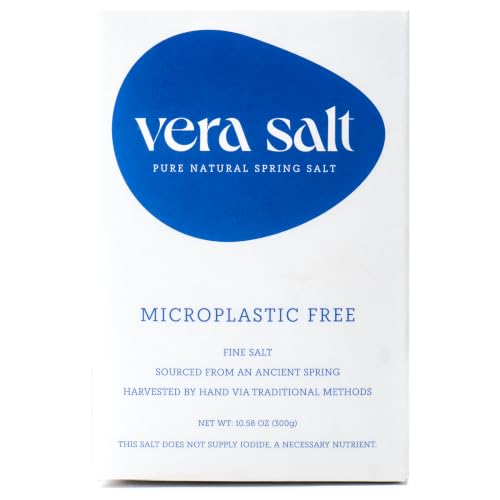
- FINE TEXTURE FOR VERSATILE USE – Vera Salt’s Fine Spring Salt dissolves easily, making it ideal for cooking, baking, soups, stews, adrenal cocktails, and electrolyte mixes. The ultra-fine grain offers clean, consistent seasoning in every pinch.
- SPRING-SOURCED AND HAND-HARVESTED – Sourced from a natural spring in Spain, this fine salt is hand-harvested using traditional methods.Unrefined to preserve its original mineral composition, Vera Salt doesn't undergo any bleaching, washing or processing.
- CLEAN COMPOSITION WITH NO ADDITIVES – This white crystal salt has no added preservatives, additives, or anti-caking agents—just finely textured spring salt in its natural form for those who prefer a simple, unrefined option. Brand support applies to authorized purchases.
- THIRD-PARTY TESTED FOR PURITY – Sourced from a protected spring, this spring salt offers a clean alternative to typical sea salts and rock salts. Third-party tested for microplastics and heavy metals.
- PLASTIC-FREE PACKAGING – Stored in a sturdy paper box with a plant-based inner bag to minimize plastic contact during packing and storage, this spring salt avoids plastic contact from source to table.
The packaging deserves its own sentence, because it is the only pick in this guide that solves it completely: a plant-based cardboard box with a protective inner layer made from plant starch, so the salt never sits in plastic at all. The honest trade-offs are reach and habit. Vera is a smaller brand, so supply and shipping are less predictable than the supermarket giants, and a fine spring salt behaves like a fine table salt in recipes, which means cooks who season by volume with flaky kosher salt need the conversion note in the technique section below. If you buy one salt from this guide, this is the one we would buy first. There is also a flake version sold in a glass jar, the Vera Salt Flake Spring Salt, if you want the same source as a finishing salt.
2. Baja Gold Signature Mineral Sea Salt: the mineral sea salt with lab work behind it
Baja Gold Signature Mineral Sea Salt is a solar-dried, unrefined sea salt from the Sea of Cortez, sold in its natural grain for cooking and baking. It carries 4.8 stars from about 8,400 ratings on Amazon, the strongest verified buyer record among the sea salts here, and the brand states that it completes regular third-party laboratory testing for sodium and mineral consistency and publishes comparative results. Its appeal is the mineral profile: unrefined and naturally lower in sodium than refined table salt by composition, with the trace minerals left in rather than stripped out. One correction matters, because the Amazon title uses the word organic loosely: this salt is not USDA Organic certified, and no plain salt can carry the sourcing claims that certification implies. Treat organic in its title as marketing for natural and unrefined, nothing more.
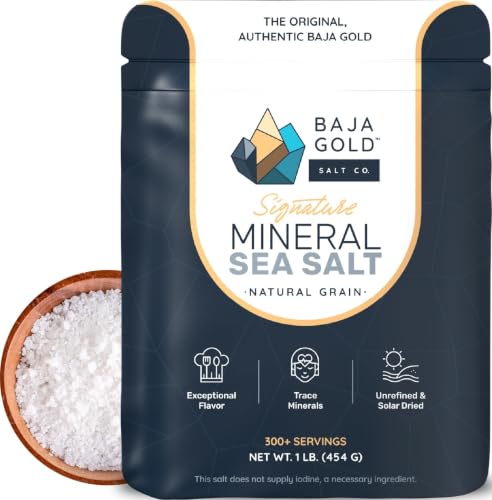
- NATURAL UNREFINED SEA SALT – Baja Gold Mineral Sea Salt is carefully harvested to retain its natural trace minerals. Unlike processed salts, this organic sea salt delivers a clean, fresh taste, perfect for cooking and seasoning dishes.
- RICH IN TRACE MINERALS – This unrefined salt has a unique mineral profile, including magnesium and potassium, adding flavor to your favorite dishes.
- AUTHENTIC BAJA GOLD SEA SALT – Harvested using traditional methods, Baja Gold Salt preserves the integrity of natural ocean minerals. Unrefined and free from additives, this natural sea salt provides a rich, full-bodied taste for all culinary needs.
- NATURAL GRAIN CRYSTALS - A medium grain size, most similar to traditional salt crystals. Perfect for finishing dishes before serving, pickling, or for a salt crust on meat or fish.
- RESEALABLE BAG FOR FRESHNESS – Packaged in a convenient 1 lb. resealable bag, our organic salt stays fresh for years to come. With 300+ servings, this mineral salt for eating is a must-have staple for every kitchen and pantry.
The honest cons are the two you would predict from the science sections. It is a modern sea salt, so it belongs to the category that tests highest for microplastics as a class, and Baja Gold does not publish a microplastics result the way Vera does. An independent spot check summarised in the pantry investigations above found lead at 114 parts per billion in a Baja Gold sample, which is far below the grey salt results below and well within the range of ordinary foods, but it is not a non-detect either. It also ships in a resealable plastic pouch, so decant it into a glass jar or ceramic crock when it arrives, as our storage section recommends for every pouch salt here. Kept in that perspective, it is a well-tested, well-liked mineral sea salt whose maker at least submits to lab work, which is more than most of the shelf can say.
3. REDMOND Real Salt, Fine: the ancient seabed pick, with its lab result printed
REDMOND Real Salt, Fine is mined from an ancient seabed deposit near Redmond, Utah, laid down millions of years before plastic existed and protected underground ever since. That single fact is its microplastics argument, and it is a good one: whatever the modern ocean is doing cannot reach a sealed pre-plastic deposit. It is unrefined, never bleached or heat-processed, contains no additives, and carries more than 60 trace minerals, which give it a faint pink tint and a noticeably rounded flavour. Buyers have voted at scale: 4.8 stars from about 27,383 ratings, the largest review base in this guide by a wide margin.
Now the part most roundups skip. Ancient ground can carry ancient metals, and an independent 2024 lab result summarised by both pantry investigations above put a Real Salt sample at about 290 parts per billion lead and about 91 parts per billion arsenic. That is one sample, not a brand-wide survey, the brand disputes characterisations of its salt as unsafe, and there is no federal lead limit for salt to break. But it is higher than the cleanest salts in this guide by a lot, and pretending the pre-plastic story settles the question would be exactly the one-sided framing this article exists to avoid. Our honest read: Real Salt remains a reasonable, hugely popular everyday salt with a genuine microplastics advantage, and readers who prioritise the lowest possible lead numbers should start with Vera or Saltverk instead and treat this as the convenience pick. It ships in a plastic pouch, so decant it to glass on arrival.
4. Celtic Sea Salt Light Grey Coarse: the traditional favourite, with the hardest numbers in this guide
Celtic Sea Salt Light Grey Coarse, from Selina Naturally, is hand-harvested from clay ponds on the Brittany coast, sun and wind dried, unrefined and additive-free, with more than 70 trace minerals and a characteristic moist, briny bite that chefs have loved for decades. It is Kosher certified and made under cGMP standards, the brand states that it is third-party tested for heavy metals including lead, and it carries 4.7 stars from about 17,920 ratings. On tradition, flavour and buyer satisfaction, it earns its place in any salt conversation.
It also carries the most difficult independent results in this guide, and a non-toxic roundup that hid them would not be worth reading. Lab spot checks summarised by the Plastic Detox and Clean Green investigations found grey Celtic samples at roughly 553 to 626 parts per billion lead, among the highest of any salt tested, and a proposed class action concerning lead in Celtic sea salt was filed in February 2025. The grey colour itself is part of the story: the clay pond minerals that fans prize are the same geology that can carry metals, and moist grey salts as a class tested worse than refined salts in those summaries. None of this makes a pinch of Celtic on a steak a poisoning event, dose still matters and occasional finishing use is a small exposure. It does mean we cannot call this a clean salt, and we rank it fourth of five for exactly that reason. If you love it, use it as the occasional finishing salt it shines as, store it in ceramic, glass or wood as the brand itself recommends, and let a tested salt do your daily cooking. Readers who want the Celtic style without this trade-off should look at the Vera flake in glass linked in the first pick instead.
5. Saltverk Flaky Sea Salt: the finishing flake with the cleanest spot check
Saltverk Flaky Sea Salt is hand-harvested in the remote Westfjords of Iceland and made entirely with geothermal energy, reviving an 18th century method with a carbon-neutral footprint claim and one raw material: Arctic seawater. As a finishing salt it is superb, all crisp pyramids and clean snap. What earns it this slot is its independent paperwork. In the Mamavation EPA-certified lab spot check of salts, Saltverk posted lead at just 6.6 parts per billion, with cadmium and mercury non-detect and arsenic at 15.3 parts per billion, one of the cleanest results in the entire investigation and dramatically cleaner than the grey salt above.

- PREMIUM SEA SALT FLAKES: Discover the versatility of our sea salt flakes—crunchy, mineral-rich, and uniquely flaky. Perfect for cooking, brining, curing, and seasoning, this kitchen essential enhances your recipes with bold, rich flavor. Elevate your culinary creations and never settle for less again.
- COMMITTED TO QUALITY: Crafted with care for quality and the environment, our salt offers a carbon-neutral footprint, adding flavor responsibly. Infuse your dishes with Iceland's essence, made sustainably with pure seawater and geothermal energy.
- TRADITION: Founded in 2011, Saltverk embraces a centuries-old tradition of salt production from Iceland’s Viking waters, following the method established by the Danish king in the 18th century. Experience the essence of Iceland's Westfjords in every bite of our sea salt flakes, crafted with tradition and natural purity.
- NON-PERISHABLE: Experience the essence of Iceland's Westfjords in every bite of our sea salt flakes, crafted with tradition and natural purity. Rest assured, each flake is environmentally friendly and non-perishable, preserving its quality and flavor over time.
- TRUSTED CHOICE: Saltverk's Icelandic sea salt has gained recognition by being featured on the show 'Uncharted,' which premiered on National Geographic, making it a trusted choice used in the finest restaurants and homes around the globe.

The trade-offs are scope and source. It is still a modern sea salt, so the microplastics class concern applies in principle even though its remote, low-traffic waters are about as favourable as ocean sourcing gets, and no brand-specific microplastics count is published for it. It is also a finishing salt in a small box, priced per ounce like one, so using it as your daily cooking salt would be an expensive habit. The sensible pantry system, and the one this guide is really recommending, is a tested everyday salt for the pot and a clean flake like this one for the table. Saltverk is the flake we would put on the table.
The spice picks
All four spice picks come from one brand, and that is a conclusion, not laziness. When the Consumer Reports dataset is sorted by brand, Simply Organic, the bottled line of the farmer-owned Frontier Co-op, recurs on the low-concern side across more categories than any other national brand, including turmeric, black pepper, ginger and cinnamon-adjacent categories. Its jars are glass with metal caps, its spices are certified organic by QAI, and its line is non-ETO and non-irradiated, which matters because ethylene oxide treatment and irradiation are the two sterilisation shortcuts a non-toxic shopper is usually trying to avoid. Two honest limits apply to the whole set. First, each jar has a small plastic sifter insert under the cap, so glass jar with a metal cap is the accurate description, not plastic-free. Second, Simply Organic does not publish batch-by-batch heavy metal lab reports, and USDA Organic certification does not include heavy metal testing. Organic is a strong baseline for pesticides and sourcing. It is not a metals guarantee, for this brand or any other, and the picks below are chosen because independent testing kept treating the brand kindly, not because a certificate promised it would.
6. Simply Organic Ground Turmeric Root: the daily turmeric with a potency spec
Simply Organic Ground Turmeric Root is certified organic turmeric sourced from India, Guatemala and Nicaragua, sold in a glass jar, with a brand-stated minimum of 4 percent curcumin. That potency floor is a real differentiator in a category where colour is the historic adulteration target: a brand that specifies and checks curcumin content is at least measuring the compound that makes turmeric yellow in the first place, rather than relying on colour alone. It carries 4.8 stars on Amazon, and in the Consumer Reports testing the Simply Organic turmeric landed on the low-concern side while several competitors did not.

- Ground Turmeric Root - This vibrant, organic ground turmeric root brings a warm, earthy flavor with subtle peppery notes, perfect for adding color and depth to your culinary creations.
- Best uses - Great for curries, soups, rice, and smoothies, this versatile spice enhances both savory and sweet dishes with its bold, antioxidant-rich properties.
- Grown for something greater - Simply Organic works directly with sourcing partners whenever possible, paying fair prices directly to them, without a middleman, to maximize the grower's return.
- Organic Bottled Spices - Elevate your dishes with Simply Organic Bottled Spices, where the pure, delicious flavor of our spices and seasonings bring the goodness of organics to everyday meals.
- About us - We are Simply Organic. The original, all-organic spice brand that lives up to the promise of our name in all we cultivate and bring to the table.
Read the Forsyth research above before deciding how to use it. The lead chromate findings describe adulterated supply chains in South Asia, not this jar, and no US retail turmeric test we found puts this brand in trouble. The practical lesson is about habit size: a daily heaped teaspoon in a golden milk routine is a different exposure decision from a teaspoon in a curry twice a month, for any brand. If turmeric is a daily supplement habit in your house, this tested, certified, potency-specified jar is the sensible default, and rotating your routine so no single spice is a daily megadose is the sensible system around it.
7. Simply Organic Ceylon Cinnamon: true cinnamon, chosen on species
Simply Organic Ceylon Cinnamon is the pick that shows why species names matter more than front-label adjectives. Most supermarket cinnamon is cassia, a harsher, cheaper relative with far higher levels of coumarin, a compound that is hard on the liver at sustained high doses. This jar is true cinnamon, Cinnamomum verum from Sri Lanka, the low-coumarin species, certified organic, and packaged in a clear glass jar with a recyclable metal cap, as the listing itself states. For anyone who puts cinnamon in oatmeal, coffee or smoothies daily, the species swap is the single highest-value change in this whole spice section, and it costs nothing in flavour once you adjust to Ceylon’s softer, citrusy profile.

- Ground Ceylon Cinnamon - This high-quality, organic Ceylon cinnamon delivers a sweet, mild, and aromatic flavor that adds warmth and depth to a variety of dishes.
- Best uses - Ideal for cookies, cakes, smoothies, oatmeal, and more, this cinnamon enhances both sweet and savory recipes with its delicate, refined taste and fragrance.
- Grown for something greater - Simply Organic works directly with sourcing partners whenever possible, paying fair prices directly to them, without a middleman, to maximize the grower's return.
- Organic Bottled Spices - Elevate your dishes with Simply Organic Bottled Spices, where the pure, delicious flavor of our spices and seasonings bring the goodness of organics to everyday meals.
- Simply Organic is a 100% certified organic spice brand offering spices, herbs, seasoning blends, baking flavors and extracts since 2001.
Honesty requires two notes. The listing carries a California Prop 65 lead warning, which the OEHHA section above explains: it is a warning threshold with a large safety factor, not a finding that this jar failed a food safety limit, and ground cinnamon as a category carries trace lead from soil almost regardless of brand. And ground spice is always easier to adulterate than whole spice, which is why the buying system below suggests cinnamon sticks for grinding at home if you use a lot. Within those limits, an organic true-cinnamon jar from the brand with the kindest independent test record is the ground cinnamon we would bake with, especially heading into the holiday season while the FDA alert list is still growing. Check your current jar against that alert before the baking starts.
8. Simply Organic Ground Ginger Root: the quiet workhorse, untreated
Simply Organic Ground Ginger Root completes the golden milk trio and earns its slot on process as much as provenance. It is certified organic, non-GMO, and explicitly non-ETO and non-irradiated, stated right in the product title, which removes the two treatment questions a careful buyer otherwise has to email a brand to answer. In the Consumer Reports dataset, ginger sat in the middle of the pack as a category, neither an all-brands-clean story like black pepper nor an all-brands-concerning one like thyme, which makes brand selection genuinely matter here, and this is the brand that dataset treated best overall.
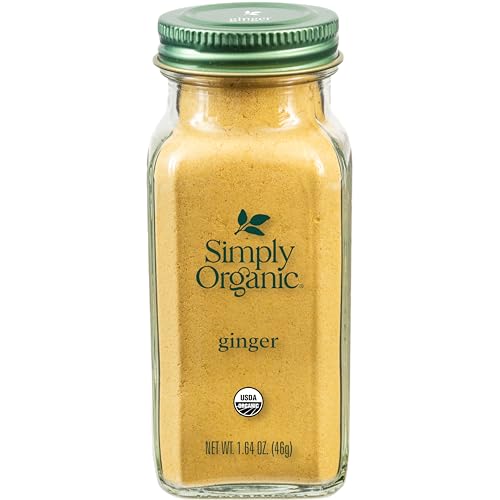
- Ground Ginger - This high-quality organic ground ginger root adds a warm, slightly spicy kick with a zesty sweetness, perfect for enhancing both sweet and savory dishes.
- Best uses - Perfect for gingerbread cookies, stir-fries, smoothies, and teas, this versatile ground ginger brings vibrant flavor and warmth to a wide variety of recipes.
- Grown for something greater - Simply Organic works directly with sourcing partners whenever possible, paying fair prices directly to them, without a middleman, to maximize the grower's return.
- Organic Bottled Spices - Elevate your dishes with Simply Organic Bottled Spices, where the pure, delicious flavor of our spices and seasonings bring the goodness of organics to everyday meals.
- Simply Organic is a 100% certified organic spice brand offering spices, herbs, seasoning blends, baking flavors and extracts since 2001.
The trade-offs are the shared ones: the plastic sifter insert under the metal cap, no published batch metals report, and the general ground-spice rule that potency fades faster than whole rhizome would. Ground ginger is also the spice most households already use in tea, baking and stir-fries several times a week, so it benefits most from the storage rules below: glass jar, dark cupboard, away from the stove’s heat and steam, and replaced on a yearly rhythm rather than kept until it smells like dust.
9. Simply Organic Black Pepper: the low-concern staple in the bigger jar
Simply Organic Black Pepper in the larger 4 ounce glass jar is the set’s everyday grinder-and-shaker staple. Black pepper was one of the seven categories in which every brand Consumer Reports tested came back below its concern threshold, so this is the lowest-drama spice purchase in the guide: certified organic supply, glass packaging, and a category with a clean independent record. It is also one of the three spices in the 2026 Iranian microplastics study, which found black pepper the lowest of its three samples, and the one you are most likely to grind fresh, which connects directly to the grinder section next.

- 4.0 ounces; Tin canister
- Black pepper is one of the world's most popular spices.
- Certfied Organic; Kosher
- Simply Organic is proud to be a 2019 Whole Planet Foundation $100,000 Fund Member donating f unds to support microentrepr eneurs, pr imarily women, internat iona lly and domes tic ally to al leviate global poverty.
- Simply Organic is committed to supporting organic and sustainable farming communities., A Brand of Frontier Co-op, responsible to people and planet
One practical note decides how to use this pick. Pre-ground pepper loses its volatile aromatics within months, while whole peppercorns keep for a year or more, so heavy pepper users get better flavour and a longer window from buying whole and grinding. That advice only holds if the grinder itself is not adding plastic, which is a real and newly documented failure mode. Read the next section before you refill a supermarket grinder jar.
Can your spice grinder add plastic to dinner?
Yes, if its burrs are plastic, and this is the newest failure mode in the pantry. Zbucki and Plazuk reported in Health Problems of Civilization in 2024 that grinding Himalayan salt and black pepper in grinders with polymer burrs transferred microplastic particles from the burrs into the ground spice, with both the amount released and the burr wear rate depending on which polymer the burr was made from. It is a small lab study and it does not establish a health dose, but the mechanism is simple abrasion, the same physics as every other shedding story on this site. A widely discussed 2026 test of supermarket grinder heads, summarised in the Plastic Detox pantry investigation linked earlier, put the scale in kitchen terms: tens of grams of salt or pepper through disposable plastic grinder heads shed anywhere from about a thousand to over fifteen thousand fragments depending on the head. The disposable grinder jar, the one built into the spice bottle and thrown away with it, is the worst design in the category: soft polymer burrs, ground hard against salt crystals, directly over food.
The fix is boring and permanent. Buy pre-ground spices in glass from tested brands for the spices you use ground, as the picks above do, and for pepper and other whole spices, use a refillable mill with a ceramic, stainless steel or stone grinding mechanism rather than a disposable plastic-burr jar. Treat any grinder whose mechanism you cannot identify as plastic until proven otherwise, because on supermarket jars it almost always is. We are building a dedicated mills guide as a follow-on to this article; until then, the rule above will keep the grinder from quietly undoing the choices in the rest of this page.
What about anti-caking agents, iodine and kosher salt conversions?
Three label questions come up in every salt discussion, and each has a calmer answer than the internet usually gives. First, anti-caking agents. The one that frightens people is sodium ferrocyanide, also listed as yellow prussiate of soda, because the name contains cyanide. The chemistry is not the scare story: the cyanide is tightly bound to iron in the ferrocyanide complex, absorption is low, and EFSA concluded in its 2018 re-evaluation of ferrocyanides that there is no safety concern at authorised levels, setting a group acceptable daily intake of 0.03 milligrams per kilogram of body weight per day against real exposures far below it. In the United States, the FDA regulation at 21 CFR 172.490 caps sodium ferrocyanide in salt at 13 parts per million. Choosing an additive-free salt like every pick in this guide is a perfectly good preference. It just does not need a cyanide headline to justify it. The more genuinely open file is calcium silicate, the other common anti-caking agent: EFSA said in its 2018 silicates re-evaluation that safety could not be assessed because chronic data were lacking, which means data gaps, not demonstrated harm. One additive got a clean verdict with numbers, the other got an honest shrug, and your labels will never tell you which is which. Now you know.
Second, iodine. Iodised salt exists because iodine deficiency was a genuine public health problem, and it still matters for thyroid function, especially in pregnancy. A quarter teaspoon of iodised table salt provides a substantial share of the daily iodine requirement, while none of the unrefined salts in this guide provide meaningful iodine. The workable system is not complicated: if your household eats plenty of seafood, dairy and eggs, iodine from food usually covers the gap and a non-iodised cooking salt is a fine default. If your diet is largely plant-based, or anyone in the house is pregnant, keep an iodised salt in the pantry for some cooking or talk to your clinician, rather than assuming a mineral salt covers it. Trace minerals in unrefined salt are real but nutritionally tiny at gram doses, for iodine and everything else. Salt is a seasoning, not a supplement.
Third, the conversion that quietly wrecks recipes. Kosher salts are not interchangeable by volume. Diamond Crystal kosher salt is a light, hollow flake, Morton kosher salt is denser and rolled, and fine table or spring salt is denser still, so a tablespoon of one can carry close to twice the sodium of a tablespoon of another. If a recipe was written for one and you season with another, the dish, not the salt, takes the blame. When you switch to a fine salt like Vera or Redmond from a flaky kosher habit, start with about half the volume you are used to, taste, and adjust. Weighing salt for baking removes the whole problem, and 1 gram of any salt is, reassuringly, 1 gram of salt.
Join Our Free Facebook GroupNon-Toxic Family Living: parents sharing swaps that work →
How do you choose, store and rotate salt and spices well?
Start with the buying system, because it prevents most problems before storage ever matters. For salt, decide by source and evidence: a spring or ancient deposit salt with published testing for daily cooking, a clean-tested flake for finishing, and no salt bought on colour alone, since pink and grey are geology, not quality grades. For spices, buy certified organic from brands with a kind independent test record, in glass, in the smallest size your usage justifies. Prefer whole spices for anything you use in quantity and can grind in a ceramic or steel mill, including peppercorns, cumin, coriander and cinnamon sticks, and buy ground for the spices you use by the pinch. Treat thyme and oregano, the two categories where every tested brand concerned Consumer Reports, differently from the rest: buy them fresh or freeze-dried when you can, or grow a windowsill pot, which for oregano especially is close to a weed in the best sense. And check any ground cinnamon in your cupboard against the current FDA alert list before holiday baking. If yours is listed, the advice is discard or return, not use it up.
Storage is where good purchases go to die quietly. Salt is nearly immortal but hygroscopic, so pouch salts should be decanted into a glass jar or ceramic crock with a lid, kept dry, and never stored in the plastic grinder jar they were sold in. Ground spices peak for roughly six months and stay acceptable for about a year, while whole spices hold one to two years or more, so date the jar when you open it and let the date, not your optimism, decide replacements. Keep every jar in a dark cupboard away from the stove, because heat, steam and light are the three accelerants of flavour loss, and never shake a jar directly over a steaming pot, which doses the contents with moisture each time. If a spice has faded to coloured dust with no aroma when rubbed between your fingers, its active compounds have faded with it, and no storage trick brings them back.
Finally, the dose habit that ties the whole guide together. The heavy metal findings in spices are framed at typical servings with regular use, which means frequency and portion are the levers you actually control. Rotate your daily spices rather than megadosing one, be more careful with daily-use spices for kids, whose exposure per body weight runs higher, and remember that cooking does not remove heavy metals, so sourcing is the intervention, not technique. None of this requires fear at the dinner table. It requires a tested salt in the crock, glass jars in the cupboard, a grinder that is not made of the material you are trying to avoid, and a once-a-year pantry clear-out. That is a weekend project, not a lifestyle overhaul.
Frequently asked questions
Which salt has the least microplastics?
On the published evidence, spring salt and ancient seabed salt have the strongest cases, because neither is evaporated from modern ocean water. Vera Salt publishes third-party microplastics testing for its spring salt, and Redmond Real Salt comes from a sealed pre-plastic deposit. Sea salts as a class test highest in the global studies, though counts vary enormously by method.
Which salt has the least heavy metals?
Not always the same salt, which is the point of this guide. In independent spot checks, refined kosher salts and Saltverk flakes posted non-detect or single-digit lead results, while grey Celtic samples posted the highest lead figures. Vera Salt publishes its own metals results below 0.020 milligrams per kilogram. Always weigh a sample result as a sample, not a lifetime brand verdict.
Is Celtic sea salt safe?
It is a legal, hugely popular salt with no federal limit to break, and occasional finishing use is a small dose. It is also, on independent spot checks, among the highest-lead salts tested, at roughly 553 to 626 parts per billion in the samples summarised here, with litigation filed in 2025. We keep it in this guide with those numbers printed, ranked fourth of five, and suggest a tested salt for daily cooking.
Is pink Himalayan salt better?
Not automatically. In the Australian testing, coarse Himalayan pink salt posted the highest microplastic count of the salts sampled at about 174 particles per kilogram, and independent metals summaries describe wide brand to brand variation in pink salts. Pink is a colour from mineral geology, not a test result. Buy a specific tested product, not a colour.
Does organic mean a spice is low in heavy metals?
No. Consumer Reports found that organic status did not predict cleaner results in its 126-product spice testing, and USDA Organic certification does not include heavy metal testing. Organic remains valuable for pesticide and sourcing reasons. For metals, what matters is the brand’s own testing and its independent test record.
Which spices are riskiest for heavy metals?
Thyme and oregano, where every brand tested concerned Consumer Reports, and ground cinnamon and turmeric, which carry the recall and adulteration records detailed above. Black pepper, coriander, curry powder, garlic powder, saffron, sesame and white pepper tested below concern across every brand in that dataset.
Should I buy whole or ground spices?
Whole, for anything you use often and can grind in a ceramic or steel mill: they keep one to two years, resist adulteration, and taste better. Ground in glass from a tested brand is the right call for pinch spices and blends. Avoid disposable plastic-burr grinder jars either way, because the burrs themselves can shed into the food.
Does cooking remove heavy metals from spices?
No. Lead, cadmium and arsenic are elements, and heat does not destroy them. Sourcing, brand testing and portion habits are the only real levers, which is why this guide spends its length on buying rather than on preparation tricks.
What should I do with the cinnamon already in my cupboard?
Check the brand and lot against the current FDA ground cinnamon alert. Listed products should be thrown away or returned, per the agency’s advice. Unlisted cinnamon from a tested, certified brand, especially true Ceylon cinnamon, is a normal pantry item. When in doubt, replace a bargain jar: cinnamon is cheap, and certainty is worth more than the jar.
How do I read a brand’s lab report?
Look for three things: the lab is a named third party, the result is for the specific product and a recent lot, and the numbers come with units and detection limits. ND means non-detect at the stated limit, not proven zero, and LOQ is the lowest level the lab can reliably quantify. A brand that publishes all of that, as Vera does for its salt, is showing its work. A brand that says lab tested with no report is asking for trust it has not earned yet.
Add Us as a Preferred Source on GoogleOne tap, and our guides show up first in your Google results →
Keep reading
Building out the rest of the low-plastic pantry? Start with our plastic-free food storage guide and the best glass food storage containers for where these staples should live, then see what the research says about microplastics in tea bags, the other daily sprinkle most kitchens never question. For the tools that touch these ingredients, our non-toxic cooking utensils guide covers the steel, wood and silicone swaps, and our whole-house water filters explainer covers the other daily ingredient, the water you cook all of it in.