Non-Toxic Pet Toys and Pet Swaps: What Your Dog and Cat Actually Chew, Lick and Sleep On
This article contains affiliate links. If you buy through our links, we may earn a small commission at no extra cost to you. We never claim to have tested products we have not used, and we check materials and listings before we link anything.
It starts, as most pet toy stories do, with a toy that did not survive the evening.
A bright vinyl squeaker, bought that afternoon, is in pieces by bedtime. The squeaker is out. A corner is missing, and nobody in the room can say for sure where it went. The dog looks delighted. The cat, who was never offered the toy at all, is licking her paws on the rug where the pieces landed, grooming plastic dust and floor grit into her stomach the way cats do everything, thoroughly and on her own schedule.
That little scene is the whole problem with the pet aisle in miniature. Our pets do not handle their toys the way a child handles a toy, and they do not handle them the way we handle our own things. A dog tests a toy with the full force of its jaw, for hours, in saliva. A cat bats a toy across the floor, carries it in her mouth, then grooms whatever it left on her coat. Both of them live at floor level, breathing and licking the exact layer of the home where worn plastic ends up. If any member of the household was going to get the maximum exposure from a cheap plastic toy, it was never going to be us. It was always going to be them.
So here is the question this guide answers, plainly and in full: which non-toxic pet toys and pet swaps are actually worth buying, what materials earn that label, and which popular options fail their own marketing? We will start with the verdict, argue against it honestly, show you the pet specific science that almost no other guide bothers to cite, and then rank the rest in one place.
The verdict, up front
The short answer: if you buy one toy swap first, buy the KONG Classic. It is made from a natural rubber formula, it has been the default stuffable dog toy for decades for a reason, and it turns chewing from a destructive habit into a supervised, food paced activity. At 4.6 stars on Amazon, it is also the rare pet product where the rating, the material and the design all point the same way. Natural rubber is not plastic, it does not carry the plasticizers that make vinyl toys a concern, and a stuffable toy slows a dog down instead of inviting it to shred.
That is the pick. Now let us try to talk you out of it, because a verdict that cannot survive its own objections is not worth much.
Get the Weekly Swaps
One short email a week: the newest microplastics studies in plain English, plus the swaps that are actually worth your money. Join free and we will send you our room-by-room microplastic checklist to get you started.
Get Our Free Room-by-Room Microplastic ChecklistJoin the newsletter and get the checklist free →
The case against it
The strongest objections to the KONG Classic are real, and we would rather state them here than let you discover them on your own floor.
Objection one: the red formula is only for average chewers. True, and it matters. The Classic is the middle strength in the KONG rubber range. A determined power chewer can tear chunks from it, and a chunk of any material, rubber included, is a swallowing and blockage risk. The honest answer is not to abandon natural rubber. It is to size up, supervise, and move a genuinely destructive chewer to a heavier natural rubber tool built for that job, which is exactly why the Goughnuts pick appears in the ranked alternatives below. No toy in this guide, and no toy anywhere, is a leave the dog alone with it forever toy.
Objection two: natural rubber is still something a dog can chew pieces off. Also true. Natural rubber earns its place here on chemistry, not invincibility. It is a plant derived elastomer, not a synthetic polymer blend, and it does not need the phthalate plasticizers that soften PVC vinyl. But mechanically, a torn piece is a torn piece. The rule that protects your dog is inspection, not material faith: check the toy before and after play, and retire it the moment the surface starts to chunk, crack or peel.
Objection three: what you stuff it with can undo the good. Fair. A stuffable toy filled daily with sugary, heavily processed fillings is not a health product, it is a dessert delivery system. The fix is boring and effective: use a portion of the dog’s regular food, plain pumpkin, or a smear of something simple, freeze it to slow the dog down, and count it in the day’s food rather than on top of it. The toy is the swap. The filling is your call, and it should be a considered one.
Objection four: it does nothing for cats. Correct, and that is a limit of the verdict, not a flaw in it. Cats need a completely different logic: small, light, mouth sized toys in materials they are drawn to, with no strings to swallow and no dog scale chewing involved. That is why the alternatives give cats their own ranked picks, in wool and in catnip cotton, instead of treating them as small dogs.
Objection five: one toy does not fix the pet aisle. Also correct. The bowl a pet eats from twice a day, the bed it sleeps on for twelve hours, and the bin its food sits in for weeks all involve more contact time than any single toy. The verdict is the starting point because toys take the most violent mechanical abuse. The rest of this guide is the full swap, bowls, beds, chews and storage included, ranked after the evidence.
What does chewing actually do to a plastic toy?
Chewing is not gentle contact. It is repeated compression, tearing and abrasion, in warm saliva, over months. That combination is close to a laboratory leaching protocol, and researchers have run it as one.
In Wooten and Smith’s 2013 study in Chemosphere, researchers at Texas Tech tested canine toys and training devices by measuring what leached out of them into synthetic canine saliva. The training bumpers were the worst performers, with leachates dominated by the phthalate DEHP and by bisphenol A, and simulated chewing increased how much leached. Some leachates also showed estrogenic and anti-androgenic activity in laboratory screening. Read that carefully: the study does not prove a given toy harmed a given dog. It proves something more useful for a buyer, which is that the chemicals are in some of these products, that they come out in saliva like conditions, and that chewing makes more of them come out.
A decade later, Park and colleagues reported in Chemosphere in 2024 that bisphenol A released from dog toys into synthetic saliva promoted fat cell development in canine stem cells in the laboratory, through a hormone related signalling pathway. In that test set, phthalates and azo dyes were not detected, and BPA was the mover. Again, this is cell work, not a clinical outcome in living dogs. But it answers the shrug that says BPA exposure is a human only story. Canine cells responded to a canine toy leachate. That is the kind of specific, checkable finding a buying decision should rest on, stated at its real strength and no stronger.
The practical translation is a short list. Age matters: a weathered, sun faded, cracked toy is a different chemical object from the same toy new, because degradation opens the material up. Intensity matters: the power chewer gets a different exposure from the gentle mouthing dog, from the same toy. And material matters most of all, because a toy that contains no plasticizers has no plasticizers to leach, however hard it is chewed. That last point is the entire logic of this guide.
Have microplastics actually been found in dogs and cats?
Yes. Not in the vague, somewhere in the ocean sense. In pet food, in pet faeces, in internal tissues, and in reproductive tissue, in peer reviewed work you can read yourself.
Zhang, Wang and Kannan reported in Environmental Science and Technology in 2019 that they measured PET and polycarbonate microplastics in 58 pet foods and 78 faecal samples from the Albany, New York area. The finding that should shape how you think about this whole topic is the comparison: levels in faeces were one to two orders of magnitude higher than levels in food. Their conclusion was that diet is a minor source for pets, and that non-food household exposure dominates. In plain English, what your pet breathes, licks, chews and lives among at home appears to matter more than what comes out of the food bag. That is a strong scientific reason to care about toys, bowls, beds and floors, and a weak reason to panic about any single meal.
Prata and colleagues reported in Animals in 2022 on internal tissues from 25 dogs and 24 cats in Porto, Portugal. Suspected microplastics turned up in 35 of the 49 animals and in 80 of 242 samples, across lung, gut, liver, kidney and blood clot samples, with about half the particles in the very small 1 to 10 micrometre range, and laboratory confirmation identifying polymers including PET in a subset. The authors were appropriately cautious, the counts were low and the work is preliminary. Preliminary is not the same as meaningless. It establishes that particles cross into companion animal tissues in ordinary urban homes, which is the fact that makes the exposure routes worth reducing where reducing them is cheap and easy.
The reproductive finding is the one most likely to stop a reader mid scroll. Hu and colleagues at the University of New Mexico reported in Toxicological Sciences in 2024 that pyrolysis testing found twelve types of microplastic in all 47 canine testes and all 23 human testes they examined, at a mean of 122.63 micrograms per gram in dogs, with polyethylene dominant, and with PVC and PET levels negatively correlated with normalised testis weight in dogs. Correlation is not causation, and the study does not claim a dog was harmed by a toy. What it does is remove the last comfortable assumption, that this is a human exposure story our pets are somehow outside of. They are not outside it. They share our homes, our floors and our materials, and in some ways, floor level living, constant grooming, mouth first exploring, they are deeper inside it than we are. A 2023 review by Prata and Dias-Pereira in Animals makes exactly that point, describing companion animals as sentinels of household exposure, which is a scientific way of saying that what shows up in them is a signal about the home itself.
One newer survey deserves a mention with its limits attached. Thrift and Galloway reported in Environmental Toxicology and Chemistry in 2026 that microplastics appeared in 76 percent of the commercial pet food products they tested in the UK, with wet food the highest risk format. It is a single, recent survey and should be read as such. We cite it for one narrow purpose: food packaging and processing are part of the picture too, which is why this guide includes food storage and bowls, and why canned food gets its own honest paragraph below.
Why does the food bowl belong in a toy guide?
Because contact time beats drama. A toy gets an hour of violent attention. A bowl gets two meals a day, every day, for the life of the pet, often with warm, fatty, acidic food sitting in it, which is exactly the combination that moves chemicals out of a material and into food.
The canned food evidence makes the point from the other direction. Koestel and colleagues at the University of Missouri reported in Science of the Total Environment in 2017 that fourteen dogs fed canned diets for two weeks, including a diet sold as BPA free, showed serum BPA rising roughly threefold, alongside changes in blood chemistry measures and gut microbes. The can lining, not the food itself, was the suspected source. Nobody is asking you to stop feeding your dog. The takeaway is that food contact materials around pets deserve the same scrutiny we already give our own, and that a bowl you choose once and use for years is one of the highest leverage swaps in the house.
Material by material, the bowl logic runs like this. Plastic bowls are cheap, light and everywhere, and they scratch. Scratches do two things: they shed, and they shelter bacteria in grooves that washing struggles to reach. Stainless steel is non-porous, has no coating and no glaze to fail, and its quality is knowable if the maker names the grade. Grade 304, sold as 18/8 or 18/10, is the normal food grade default, chromium and nickel alloyed for corrosion resistance. Cheaper grade 201 swaps in manganese for some of the nickel and resists corrosion less well over years of dishwashing and acidic wet food. Grade 316 adds molybdenum for chloride resistance and is the premium option. A listing that just says stainless steel, with no grade, is telling you nothing, and that silence is itself information. Ceramic is the other serious option: heavy enough to stay put, smooth, and genuinely pleasant for slow feeding designs. Its weakness is the glaze. The FDA’s guidance on lead-glazed traditional pottery explains that lead in glazes can leach into food when pottery is improperly fired, that handmade and irregular ware is the problem category, and that ware labelled lead free has sometimes tested at or above action levels. Applied to pet bowls, the rules write themselves: buy food grade ceramic from a named maker who states a lead free glaze, never use a chipped or cracked bowl for wet food, and retire damaged ceramic rather than demoting it to the water station.
Join Our Free Facebook GroupNon-Toxic Family Living: parents sharing swaps that work →
Who regulates pet toys, exactly?
Nobody, in the way most buyers assume. There is no United States federal safety standard written for pet toys. There is no pet toy equivalent of the rules that govern a child’s toy, no mandatory testing regime for what leaches out of a dog chew, and no recall system with the same teeth. Some responsible brands voluntarily test against children’s toy standards such as CPSIA requirements or ASTM F963, and that voluntary borrowing is worth crediting when a brand names it and shows it. But it is voluntary. The word non-toxic on a pet toy is a marketing claim, not a certification, and the word natural on a rope toy can hide a cotton and polyester blend, as we will show you in the alternatives.
That vacuum is not a reason for despair. It is a reason for a different buying method. When there is no regulator, material identity is the whole game. You cannot outsource the judgment to a label, so you judge the material itself: is it one substance you can name, from a maker who names it, with a failure mode you can inspect for? Natural rubber passes that test. Solid stainless steel passes it. Felted wool passes it. A proprietary plastic blend with a green leaf on the packet does not, however recyclable it may be. Keep that test in mind, because it explains every ranking that follows, including the popular pick we deliberately leave out.
Cats are not small dogs
Every major competitor guide we read for this article was dog only. That is a strange omission, because the cat exposure route is in some ways the more efficient one. A cat does not destroy toys with jaw force. A cat carries toys in her mouth, bats them under furniture where dust lives, sleeps curled around soft toys and beds, and then grooms, ingesting whatever her coat and paws collected. Her risks are also different in kind. The emergency veterinarians see from cats is rarely a chewed chunk. It is the linear foreign body: string, yarn, tinsel and frayed rope, swallowed at one end and anchoring in the gut while the intestine keeps moving, which is one of the most dangerous obstructions in feline medicine. That single fact should reorder your cat toy basket. Short, dense, felted toys with nothing to unravel are the safe shape. Long strings, wand ribbons left out unsupervised, and fraying yarn toys are not enrichment, they are a hazard with good branding.
Wool deserves a precise word here, because you will see claims online that felted wool is fully digestible and therefore safe to eat. We found no peer reviewed evidence for that claim, and we are not going to repeat it. The honest case for felted wool is mechanical, not magical. Dense felting holds together, it does not splinter or shard, the natural lanolin scent draws cats in, and small amounts of short fibre will usually pass through. Eating a substantial amount of any toy material can obstruct a gut, wool included. So the rule is the same as everywhere else in this guide: supervise the shredders, size the toy to the animal, and retire wool toys once a cat can tear them apart. Honesty like that is less catchy than a digestible claim. It is also how you keep a cat safe.
Catnip has a similar honesty note. Roughly a third of cats inherit no response to catnip at all, so a catnip toy for those cats is simply a well made fabric toy, which is fine, as long as you know that is what you are buying. And for the bowl: cats eat best from wide, shallow dishes that do not press their whiskers, a preference often called whisker fatigue. The evidence for that term is debated, and we flag it as debated, but the wide shallow shape costs nothing and many cats plainly prefer it.
If not this one, then which? The ranked alternatives
Here is the rest of the swap, in one ranked section, in the order we would actually buy them. The ranking logic is simple: daily contact and clear material wins first, then the specialist tools, then the comfort and storage upgrades. Every pick is a named brand, sold on Amazon, in a material we can state in one sentence. The one we would skip is named at the end, with its reason, unlinked on purpose.
1. For the bowl swap, the one we would buy first: the Basis Pet Stainless Steel Bowl. If the verdict is the toy, this is the quiet overachiever of the whole guide. Basis Pet makes its bowls in the USA from 304 grade, 18/8 stainless steel, and states that every batch is independently tested for lead, mercury and cadmium. That combination, a named grade plus batch testing plus domestic manufacture, is exactly what the no regulator section told you to look for, and almost no pet bowl brand offers all three. It is the right first purchase for a cat household too, where it replaces a scratched plastic dish at both meals, every day. The honest cons: it has no non-skid base, so it will travel across a hard floor in front of an enthusiastic eater unless you put a mat under it, and it costs more than an imported bowl whose grade nobody states. We would pay it. A bowl is a ten year object. Buy the tested one.

2. For the chew that is food, not plastic: the Himalayan Dog Chew Yak Cheese Chew. The nylon chew bone is one of the strangest normal objects in pet care: a plastic stick, marketed to be gnawed for weeks, shedding non-digestible shards by design. The yak chew replaces it with an actual food, yak and cow milk, salt and lime juice, pressed and dried hard in the Himalayan cheese tradition. At 4.4 stars with more than twelve thousand ratings on Amazon, it is also one of the best evidenced picks in this guide. Now the warning, stated at full strength: it is very hard, and hard chews can fracture teeth, especially the large upper premolar vets call the slab fracture tooth. Use the thumbnail test: if you cannot dent it slightly with a thumbnail, it is hard enough to demand supervision and a moderate chewer. It is not for puppies under twelve weeks. And when it wears down to a nub, take the nub away, because that last piece is a choking risk. The brand’s own trick is a good one: microwave the nub and it puffs into an edible crunchy piece, so nothing is wasted and nothing is swallowed whole.
3. For the power chewer who destroys the verdict pick: the Goughnuts Tug Toy. Goughnuts exists for the dog the KONG Classic cannot handle. Its toys are engineered natural rubber, reinforced for aggressive chewers, made in California, and built around a safety idea we wish every toy maker copied: a red inner layer that tells you when to stop. When the red shows, the toy is done and the company replacement guarantee applies. That is failure mode design, the toy announcing its own retirement, and it directly answers the chunking objection from the case against section. The cons are plain: it is heavy, it is not pretty, it costs real money, and a tug toy is for supervised interactive play, never a solo chew. Goughnuts itself says no toy is indestructible, and that honesty from the toughest brand in the category is the correct frame for every pick here.

- ✅ AGGRESSIVE CHEWERS, MEET YOUR MATCH — Your search for a toy that can stand up to your dog’s aggressive chewing is over. Goughnuts long lasting pull dog toys make tug of war more fun while saving you money you'd otherwise spend replacing toys.
- ✅ ENGINEERED FOR MAXIMUM DURABILITY — Designed by a rubber chemist with 30 years of dog chew toy experience, our sturdy rubber tug toys offer no weak spots that your dog could bite through, so you and your dog can play countless games of tug-of-war.
- ✅ ULTIMATE SAFETY— Our tug toys are made to prevent dogs from chewing off and ingesting pieces that can cause intestinal blockages, resulting in surgery or death while keeping your hand out of harm’s way so you can enjoy tug-of-war as much as your pup.
- ✅ THE PERFECT SIZE FOR YOUR DOG —The wider the toy, the harder it is for them to complete their bite and tear off pieces. We offer toys in many sizes, including our tug toy for large breed dogs, which has 1.5” cross sections for safe, supervised play.
- ✅ GUARANTEED FOR LIFE— Goughnuts is a female- and family-owned company that manufactures in the USA. Our super durable dog toys are nearly indestructible, but if your dog manages to damage them, we'll replace your purchase under our lifetime warranty.
4. For cats, the wool pick: the Hustle and Blush Love Ewe Felted Wool Cat Toys. These are hand felted from 100 percent New Zealand wool, in small two inch shapes that are the right scale for a cat to bat, carry and bunny kick. Wool is the rare cat toy material that improves on plastic in every direction at once: no plasticizers, no shards, no squeaker to extract, a natural lanolin scent cats are drawn to, and a dense felted body with nothing to unravel into a linear foreign body, provided you retire it once it starts to come apart. One boundary, clearly: at two inches, these are cat and very small dog toys, supervised. They are not dog chew toys, and a medium dog could swallow one whole. Keep the species logic clean and this is the easiest cat swap on the list.
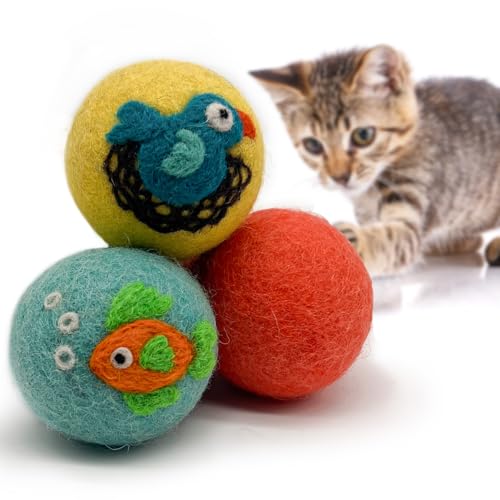
- MADE WITH 100% ORGANIC WOOL: Our cat toys are crafted with 100% premium New Zealand wool, making them safe and non-toxic for indoor cats and dogs. Free from fillers and Azo dyes, our wool cat balls are an ideal addition to your pet's toy collection. Great for promoting physical activity and mental stimulation, our felt balls for cats encourage play, making them an ideal cat gift or cat toys for indoor cats.
- INTERACTIVE & STIMULATING PLAY: Designed to keep your cat engaged, our interactive cat toys offer endless hours of fun. Great for cats who love to chase, pounce, and fetch, our wool cat toys encourage healthy exercise and mental stimulation. The soft texture and bright colors make them irresistible, ideal for kitten development, or as a fun gift for cats and a thoughtful cat gift for cat lovers or cat gifts for women.
- CUTE DESIGN FOR ENDLESS FUN: Each set of our felt cat toys comes with 3 hand-felted wool balls. Measuring 2 Inch, our wool cat toys cater to various play styles, ensuring your pet stays active and entertained. Our adorable wool felt balls are ideal as cat toys, or pet toys, and make a thoughtful gift for cat lovers or anyone seeking a unique gift for pets.
- HANDMADE & DURABLE: Our felt balls for cats are handcrafted with care, using premium wool, ensuring they last longer than factory-made cat toys. Our wool cat balls are safe and free from lead, Azo dyes, and other harmful chemicals. Handmade by artisans in underprivileged communities, our wool toys for cats are ethically produced, making them a great option for your cat while supporting women in need.
- SUPPORTS ANIMAL RESCUE PROGRAMS: A portion of the proceeds from each purchase goes to support the KAT animal rescue center in Nepal. This nonprofit organization provides medical care, food, shelter, and adoption services to rescued street animals. By purchasing our wool cat balls, you're not only giving your pet a fun, interactive cat toy but also contributing to animal welfare and making a positive impact.
5. For the catnip cat, the American classic: the Yeowww! Catnip Banana. DuckyWorld has made this toy in the USA for years, and the construction is what earns it a place here: a cotton twill outer, filled with organically grown catnip and nothing else, no filler stuffing, no plastic crinkle film. For the two thirds of cats who respond to catnip, it is close to a perfect object, sturdy enough for serious bunny kicking. For the third who do not respond, remember the honesty note from the cats section: you have bought a durable cotton banana, and your cat will tell you within a minute which cat you have. The twill will eventually tear under determined kicking, and when it does, loose catnip makes a cheerful mess and the toy retires. That is a good life for a cat toy.
6. For the cat who wants a room of her own: the MEOWFIA Felted Wool Cat Cave. A cat cave is a bed, a hiding place and a toy in one object, and this one is hand felted from 100 percent Merino wool, formed with soap, water and pressure, with no synthetics in the structure. Cats choose enclosed, scent holding, temperature neutral spaces, and wool delivers all three without a foam or polyester fill anywhere in the product. Size honestly: the medium suits cats up to roughly ten to twelve pounds, so bigger cats need the large. It is hand wash only, sizes vary slightly because each one is handmade, and wool is not waterproof, so accidents soak in rather than wiping off. For a cat who loves a cave, those are acceptable trades. For a household that needs everything machine washable, skip to the next pick instead.
7. For the dog bed, without the foam slab: the Molly Mutt Dog Bed Duvet. Most dog beds are a block of polyurethane foam in a polyester cover, which is to say, a plastic mattress your dog spends half its life on. Molly Mutt’s idea is the cleverest in the category: a 100 percent cotton duvet cover, made to be stuffed with your own old clothes, towels and pillows. You get a washable, natural fibre bed, your worn clothing makes it smell like you, which is the scent your dog would choose anyway, and textiles you already own get a second life instead of a landfill trip. The trade is support. A clothes stuffed duvet is a fine bed for most dogs, but it is not an orthopedic foam bed, and a senior or arthritic dog who genuinely needs structured support should not lose it for the sake of a material rule. Serve the dog first. For everyone else, this is the bed swap we recommend, and the cover washes as easily as your own bedding, which matters more in practice than any other bed feature.
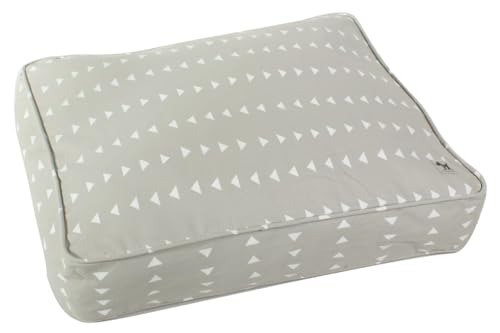
- 100% cotton canvas
- breathable
- sustainable
- machine washable
- no harmful chemicals

8. For food storage, with a disclosure: the simplehuman Pet Food Storage Container. The standard pet food bin is a thin plastic tub, and kibble is a fatty food, and fat is exactly what draws chemicals out of plastic during weeks of contact. This can answers most of that: a brushed stainless steel body, an airtight silicone gasket seal, a lock tight handle and a magnetic scoop on the lid, at 4.6 stars with more than seven thousand ratings. Now the disclosure, because this guide does not oversell: the removable inner bucket is BPA free plastic. So this is not a zero plastic interior. It is a steel can that keeps food fresher, seals properly, and reduces the plastic contact story from a flimsy all plastic bin to one rigid bucket, and if you want truly zero plastic contact, the honest route is keeping food in its original bag inside the can, a tip many vets recommend anyway for freshness and for keeping the batch information. It is heavy when full and it is the premium option in this guide, and it is also the pick most likely to become a future deep dive on this site, because food storage is where the contact time argument is strongest.

- AIRTIGHT SEAL, LOCKED TIGHT: Clamp the lid shut and a silicone gasket forms an airtight seal — keeping pet food fresh and curious paws out.
- EXTRA-LARGE CAPACITY: Holds 36-44 lb / 16-20 kg of dry dog food, cat food, or bird seed — sized for typical 40 lb retail bags.
- SCOOP, READY WHEN YOU ARE: An included measuring scoop attaches magnetically under the lid — no fumbling at feeding time, no lost scoop.
- FOOD-SAFE STORAGE: Removable BPA-free inner bucket lifts out for easy cleaning. Engineered to keep dry food fresh and contained.
- NOT JUST FOR KIBBLE: Also great for storing bulk pantry items like flour, rice, sugar, charcoal, or bird seed.
The one we would skip: West Paw Zogoflex, and vinyl toys generally. This will surprise readers, because West Paw is a genuinely good company: American made, recyclable, with a take back programme, and toys that last. But Zogoflex is a proprietary synthetic plastic, and an article promising plastic free, natural material pet toys cannot hand its readers a plastic toy because the plastic is well managed. Recyclable is a real virtue. It is a different virtue from plastic free. If durability is your only goal, Zogoflex is a reasonable buy elsewhere. It does not meet this guide’s bar, so it gets no link here. Vinyl toys fail harder and cheaper: vinyl is PVC, the plastic this site warns about most, softened with the very plasticizers the Texas Tech work found leaching into saliva. The squeaky vinyl toy from the cold open is the first thing we would throw out. Two traps in the same spirit, so you can spot them yourself: rope toys sold as cotton that are actually cotton and polyester blends, which shed plastic fibre while wearing a natural label, and whole antlers marketed as the natural chew, which are natural, certainly, and also hard enough that veterinary dentists routinely warn they crack teeth. Natural is a material claim. Safe is a separate question. Ask both, every time.
Browse Our Full Amazon StorefrontAll our non-toxic pet toy and pet swap picks in one place →
The buying plan: what we would actually buy, in what order
If we were starting from a basket of plastic pet gear today, here is the exact order we would spend in, and what we would deliberately not spend on.
First, the daily contact swaps. One Basis Pet bowl set per pet, food and water, because twice daily contact for years beats every other exposure in the house. If your pet eats from ceramic now and the bowl is intact, food grade and lead free, keep it and spend elsewhere. The swap is from plastic and from damaged ceramic, not from good ceramic.
Second, one good toy per animal, not a basket refresh. The KONG Classic for an average chewing dog, sized up one size from what you think you need, or the Goughnuts Tug if your dog has already proven it destroys standard toys. For a cat, the Hustle and Blush wool toys first, and add the Yeowww! Banana once you know whether your cat answers to catnip.
Third, replace the chew, not the habit. Dogs need to chew, and a ban simply moves chewing to your furniture. Swap nylon bones for the Himalayan yak chew, supervised, with the thumbnail test and the nub rule, and let the chewing need be met by a food instead of a polymer.
Fourth, the comfort and storage upgrades, when budget allows. The Molly Mutt duvet when the current dog bed dies, the MEOWFIA cave for a cave loving cat, and the simplehuman can when the plastic kibble bin cracks, warps or starts to smell like old fat, which old plastic bins reliably do.
What we would skip spending on: a full toy basket replacement in one order, because pets have preferences and one proven toy beats six ignored ones; any toy whose material the maker will not name; recycled plastic toys sold as eco, because recycled plastic still sheds microplastics; and premium versions of low contact items, where the money does more work in the bowl and the chew. Spend where mouths, meals and sleep are. Save everywhere else.
How do you keep these toys safe once they are home?
Material choice is half the system. Inspection is the other half, and it is free.
Wash by material. Stainless bowls go in the dishwasher, and should, because washing method matters more to bowl hygiene than bowl material does. Natural rubber toys wash with warm soapy water and dry fully before stuffing. Wool toys spot clean, or hand wash gently and reshape while damp, and must dry completely before returning to a cat who will mouth them. Cotton bed covers machine wash like bedding, because a bed you cannot wash is a bed you will not wash.
Inspect on a schedule, not on a suspicion. Before play, run a thumb over rubber toys for cracks, chunks and peeling. Check wool toys for tearing seams. Check rope toys, if you still own any, for fraying, and retire them the moment strings lengthen, because that is the linear foreign body risk arriving on schedule. Keep toys indoors and out of direct sun where you can, because weathering and ultraviolet light age polymers and rubber alike, and the Texas Tech work tells you aged, chewed material leaches more readily than new material.
Retire without sentimentality. A toy that has given two years of service and started to come apart has done its job. The discard rules are simple: rubber that chunks, ceramic that chips, wool that tears open, any toy small enough, once worn, to fit entirely in the mouth of the animal playing with it. Size is a safety feature that wear erodes, which is why the oldest toy in the basket deserves the hardest look.
Finally, supervise by toy type, forever. Tug toys, chews and stuffable toys are supervised categories. Balls and felted toys in good condition are lower supervision, never no supervision for a known shredder. None of this is anxiety. It is the ordinary care you would give any object an animal puts in its mouth daily, applied consistently because there is no regulator doing it for you.
Rapid-fire FAQ
Are plastic dog toys actually unsafe? Some are, measurably. Texas Tech researchers found phthalates and BPA leaching from dog toys and bumpers into synthetic saliva in 2013, and chewing increased it. That does not condemn every plastic toy ever made. It does mean vinyl and unnamed blends are a poor bet, and natural materials remove the question entirely.
Is the KONG Classic really plastic free? Yes, on material. It is a natural rubber formula, not a synthetic plastic, and natural rubber needs no phthalate plasticizers. It still needs supervision, because a torn chunk of anything is a swallowing risk.
Are tennis balls safe for dogs? We would not use them as chew toys. The felt is abrasive enough to wear tooth enamel over time, the ball can compress and become a throat risk for large dogs, and the materials are synthetic. A solid natural rubber ball is the better fetch tool.
Is silicone a plastic? Silicone is a synthetic polymer, but a different family from plastics like PVC, built on a silicon and oxygen backbone rather than a carbon one. It is a reasonable middle material for some pet uses. This guide simply ranked natural rubber, wool, cotton, steel and ceramic ahead of it, because those materials answer the question more completely.
Are wool cat toys safe if my cat chews them? Dense felted wool is one of the safer cat toy materials, with no shards, splinters or plasticizers. But no toy is safe to eat in quantity, claims that wool is fully digestible are not backed by peer reviewed evidence, and a wool toy that can be torn apart should be retired.
Stainless steel or ceramic: which bowl is better? Stainless, named grade 304, is the default winner: unbreakable, non-porous, nothing to chip into food. Good ceramic is a close second and the better slow feeder material. The loser is whichever bowl is damaged: chipped ceramic and deeply pitted steel both retire.
How often should you replace a dog chew toy? When inspection says so, not when a calendar does. Cracks, chunks, a visible inner layer, or a size worn small enough to swallow are all same day retirement signals. A toy in perfect condition at a year old is safer than a shredded toy at a month old.
Can puppies use these picks? Puppies need softer, size matched toys and no hard chews, because baby teeth fracture easily. The yak chew is not for puppies under twelve weeks, and hard chews generally wait for adult teeth and a known chewing style. When in doubt, ask your vet, who knows your dog’s mouth and we do not.
What about raw bones and antlers? Cooked bones splinter and are an easy no. Raw bones carry bacterial and fracture questions that deserve a vet conversation, not a blog verdict. Whole antlers are natural and genuinely popular, and hard enough that veterinary dentists warn about cracked teeth, which is why they are a skip for power chewers in this guide rather than a pick.
Do these swaps actually reduce my pet’s microplastic exposure? They reduce the sources we can identify and control: chewed plastic, scratched plastic bowls, foam beds and plastic food storage. The 2019 pet food and faeces research suggests household, non-food exposure is the larger share for pets, and household sources are precisely the ones a buying guide can change. We cannot promise a number. We can remove the obvious inputs.
Add Us as a Preferred Source on GoogleOne tap, and our guides show up first in your Google results →
Keep reading
If the pet aisle got you thinking about the rest of the house, start with our guide to non-toxic toys that are not plastic for the two legged members of the family, then our non-toxic bedding guide for the beds the humans sleep in, and our best non-toxic cleaning products for the floors your pets live at eye level with. The logic is the same everywhere: name the material, check the failure mode, and buy the version you do not have to wonder about.